Morrow Mountain Projectile Point: Identification, Age & Range
Morrow Mountain is a Middle Archaic contracting-stem point (about 7,100–6,000 B.P.) found across the Southeast and Atlantic Seaboard, often made of quartz.
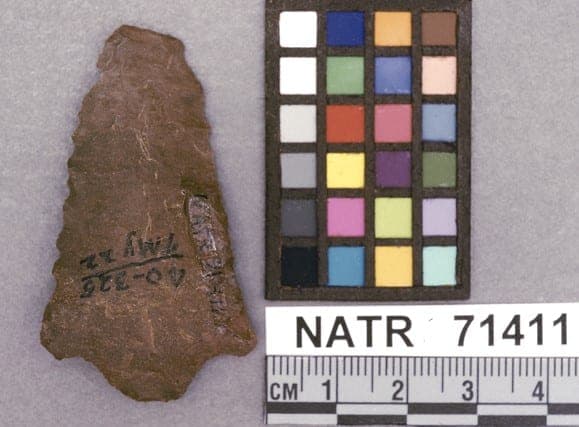
Photo: R Bruhn · National Park Service NPGallery (Natchez Trace Parkway / Southeast Archeological Center) · Public domain
At a glance
Period
7,100 - 6,700 B.P.
Typical size
21–90 mm long, 18–50 mm wide
Region
These points are found along the Atlantic Seaboard northeast into New England, west into the Tennessee River basin, and into the Gulf coast states.
If you have found a rough triangular point with a short tapering stem in the Carolinas, Georgia, or the Tennessee Valley, Morrow Mountain belongs near the top of your list. It is one of the most abundant Middle Archaic types in the Southeast, made between about 7,100 and 6,000 B.P. Joffre L. Coe named the type in 1964 for Morrow Mountain in North Carolina, near the Doerschuk type site in Montgomery County.
How to identify a Morrow Mountain point
The defining trait is the contracting stem: it narrows from the shoulders downward rather than expanding or being notched. Archaeologists split the type in two. Type I has a broad blade with convex edges, widest above the shoulders, and a short, wide tapering stem ending in a straight to convex base, usually with light grinding in the hafting area. Type II carries a longer, often narrower blade on an elongated contracting stem that tapers to a convex or even pointed base, with no basal grinding at all.
Shoulders on both forms generally slope upward and are only rarely barbed. Sizes run 21 to 90 mm long, with most examples in the 36–50 mm range, 18 to 50 mm wide, and 7 to 11 mm thick. Flaking is random rather than patterned, and the finish is often less refined than on earlier Archaic types. Material is a strong regional clue: makers used whatever stone was close at hand — quartz, quartzite, rhyolite, chert, and slate — so many Piedmont examples are chunky white quartz rather than glossy flint.
Age and where it's found
Morrow Mountain is a Middle Archaic type, with Type I dated around 7,100–6,700 B.P. and Type II around 6,800–6,000 B.P. Radiocarbon dates from sites such as Cactus Hill, Ice House Bottom, and Russell Cave suggest Type I is the older form, though some researchers caution that the two may have overlapped. In the southeastern sequence, Morrow Mountain follows Stanly and Eva points and precedes Savannah River and Guilford points. Related forms include the Round Base and Straight Base varieties of Morrow Mountain, plus the Stark point — the name used for Type II in New England.
The distribution runs along the Atlantic Seaboard from the Gulf states northeast into New England, and westward through the Tennessee River basin, with occasional finds in the Ohio River valley. Whether the type truly extends into Florida is debated; some researchers assign the Florida material to the separate Westo type.
Think you found a Morrow Mountain?
Upload a photo and our shape-matching AI will compare it against 1,000+ documented point types — with an honest read on how well it fits.
More type guides