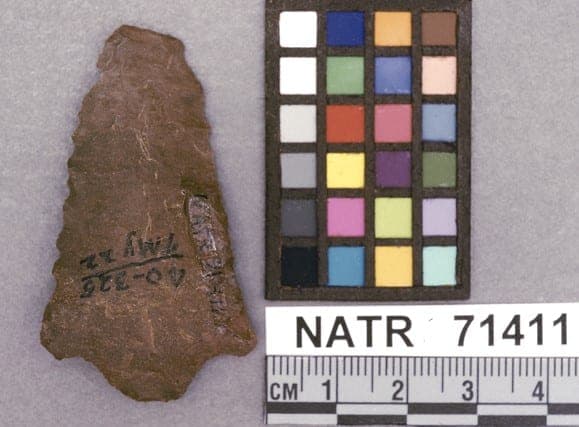
Perdiz Projectile Point: Identification, Age & Range
Perdiz points are small Late Prehistoric arrow points (1,000-500 B.P.) from Texas and northern Mexico, identified by a long, pointed contracting stem.
At a glance
Period
1,000 - 500 B.P. · Late Prehistory
Typical size
15–60 mm long, 12–30 mm wide
Region
This point is primarily found from the Trans Pecos region of Texas and Chihuahua and through-out the Rio Grande River valley.
The Perdiz is the arrow point many Texas finders eventually meet: a small, thin, sharply barbed triangle with a long stem that tapers down to a point, made during the last thousand years before European contact. J. Charles Kelley named the type in 1947 for Perdiz Creek in Presidio County, Texas, with the Lehmann Rock Shelter in Gillespie County as the type site. Examples from northeastern Mexico were once given the separate name Nopal, and the crude, single-faced Cliffton point is generally considered an unfinished Perdiz preform.
The type actually had a longer road to its name than the 1947 date suggests. Kelley, Campbell, and Lehmer described these points without naming them in 1940, and in 1942 Kelley first attached the label Perdiz Pointed Stem, which was later shortened. A one-faced variant described in 1952 as the Foyle Flake is now generally folded in with Cliffton.
How to identify a Perdiz point
Size is your first clue that you are holding an arrow point rather than a dart point. Perdiz points run 15 to 60 mm long and 12 to 30 mm wide, and most examples are well under two inches. They are thin, finely flaked in a random pattern, with a flattened to slightly lens-shaped cross section.
The stem is the diagnostic feature. It is long for the size of the point, commonly making up a third to half of the total length, and it contracts steadily until it ends in a point at the base; some bases are instead rounded or convex. Paired with strongly barbed shoulders, that tapering stem gives the Perdiz an unmistakable profile. Blade edges are usually straight and are frequently serrated.
Expect real variation in size. Suhm and Krieger noted that while most examples sit squarely in arrow-point territory, the largest approach 60 mm and edge toward dart-point proportions. Also watch for pieces flaked on only one face: those are usually Cliffton preforms that never got finished into true Perdiz points.
Age and where it's found
Perdiz points date to about 1,000 to 500 B.P., in the Late Prehistoric period, when the bow and arrow had fully replaced the atlatl across the region. The core distribution runs from the Trans-Pecos of Texas and Chihuahua through the length of the Rio Grande valley.
From that core the type spreads north into the Red River valley, east into western Louisiana, and south through Tamaulipas into the northern reaches of Zacatecas and San Luis Potosi.
Think you found a Perdiz?
Upload a photo and our shape-matching AI will compare it against 1,000+ documented point types — with an honest read on how well it fits.
More type guides