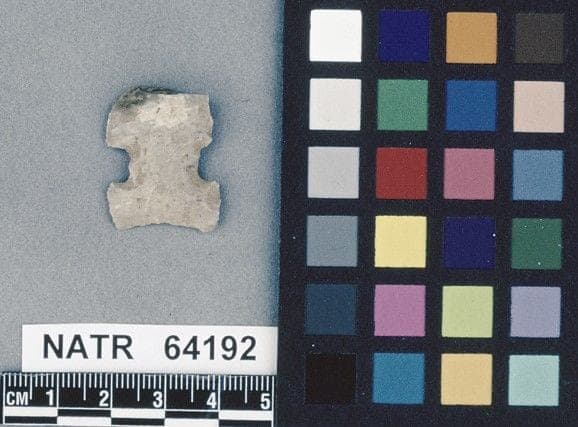
Adena Stemmed Projectile Point: Identification, Age & Range
Adena Stemmed is a large straight-stemmed point of the Ohio River Valley Mound Builders, dating roughly 3,500-1,300 B.P., Late Archaic to Woodland.
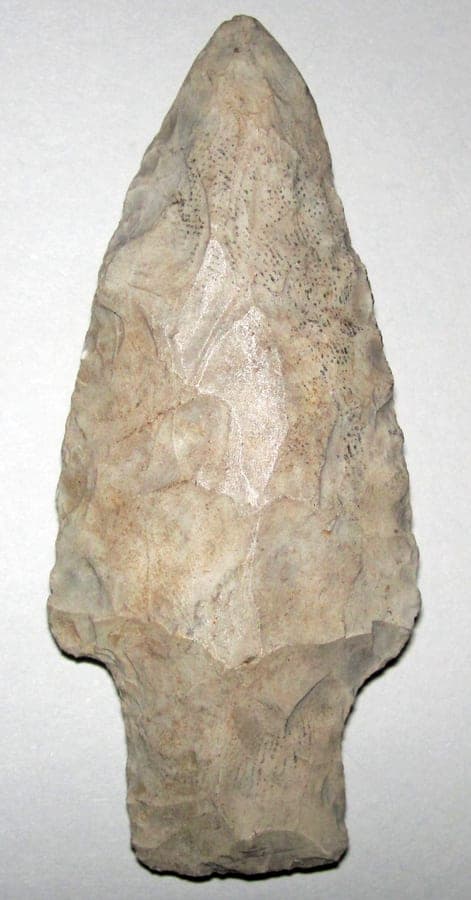
Photo: James St. John · Wikimedia Commons · CC BY 2.0
At a glance
Period
3,500 - 1,300 B.P. · Late Archaic to Woodland
Typical size
50–150 mm long, 23–43 mm wide
Region
These points are found within the Ohio River Valley.
Adena Stemmed is the namesake point of the Adena culture, the earliest of the great Mound Builder societies of the Ohio River Valley. William C. Mills identified the type in 1902 at the Adena Estate Mound in Ross County, Ohio. Because Adena people moved goods through a far-reaching trade network, finders well beyond Ohio search for — and occasionally find — these substantial stemmed points.
How to identify a Adena Stemmed point
This is a large point by most finders' standards: 50 to 150 mm long, with typical examples around 56 to 70 mm — longer than a house key even at the low end — and 23 to 43 mm wide. The blade stretches long, its edges convex, and the cross section is a thin ellipse, generally 7 to 15 mm thick.
The stem does most of the diagnostic work. It is broad — usually about half as wide as the blade itself, measuring 18 to 27 mm across and 15 to 30 mm long — and mostly straight-sided, though it can expand or contract slightly, and it ends in a convex, rounded base that typically lacks grinding. Shoulders are weak, running straight, rounded, or angled slightly upward; nothing about the point is barbed or notched. Makers shaped the blank with random percussion flaking and finished the edges with pressure retouch, leaving no patterned scars. Most examples are cryptocrystalline stone such as chert or flint, commonly heat treated; jasper, chalcedony, quartzite, and rhyolite show up only rarely.
Age and where it's found
The type spans roughly 3,500-1,300 B.P., from the Late Archaic through the Woodland period, and its cultural heart lies with the Adena mound-building tradition — the first in a sequence that continued with the Hopewell and Mississippian cultures. Classic Adena Stemmed points concentrate in the Ohio River Valley, while the wider Adena-Hopewell exchange sphere carried related forms much farther afield, including the Delmarva Adena-Hopewell complex of about 2,500-1,300 B.P.
The Adena family is extensive: named relatives include the Adena Blade, Adena Robbins, Adena Waubesa, Adena Narrow Stem, Cresap, Kramer, and the ceremonial Turkeytail forms. A large, well-made stemmed point from an Ohio Valley field could belong to any of several of these, so compare the stem shape and base carefully before settling on a name.
Think you found a Adena Stemmed?
Upload a photo and our shape-matching AI will compare it against 1,000+ documented point types — with an honest read on how well it fits.
More type guides