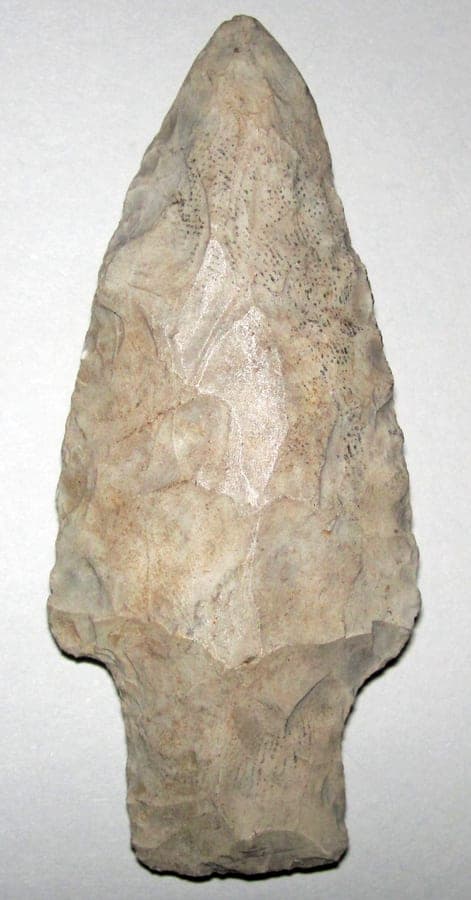
Gary Stemmed Projectile Point: Identification, Age & Range
Gary Stemmed points are thick contracting-stem dart points (3,500-1,900 B.P.) common across Texas, Oklahoma, Louisiana, Arkansas, and the Mississippi Valley.
At a glance
Period
3,500 - 1,900 B.P. · Late Archaic to Early Woodland
Typical size
35–85 mm long
Region
These points are found through out the mid to lower Mississippi River Valley with the heaviest concentrations found in Texas, Oklahoma, Louisiana, and Arkansas.
The Gary is one of the most frequently found dart points across Arkansas, Louisiana, Oklahoma, and Texas: a plain, sturdy, contracting-stem point that stayed in use for well over a thousand years. The type was named in 1949 by Perry H. Newell together with Alex D. Krieger, working from material at the George C. Davis site in Cherokee County, Texas. If you pulled a thick, stemmed point from a plowed field anywhere in the western Gulf South, Gary should be one of your first candidates.
How to identify a Gary Stemmed point
Check two things: the stem and the thickness. The stem contracts from the shoulders down to a rounded or pointed base, though a minority of examples instead show a slightly expanding stem with a convex base. And unlike many thin, finely made dart points, Gary points are noticeably thick, typically 9 to 10 mm, elliptical in cross section, and chunky in the hand.
Overall length runs 35 to 85 mm, with rare examples outside that range, and shoulder width spans 20 to 50 mm. The triangular blade may be straight-edged or convex, and occasionally concave on resharpened pieces. Shoulders can carry a slight barb, sit straight across, or on some points taper upward into the blade. Flaking is random and generally utilitarian rather than fine.
The type is famously variable. Researchers have split it into named groups, including Camden, LeFlore, Mabin, Maybon, and Melvern, and Cambron argued the type needed even further subdivision. Practically, if your point fits the thick-bodied, contracting-stem description above, Gary is a strong bet across most of its range.
Age and where it's found
Gary points date from roughly 3,500 to 1,900 B.P., from the Late Archaic into the Early Woodland. The type is grouped in the Dickson Contracting Stem Cluster, a set of look-alike points mostly tied to the Adena culture of the Ohio River valley; Gary matches those points in form, age, and general geography but was not itself an Adena product.
Geographically, Gary points blanket the central and southern reaches of the Mississippi drainage, and nowhere are they denser than in Arkansas, Louisiana, Oklahoma, and Texas.
Think you found a Gary Stemmed?
Upload a photo and our shape-matching AI will compare it against 1,000+ documented point types — with an honest read on how well it fits.
More type guides