Cottonwood Triangular Projectile Point: Identification, Age & Range
Cottonwood Triangular is a small, thin unnotched triangular arrow point found across the Great Basin, Southwest, and California, dating 900-200 B.P.
At a glance
Period
900 - 200 B.P. · Developmental to Historic
Typical size
11–53 mm long, 6–18 mm wide
Region
This point is found through out the Great Basin, Colorado Plateau, the Southwest Region and California.
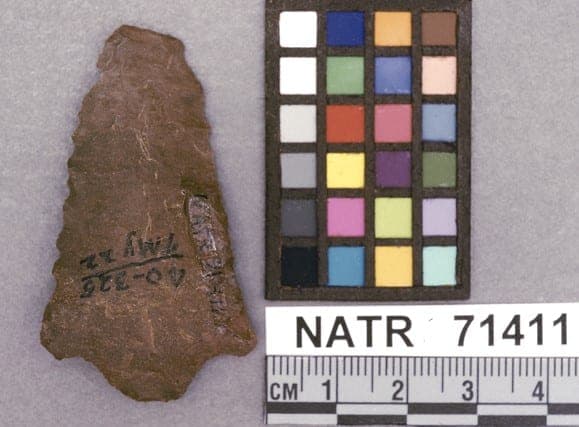
Cottonwood Triangular is the simplest arrow point in the western record: a small, thin triangle with no notches, no stem, and no barbs. That plainness makes it one of the most frequently found late prehistoric types across the Great Basin, the Southwest, and California, and also one of the easiest to dismiss as a mere blank or fragment. Edward Lanning named the type in 1963 for the Cottonwood site in Inyo County, California.
Despite the bare-bones shape, these were finished arrow points of the bow-and-arrow era, not rejects. They are common on late village and camp sites throughout the far West, which is why so many casual surface finds in that country turn out to be Cottonwoods.
How to identify a Cottonwood Triangular point
Most examples measure 21 to 25 mm long, so a typical piece would sit comfortably on a US quarter, though the full range runs 11 to 53 mm. Widths span 6 to 18 mm and thickness averages 3 to 5 mm. The shape varies from a tall isosceles triangle to an equilateral one nearly as wide as it is long. Blade edges are most often gently convex, sometimes straight, and occasionally curve inward; the base can be faintly concave, essentially straight, or faintly convex. The cross section is flattened and the flaking follows no organized pattern.
Because the definition is broad, Cottonwood functions as a catch-all: archaeologists have not carved it into formal subtypes by flaking style or raw material, and its many base and blade variations all carry the same name. For a finder, the practical test is thinness and finish. A well-thinned, carefully pressure-flaked little triangle from the far West likely belongs here, while a thick, crude triangle may simply be an unfinished preform for some other point.
Age and where it's found
The type dates to 900 to 200 B.P., spanning the Developmental period into historic times, and was made by Fremont, Paiute, Chumash, and other western peoples. Related forms include Cottonwood Leaf, a leaf-shaped companion type from the same tradition.
Its distribution is among the widest of any late western point, covering the Great Basin, the Colorado Plateau, the Southwest, and California, with finds reported south of the border in Baja California and adjacent northwestern Mexico.
Think you found a Cottonwood Triangular?
Upload a photo and our shape-matching AI will compare it against 1,000+ documented point types — with an honest read on how well it fits.
More type guides