Guilford Round Base Projectile Point: Identification, Age & Range
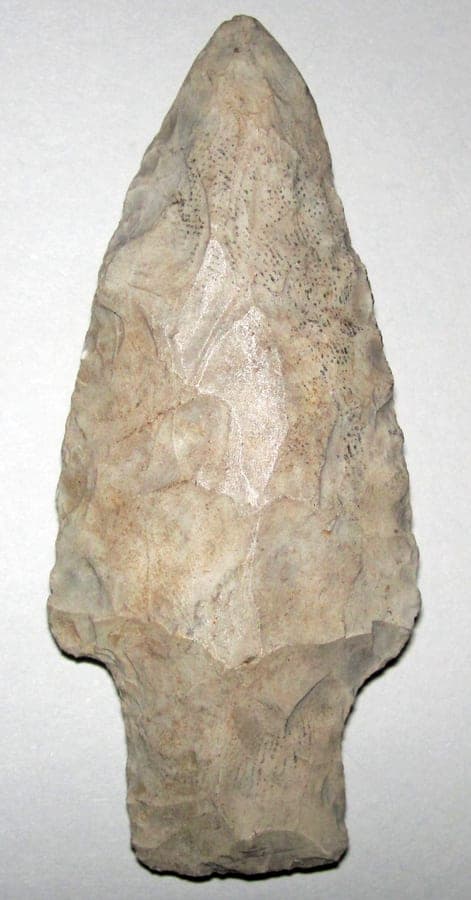
Guilford Round Base points are thick Middle Archaic lanceolates (6,200-5,000 B.P.) with rounded bases, found on the Piedmont from Virginia to Georgia.
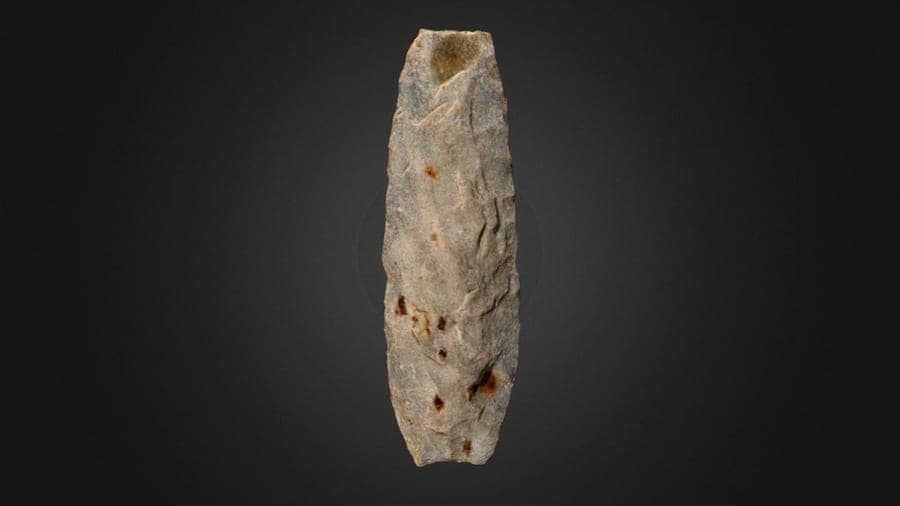
Photo: Research Laboratories of Archaeology, UNC-Chapel Hill · UNC Research Laboratories of Archaeology via Zenodo (render of a photogrammetric 3D scan) · CC BY 4.0
At a glance
Period
6,200 - 5,000 B.P. · Middle Archaic
Typical size
40–120 mm long, 15–35 mm wide
Region
These points are primarily found on the Piedmont of North Carolina and Virginia and into southern Maryland to northern Georgia.
The Guilford Round Base is one of the most common Middle Archaic finds across the North Carolina and Virginia Piedmont, and if you hunt plowed fields in that region you have probably seen one — often as a chunky quartz point that looks almost unfinished. It belongs to the Guilford Complex and was defined by Joffre L. Coe in 1964 from his landmark excavations at the Doerschuk and Gaston sites in North Carolina.
Because so many examples are made of tough, hard-to-flake quartz, Guilfords are frequently mistaken for crude preforms or rejects. The shape, not the workmanship, is what identifies them.
How to identify a Guilford Round Base point
Look first at the outline: a Guilford Round Base is a lanceolate — a leaf-shaped point with no stem, no shoulders, and no notches of any kind. The blade edges are gently convex, swelling at mid-body and curving in toward both the tip and the base. The base itself is convex, giving the point its rounded-base name, and the basal edge is typically ground smooth. Run a fingernail along the bottom edge; the dulled grinding is a good authenticity and typing clue.
Thickness is the other giveaway. These points run 5 to 12 mm thick, with a cross section that ranges from a fat oval to one carrying a ridge down the midline, so they feel heavy and stout for their size. Length runs from about 40 to 120 mm, with most examples between 65 and 95 mm — roughly the length of a credit card. Width is a narrow 15 to 35 mm. Flaking is random rather than patterned, and the most common materials are quartz and Antietam-Erwin quartzite, with rhyolite fairly frequent and chert only occasional.
Age and where it's found
Guilford Round Base points date to roughly 6,200 to 5,000 B.P., in the Middle Archaic period. Coe's stratigraphy at the Doerschuk site put them in layers overlying Morrow Mountain material and beneath Halifax points, which anchors their position in the regional sequence. The type is part of a small family that also includes the Guilford Straight Base and Guilford Yuma variants, and it is broadly related to the later Savannah River tradition.
The heartland is Piedmont country in North Carolina and Virginia, with the range stretching from southern Maryland down to northern Georgia. Examples also turn up in the Tennessee River basin, though far less often.
Think you found a Guilford Round Base?
Upload a photo and our shape-matching AI will compare it against 1,000+ documented point types — with an honest read on how well it fits.
More type guides