Savannah River Projectile Point: Identification, Age & Range
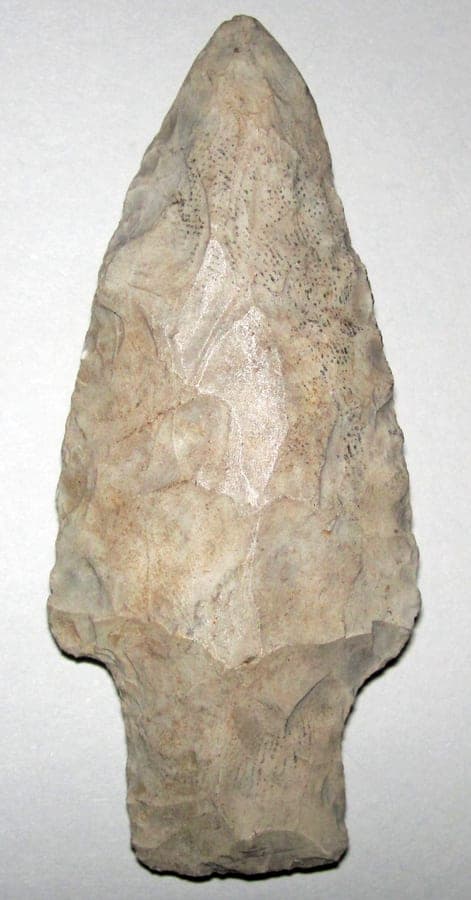
Savannah River points are large, broad-bladed stemmed points of the Late Archaic Southeast, found from New Jersey to Florida and across the Appalachians.
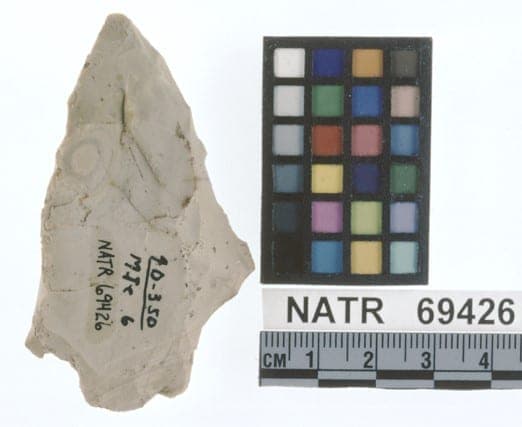
Photo: R Bruhn · National Park Service NPGallery (Natchez Trace Parkway / Southeast Archeological Center) · Public domain
At a glance
Period
5,000 - 3,000 B.P. · Middle to Late Archaic
Typical size
40–170 mm long, 28–77 mm wide
Region
This point is primarily found throughout the Appalachian mountain range to the Atlantic coast and from New Jersey down the coast into Florida.
If you found a big, broad spear point with a square-looking stem anywhere in the Southeast or along the Atlantic seaboard, the Savannah River type should be near the top of your list. This is one of the signature points of the Late Archaic in the East — a heavy-duty knife and spear form that turns up in creek beds and plowed fields from New Jersey to Florida. William H. Claflin named the type in 1931 for the Savannah River area on the South Carolina-Georgia line.
How to identify a Savannah River point
Start with size and proportions. Savannah Rivers run 40 to 170 mm long — most fall between 60 and 100 mm — and the blade is notably wide at 28 to 77 mm, giving the point a broad triangular look. The stem is short and squarish, usually straight-sided but sometimes contracting or expanding slightly, and the base is the key detail: it is most often concave, with basal thinning flakes removed, and only lightly ground if at all. Shoulders range from square to gently upward-sloping, without strong barbs. These are thick points, typically 10 to 14 mm, with a random flaking pattern rather than fine parallel work.
Material varies with local geology: Antietam-Erwin quartzite, rhyolite, quartz, and slate are common in the Carolinas and Virginia, with chert, jasper, chalcedony, and even hematite appearing elsewhere. Regional size differences are real — North Carolina examples average around 100 mm, while Alabama examples average closer to 50 mm — so a small stemmed point in the Deep South can still be a Savannah River. Be aware that many later Late Archaic and Early Woodland stemmed points get lumped in with this type; narrower stems and convex bases suggest something else, such as Elora or Paris Island.
Age and where it's found
The Savannah River cluster spans roughly 5,000 to 3,000 B.P., across the Middle to Late Archaic. The oversized classics associated with the Mill Branch phase, centered on the middle reaches of the Savannah drainage, date more tightly to about 4,150-3,800 B.P. Related and descendant forms include the Appalachian, Hamilton, Holms (a narrow-stem variety), and the smaller Early Woodland points sometimes called Small Savannah River.
The distribution is one of the largest of any eastern stemmed type: throughout the Appalachian mountain chain to the Atlantic coast, from New Jersey down the seaboard into Florida, and across the Tennessee River valley as well.
Think you found a Savannah River?
Upload a photo and our shape-matching AI will compare it against 1,000+ documented point types — with an honest read on how well it fits.
More type guides