Desert Side Notch Projectile Point: Identification, Age & Range
Desert Side Notch points are tiny triangular arrow points with low side notches, used 800-200 B.P. across the Great Basin, California, and Oregon.
At a glance
Period
800 - 200 B.P. · Late Prehistoric to Historic
Typical size
9–40 mm long, 5–15 mm wide
Region
This point is primarily found in the Great Basin, into the Sierra Nevada's in California, up into the Snake River Plain and into Oregon.
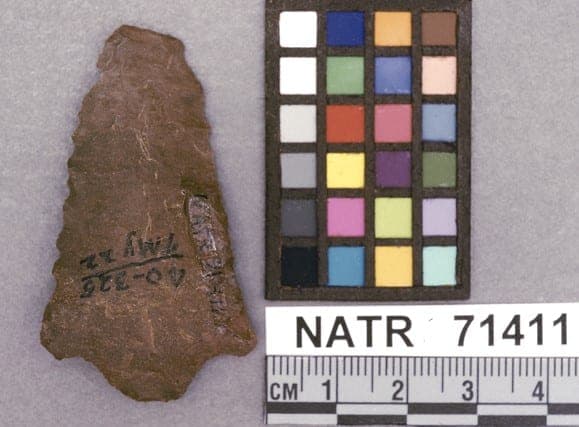
Desert Side Notch is the classic late arrow point of the far West: a tiny, thin triangle with a pair of crisp notches cut low into its sides. It served as the everyday hunting tip for Northern Paiute, Shoshone, and many other western peoples right up into the historic era, which makes it the most recent type a Great Basin or California finder is likely to pick up. Martin A. Baumhoff defined the type in 1957.
Because it remained in use after European contact, a few examples were even knapped from bottle glass, making this one of the rare types for which glass is a documented material.
How to identify a Desert Side Notch point
Everything about this point is small and thin. Lengths run 9 to 40 mm, with most between 17 and 26 mm; the blade measures 5 to 15 mm across and only 2 to 4 mm thick. The outline is an isosceles to equilateral triangle with straight or slightly convex edges, and many examples show fine serration.
The notches are the signature. Narrow, deep, and parallel, they sit low on the blade, clearly beneath its midpoint, and pinch the point down to a neck averaging about 7 mm. Below them the base flares back out to 10 to 19 mm, frequently wider than the blade above, ending in squared corners and a bottom edge that is flat or dips slightly inward. Makers roughed the point out by percussion and finished it with pressure flaking in a random pattern.
Common materials are agate, chert, obsidian, and basalt. Baumhoff and J.S. Byrne recognized four subtypes in 1959, called Delta, General (or Desert Classic), Redding, and Sierra, but most finds are simply recorded under the main type name.
Age and where it's found
The type dates to 800 to 200 B.P., the Late Prehistoric through Historic periods, when Desert cluster points replaced the earlier Rosegate series of arrow points. It was used by Northern Paiute, Shoshone, Hopi, Apache, and numerous other groups, though it appears less often in areas tied to the Fremont culture.
The core range is the Great Basin, reaching west into California's Sierra Nevada and north across the Snake River Plain to Oregon.
Think you found a Desert Side Notch?
Upload a photo and our shape-matching AI will compare it against 1,000+ documented point types — with an honest read on how well it fits.
More type guides