Eva Barbed Projectile Point: Identification, Age & Range
Eva Barbed points are Early Archaic (7,500-6,000 B.P.) basal-notched points with strong barbs, found mainly in the western Tennessee River valley.
At a glance
Period
7,500 - 6,000 B.P. · Early Archaic
Typical size
48–96 mm long, 25–39 mm wide
Region
This point is most commonly found in the western half of Tennessee in the Tennessee River valley.
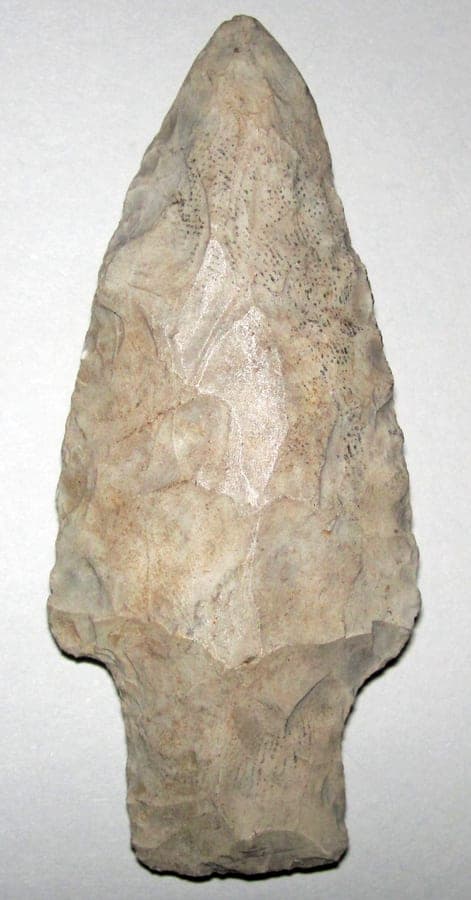
The Eva Barbed is western Tennessee's classic basal-notched point: a broad triangular blade with two notches cut up into the bottom, leaving a pair of downward-hanging barbs flanking a small central stem. It was named in 1955 by T.M.N. Lewis working with Madeline Kneberg, after the Eva site in Benton County, Tennessee, and it lends its name to the Eva cluster. For finders along the Tennessee River, few points are as distinctive when complete — and few lose their identity as fast when the barbs snap off.
How to identify a Eva Barbed point
The diagnostic feature is where the notches sit. On an Eva, both notches enter through the base itself, not the corners or sides. That basal notching creates prominent barbs at the shoulders and isolates a stem — straight or slightly tapering — that can extend below the barb tips. The stem's bottom edge runs straight or a touch convex and sometimes shows grinding or thinning. Keep in mind that resharpening shortens the barbs over a point's use life, so a heavily reworked Eva can look less barbed than a fresh one.
The blade is broad and triangular with edges that are usually convex, though some curve inward toward the tip. Cross sections are flat to thinly lens-shaped. Complete examples run 48 to 96 mm long, averaging about 61 mm, with blade widths of 25 to 39 mm and thickness of 8 to 10 mm. Workmanship is good: broad percussion flaking finished with finer percussion in a random pattern, with occasional pressure retouch along the edges. Two variants are recognized — the earlier Type I, generally larger with a short contracting stem, and the later Type II, with longer barbs and a straight to rounded stem.
Age and where it's found
Eva Barbed points date to roughly 7,500 to 6,000 B.P., in the Early Archaic. The type is related to the Cypress Creek points defined from the Morrisroe site in Kentucky and to the Morrow Mountain type that follows in regional sequences.
Distribution centers tightly on the western half of Tennessee within the Tennessee River valley, thinning through the rest of the valley. Finds only rarely reach the middle and upper Ohio drainage or western Virginia, the Carolinas, and Georgia — so location is itself a typing clue.
Think you found a Eva Barbed?
Upload a photo and our shape-matching AI will compare it against 1,000+ documented point types — with an honest read on how well it fits.
More type guides