Lost Lake Corner Notch Projectile Point: Identification, Age & Range
Lost Lake is an Early Archaic corner-notched point (9,500–8,500 B.P.) of the Midsouth and Ozarks, known for beveled, serrated blades and rounded barbs.
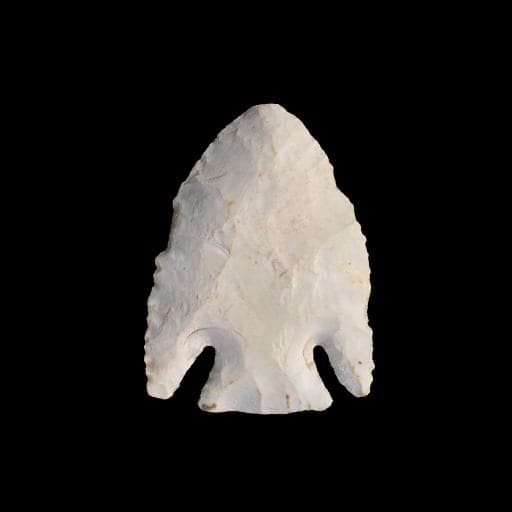
Photo: Mark W. Moore / Museum of Stone Tools · Museum of Stone Tools, University of New England (Australia) · CC BY 2.0
At a glance
Period
9,500 - 8,500 B.P. · Early Archaic
Typical size
31–81 mm long, 25–48 mm wide
Region
These points are most frequently found in Arkansas, eastern Oklahoma, eastern Kansas, and Missouri.
Lost Lake points are among the most skillfully made corner-notched points of the Early Archaic. Produced from high-quality chert between about 9,500 and 8,500 B.P., they are best known for their alternately beveled blades — a byproduct of resharpening that gives many pieces a twisted, propeller-like look when sighted down from the tip. David DeJarnette, Edward Kurjack, and James Cambron defined the type in 1962 from the Stanfield-Worley Bluff Shelter, naming it for the Lost Lake area of Limestone County, Alabama.
How to identify a Lost Lake Corner Notch point
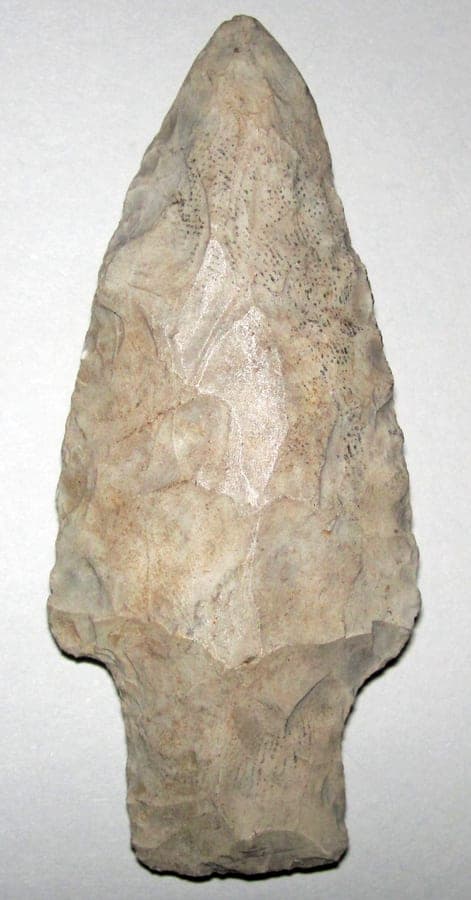
Look first at the blade edges. These points were resharpened in the haft along one edge of each face, which leaves a steep bevel and usually serrations; heavily worked examples develop a rhomboid (diamond-shaped) cross section. A fresh blade has convex edges, but repeated sharpening pulls the outline straight or slightly concave. The corner notches are deep — an old nickname for the type is "Deep Notch" — and the barbed shoulders often show a distinctive rounded profile, with barb tips ranging from rounded to squared. On the most exhausted pieces the barbs can shrink or vanish entirely.
Most examples run 31 to 81 mm long (typical finds fall around 40–55 mm) and 25 to 48 mm wide, at 6 to 13 mm thick, with a slightly expanding stem. The base varies from concave to convex, thinned with broad shallow flakes and usually ground smooth for hafting. Quality is itself a clue: Lost Lake points tend to be symmetrical and expertly flaked, with broad percussion scars finished by fine pressure work, and nearly all were struck from high-grade chert. Because a single point could be sharpened many times over its working life, two Lost Lakes from the same field can look quite different in outline — judge by the notches, ground base, and beveling rather than blade shape alone.
Age and where it's found
Lost Lake dates to the Early Archaic, about 9,500–8,500 B.P. Most classifications place it in the Thebes Cluster with Thebes, St. Charles, and Calf Creek points, though some researchers argue it is really a variant of Kirk Corner Notched.
The type is found most frequently in Missouri and Arkansas and in the eastern parts of Oklahoma and Kansas. It also occurs through the Ohio and Tennessee River valleys and south into the Gulf Coastal region.
Think you found a Lost Lake Corner Notch?
Upload a photo and our shape-matching AI will compare it against 1,000+ documented point types — with an honest read on how well it fits.
More type guides