Kirk Corner Notched Projectile Point: Identification, Age & Range
Kirk Corner Notched points are Early Archaic (9,500-8,500 B.P.) barbed, corner-notched blades found widely across the eastern United States.
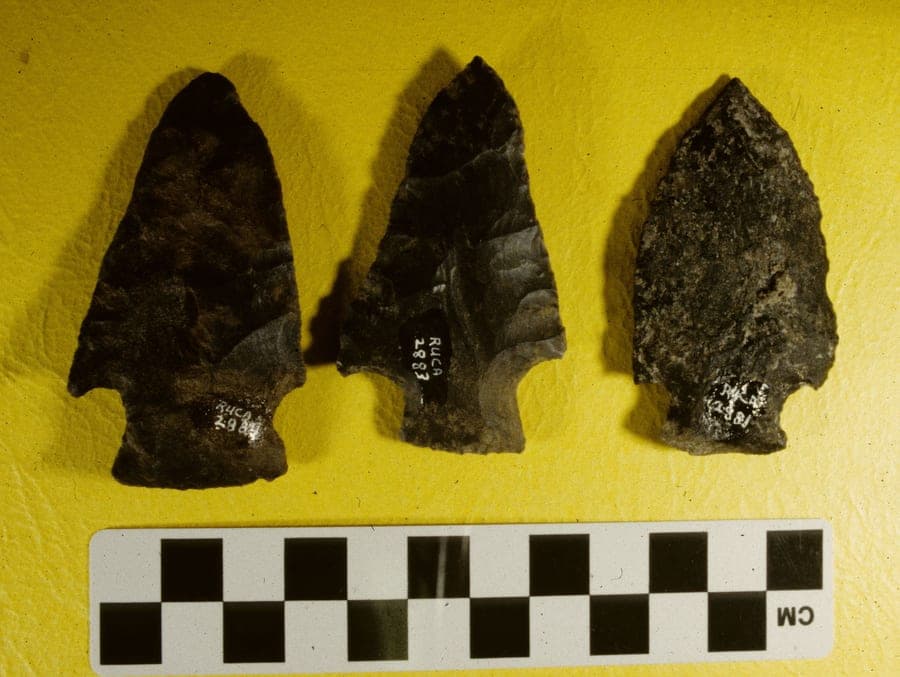
Photo: National Park Service · Wikimedia Commons (National Park Service / NPGallery) · Public domain
At a glance
Period
9,500 - 8,500 B.P. · Early Archaic
Typical size
32–120 mm long, 20–45 mm wide
Region
This point is primarily associated with the Eastern Seaboard region of the United States, into the the Gulf Coastal region and the Tennessee River and Ohio…
If you hunt creek beds or plowed fields anywhere in the eastern United States, the Kirk Corner Notched is one of the types you are most likely to run into. It is a workhorse of the Early Archaic period, dating to roughly 9,500-8,500 B.P., and it turns up from the Atlantic seaboard to the Tennessee and Ohio River drainages in real numbers.
The type was defined by Joffre L. Coe in 1964 from excavations at the Hardaway site in Stanly County, North Carolina, and named after the Kirk family, on whose land the type site sat. It anchors the broader Kirk Corner Notch cluster, and Coe believed it developed out of the earlier Palmer point.
How to identify a Kirk Corner Notched point
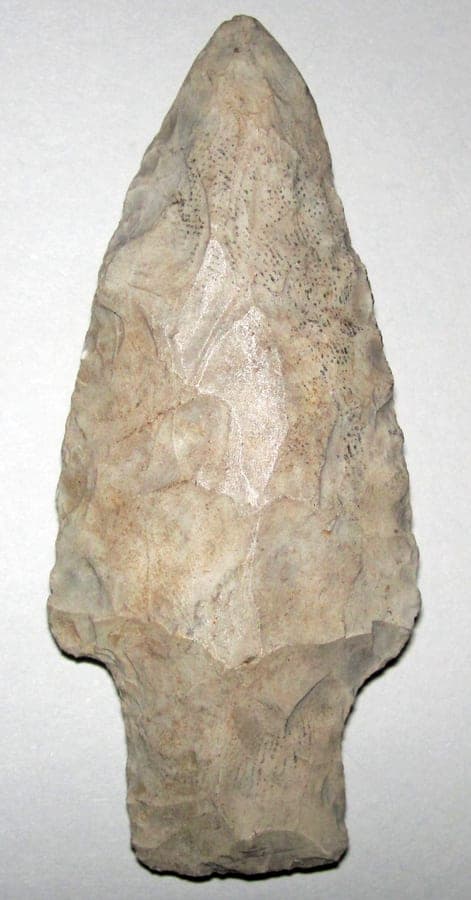
Start with the notches. Kirk points are notched in from the corners of the base, which creates an expanding stem and leaves the shoulders strongly barbed - the barbs are one of the type's most recognizable features, though they can look weaker on blades that were resharpened many times. The base itself is usually straight to concave, and only occasionally convex.
The blade is triangular and most often excurvate (bowed outward), though straight and recurved edges occur. Many examples are serrated, anywhere from fine teeth to deep saw-like cuts, and some show beveling along the edges. Flaking is random rather than patterned, and the cross section is flattened to elliptical.
Size runs medium to large: about 32-120 mm long (roughly 1.25 to 4.75 inches) and 20-45 mm wide, so a typical example is close to the length of a business card. Interestingly, averages differ by region - North Carolina examples tend to run larger than Alabama ones. A key negative trait: the base is rarely ground smooth. If your point has a heavily ground, polished-feeling hafting area, look hard at Palmer instead.
Age and where it's found
Kirk Corner Notched dates to the Early Archaic, about 9,500-8,500 B.P. At the deeply stratified St. Albans site in West Virginia, both a large and a small variety were recovered eight to ten feet below the surface in well-dated zones. Some researchers have reported dates approaching 7,100 B.P. from northeastern sites, but many specialists consider those too recent.
The heart of the distribution is the Eastern Seaboard, the Gulf Coast, and the basins of the Tennessee and Ohio rivers, with finds thinning out toward the Mississippi drainage and the Northeast. Related forms in the same lineage include Amos and Charleston Corner Notch.
Think you found a Kirk Corner Notched?
Upload a photo and our shape-matching AI will compare it against 1,000+ documented point types — with an honest read on how well it fits.
More type guides