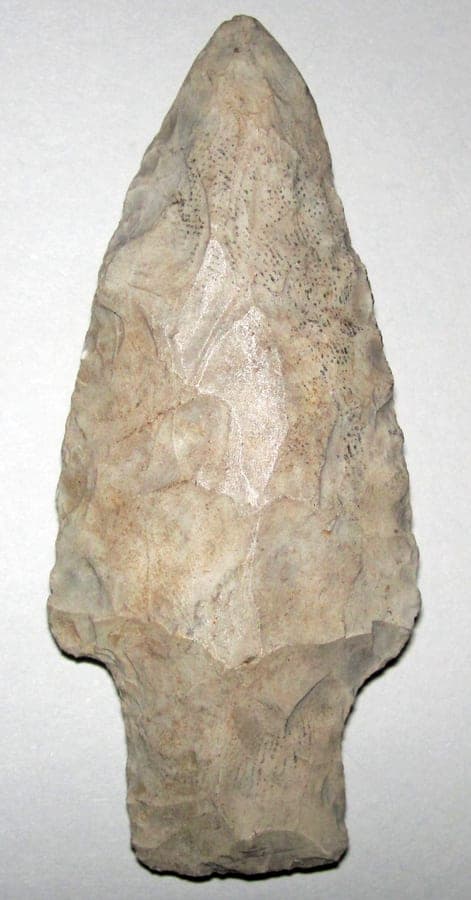
St. Charles Corner Notch Projectile Point: Identification, Age & Range
St. Charles, the Midwest 'dovetail' point, is an Early Archaic corner-notched type (10,000–8,000 B.P.) with a convex ground base and deep narrow notches.
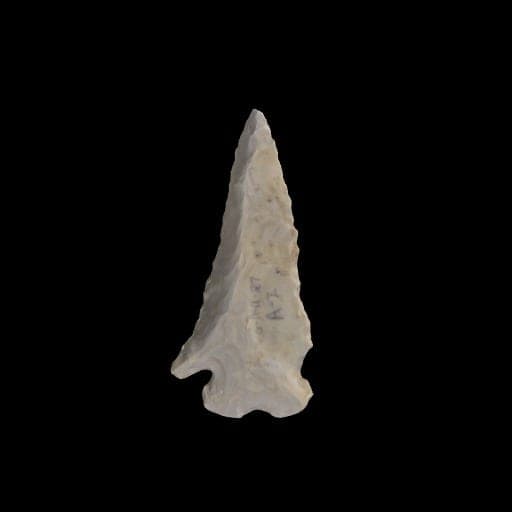
Photo: Mark W. Moore / Museum of Stone Tools · Museum of Stone Tools, University of New England (Australia) · CC BY 2.0
At a glance
Period
10,000 - 8,000 B.P. · Early Archaic
Typical size
45–160 mm long, 26–40 mm wide
Region
These points are commonly found through out the Midwest.
Collectors across the Midwest know the St. Charles point by its nickname: the dovetail. Deep, narrow notches cut in toward a rounded, fan-shaped base give the hafting area a silhouette like a dovetail joint, making this one of the most recognizable Early Archaic types in eastern North America. Edward G. Scully defined the type in 1951 from St. Charles County, Missouri, sites, and examples have been surfacing in plowed fields along the Ohio and Mississippi valleys ever since.
How to identify a St. Charles Corner Notch point
The base is the giveaway. On a St. Charles point the base is always convex — never straight — and both the basal edge and the insides of the notches are typically ground heavily smooth. Run a fingertip along the notch interiors: authentic examples usually feel worn smooth there, a subtle trait that modern reproductions often miss. The notches enter diagonally at the corners and typically run deep and slender, leaving an expanding stem below barbed (occasionally straight) shoulders. The stem itself is broad — about 24 to 31 mm across the base — which is what creates the fan-like dovetail profile.
Blades are mostly convex-edged, though resharpened pieces can be straight or recurved and may show alternate beveling or serration. These are substantial tools: documented examples range from 45 to 160 mm long, averaging about 65 mm, and 26 to 40 mm wide at only 7–10 mm thick. Flaking is even, controlled percussion with selective pressure work finishing the edges, and the type is known for consistently high workmanship. Heat treatment of the stone was not part of the tradition.
Age and where it's found
St. Charles dates to roughly 10,000–8,000 B.P. in the Early Archaic and belongs to the Thebes Cluster alongside Thebes, Lost Lake, and Calf Creek points. The type has a tangled naming history: early reports placed it in the Late Archaic or Early Woodland, and Early Archaic examples found in Alabama were separately named "Plevna" before researchers realized the two were the same type; some still apply the Plevna label to beveled examples from the Tennessee River valley.
The point occurs throughout the Midwest, most commonly along the Ohio River and middle Mississippi valleys, with less frequent finds reaching northeastern Texas, southeastern Oklahoma, and Minnesota.
Think you found a St. Charles Corner Notch?
Upload a photo and our shape-matching AI will compare it against 1,000+ documented point types — with an honest read on how well it fits.
More type guides