Pine Tree Corner Notched Projectile Point: Identification, Age & Range
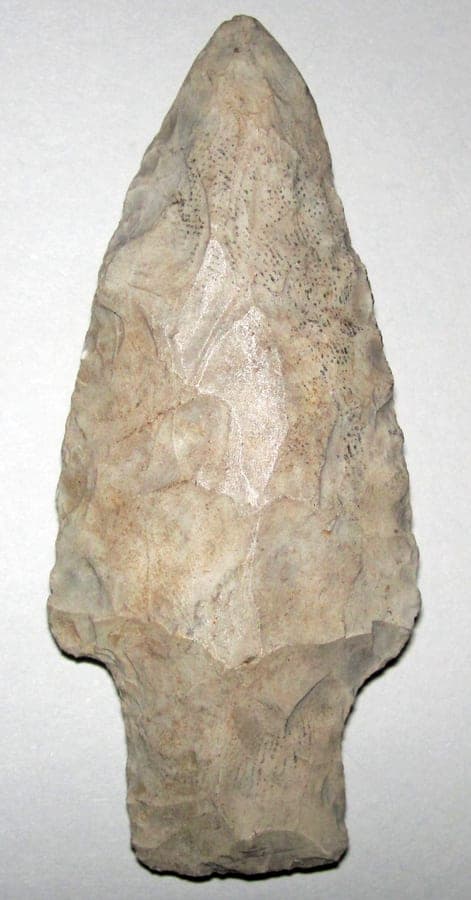
Pine Tree Corner Notched points are Early Archaic (9,500-8,500 B.P.) recurved-blade points of the Tennessee, Ohio, and mid-Mississippi valleys.
At a glance
Period
9,500 - 8,500 B.P. · Early Archaic
Typical size
40–72 mm long, 23–32 mm wide
Region
This point is found in the Tennessee River Valley and into the Ohio River valley and into the mid Mississippi River valley.
The Pine Tree Corner Notched is an Early Archaic point of the Tennessee, Ohio, and middle Mississippi River valleys, dating to about 9,500-8,500 B.P. Its calling card is a gracefully recurved blade - wide near the base, pinched in through the middle, and flaring again toward the tip - a silhouette that makes well-preserved examples stand out in any creek-gravel find.
James Cambron, a respected avocational archaeologist who worked extensively in Alabama and the Tennessee Valley, named the type in 1956 for the Pine Tree site in Limestone County, Alabama. It belongs to the Kirk Corner Notch cluster, and Justice regards it as a resharpened variant of the Kirk Corner Notched - one that keeps its full length while the blade narrows with each resharpening.
How to identify a Pine Tree Corner Notched point
Look first at the blade outline. The classic Pine Tree blade is recurvate - the edges sweep inward and then back out - though straight or slightly incurved edges occur. Serration is common, and the flaking can be collateral (regular parallel flakes meeting at the midline) as well as random, which sets some examples apart from the strictly random flaking on most Kirk points. Cross sections range from flattened or elliptical to having a median ridge.
The hafting end is essentially a Kirk base: corner notches forming an expanding stem, shoulders that run horizontal to slightly upswept, and a base that varies from convex to concave. What differs is the blade - narrower, often thinner, and proportionally long. Size runs about 40-72 mm long (averaging near 54 mm, about the width of a credit card's short side) and 23-32 mm wide.
Because the haft matches Kirk so closely, a heavily resharpened Kirk and a Pine Tree can be a judgment call; the retained length with a narrow, waisted blade is the Pine Tree signature. Collectors also frequently confuse this type with the Charleston Corner Notch, which looks similar and overlaps it in time and territory.
Age and where it's found
Pine Tree Corner Notched dates to the Early Archaic, roughly 9,500-8,500 B.P., the same window as Kirk and Palmer. Related points in the cluster include Amos, Charleston Corner Notch, Decatur, Palmer, and Stilwell.
The distribution centers on the Tennessee River Valley and extends through the Ohio River valley into the middle Mississippi River valley - a tighter, more interior range than the seaboard-spanning Kirk.
Think you found a Pine Tree Corner Notched?
Upload a photo and our shape-matching AI will compare it against 1,000+ documented point types — with an honest read on how well it fits.
More type guides