Hardin Stemmed Projectile Point: Identification, Age & Range
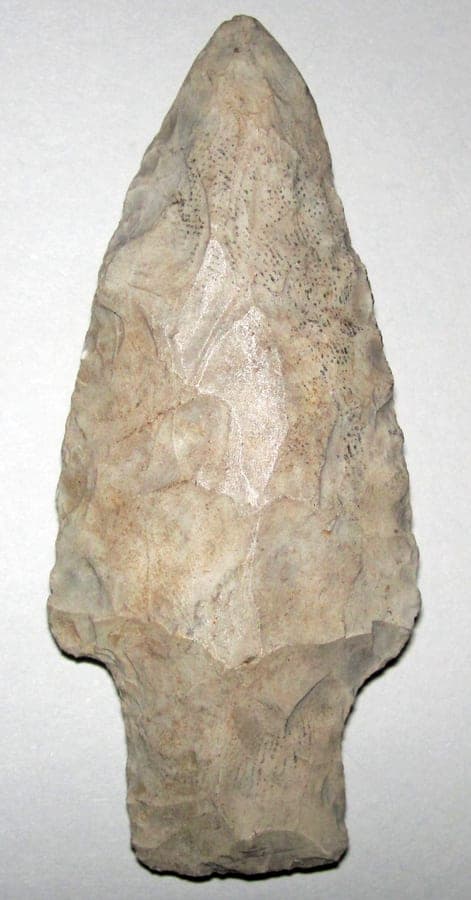
Hardin Stemmed is an Early Archaic point (10,500–7,500 B.P.) of the upper Midwest, with a long slender blade, barbed shoulders, and a ground expanding stem.
At a glance
Period
10,500 - 7,500 B.P. · Early Archaic
Typical size
45–180 mm long, 22–50 mm wide
Region
This point is most commonly found Wisconsin, Iowa, Illinois, and Missouri.
The Hardin Stemmed point — often called Hardin Barbed — is one of the premier Early Archaic types of the upper Mississippi valley. These long, slender, expertly flaked blades date to about 10,500–7,500 B.P., and the largest documented examples approach 180 mm, which puts them among the biggest points a Midwest field hunter is likely to encounter. Edward G. Scully named the type in 1951 for the town of Hardin, Illinois, based on finds from several sites in Calhoun County.
How to identify a Hardin Stemmed point
Hardin has a distinctive silhouette: a long triangular blade, barbed shoulders, and a stem that runs from straight to expanding, ending in a base that is usually straight but can be slightly convex or concave. Where the barb meets the stem, the notch forms a sharp V, and knappers commonly left a characteristic semicircular flake scar right at that junction. Bases show pronounced thinning flakes, and both the basal edge and the sides of the stem are heavily ground from hafting.
Proportions help too. The blade is notably slender — total length typically runs about four times the width — with most examples between 45 and 180 mm long (averaging 75–85 mm) and 22 to 50 mm wide. The stem is modest relative to that blade, roughly 11 to 22 mm long and 22 to 32 mm wide, so on a complete example the point reads as mostly blade. Edges are straight to gently convex, and resharpened pieces can develop a rhomboid cross section. Flaking is even percussion work finished with selective pressure trimming, and workmanship is consistently high. Makers used locally available cherts without heat treatment, so material varies across the range.
Age and where it's found
Hardin is widely thought to have developed out of the Late Paleoindian Scottsbluff point: the two share a similar outline, but Hardin lacks the parallel ribbon flaking that defines Scottsbluff. The type dates to the Early Archaic, roughly 10,500–7,500 B.P.
It is most common in Wisconsin, Iowa, Illinois, and Missouri, extending into western Indiana and eastern Oklahoma. Scattered finds are reported as far south as the Tennessee River valley and the Gulf Coastal region, where some researchers prefer the name Florida Hardin.
Think you found a Hardin Stemmed?
Upload a photo and our shape-matching AI will compare it against 1,000+ documented point types — with an honest read on how well it fits.
More type guides