Benton Stemmed Projectile Point: Identification, Age & Range
Benton Stemmed points are Middle Archaic (6,000-4,000 B.P.) broad-stemmed points of the Tennessee River Valley, known for steeply beveled stem edges.
At a glance
Period
6,000 - 4,000 B.P. · Middle Archaic
Typical size
45–170 mm long, 25–49 mm wide
Region
These points are most commonly found in the Tennessee River Valley and into the mid and lower Ohio River valley.
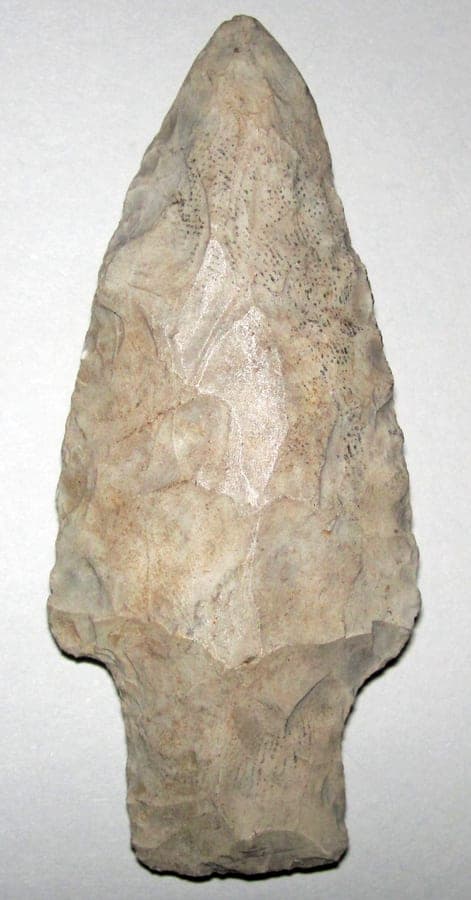
The Benton Stemmed is a hallmark of the Middle Archaic across the Tennessee River Valley, and it has one of the most reliable tells of any stemmed point in the Southeast: the edges of its stem and base are steeply beveled, almost as if squared off at an angle. Madeline Kneberg, the University of Tennessee anthropologist known for her excavations across the valley, named the type in 1956 for Benton County, Tennessee, home of the Eva site where it was defined. It anchors both the Benton Complex and the Benton Stemmed cluster of related forms.
How to identify a Benton Stemmed point
Check the stem first. On a true Benton, the stem and basal edges carry a steep bevel — tilt the point in the light and you can see the abrupt angled facets along those edges. The stem is broad relative to the blade, straight to slightly expanding, with weak shoulders that range from square to sloping upward. The base is usually straight, occasionally a touch concave. The blade is excurvate and very commonly beveled as well from resharpening, which can give larger examples a slightly twisted look.
Size covers a wide span: 45 to 170 mm long, though the average is around 65 mm, with blade width of 25 to 49 mm. For their breadth these are fairly thin points at 5 to 9 mm. Flaking is mostly random, but some examples show oblique, diagonally-run flake scars. The most frequent confusion is with stemmed Kirk forms; the consistent beveling on Bentons is the separator, since Kirks are seldom beveled that way.
Age and where it's found
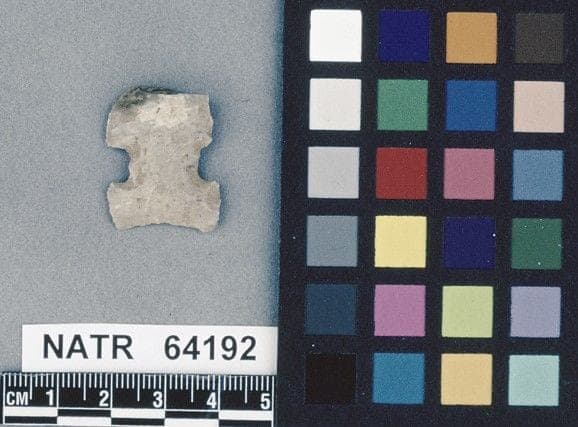
Benton Stemmed points date to about 6,000 to 4,000 B.P., in the Middle Archaic. Kneberg originally assigned them to the Early Archaic, but decades of subsequent excavation firmly repositioned the type in the Middle Archaic. The cluster includes several named relatives — among them Elk River, Buzzard Roost Creek, and the Broad Stem, Narrow Blade, and Double Notch varieties of Benton — so a point that is close but not quite may belong to one of those variants.
The heart of the range is the Tennessee River Valley, extending into the middle and lower Ohio River valley. Outside that drainage system the type drops off quickly.
Think you found a Benton Stemmed?
Upload a photo and our shape-matching AI will compare it against 1,000+ documented point types — with an honest read on how well it fits.
More type guides