Afton Projectile Point: Identification, Age & Range
Afton points are distinctive pentagonal Late Archaic points (5,000-3,000 B.P.) found across the Mississippi, Missouri, and Ohio River valleys.
At a glance
Period
5,000 - 3,000 B.P. · Late Archaic
Typical size
51–102 mm long, 30–40 mm wide
Region
This point is primarily found in the mid to lower Mississippi Rive Valley and into the Missouri River Valley.
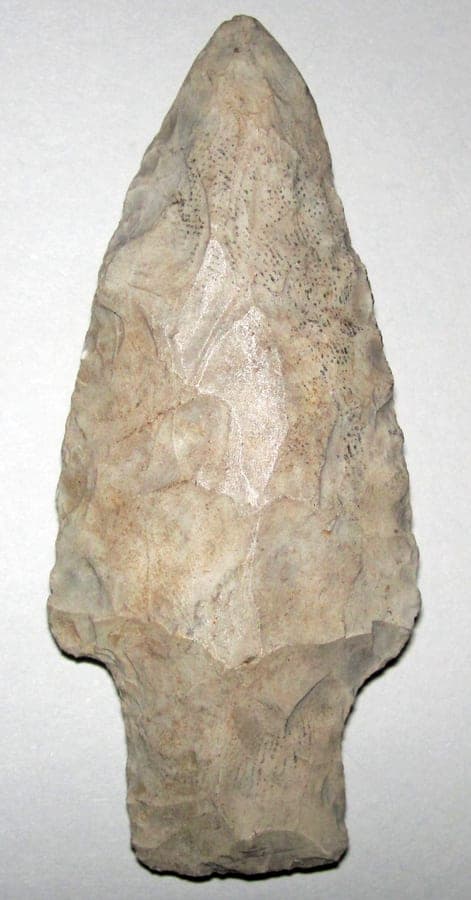
Few point types are as instantly recognizable as the Afton. Instead of the usual triangular outline, the blade forms a five-sided figure: the edges run outward from the shoulders, then break at a distinct angle partway up and converge to the tip. Collectors in Ohio and the surrounding region have long called these simply "Pentagonals" or Pentagonal Knives.
The name comes from the Afton Springs site in Ottawa County, Oklahoma, discovered by R. H. Harper, a local physician, who applied the name in 1901; Charlene Hall and Robert E. Bell formally described the type in 1953. The type dates to the Late Archaic, about 5,000-3,000 B.P.
How to identify a Afton point
Start with the outline. A true Afton has an angular, five-sided blade, flat in cross section, not the smooth continuous curve of most points. Examples run 51-102 mm long (about 2 to 4 inches) and 30-40 mm across the blade, with a thickness of 7-11 mm, so these are medium to large points rather than small arrow points.
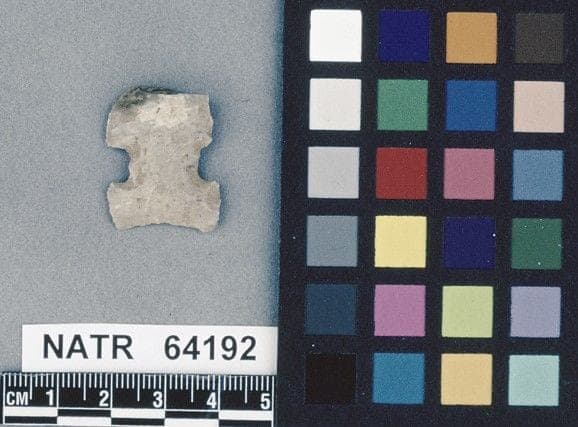
Most Aftons are corner notched with barbed shoulders and an expanding stem, ending in a straight to convex base. Bell also documented a stemmed variant whose stem is straight and whose shoulders sit horizontal or angle slightly upward. Neck width falls around 15-25 mm, and stems are short, roughly 10-18 mm.
Workmanship is typically good. The blank was shaped with broad percussion flaking and then finished along the blade with pressure flaking, leaving a random flake pattern with crisp, well-controlled edges. The most common identification mistake is confusing an Afton with a Jacks Reef Pentagonal, a much younger Woodland-era point with the same five-sided idea; the Afton is the older and larger of the two.
Age and where it's found
Afton points date to roughly 5,000-3,000 B.P. in the Late Archaic. There has been debate over whether Ohio valley Pentagonal Knives and Aftons are two distinct types, but Bell concluded in 1958 that they share the same traits and the same pre-pottery age and represent a single type.
The heartland runs along the middle and lower Mississippi and up the Missouri drainage. From there the type extends through the Ohio and Illinois River valleys and throughout the Tennessee River valley, with finds thinning out as you move toward the Red River country and east Texas.
Think you found a Afton?
Upload a photo and our shape-matching AI will compare it against 1,000+ documented point types — with an honest read on how well it fits.
More type guides