Thebes Projectile Point: Identification, Age & Range
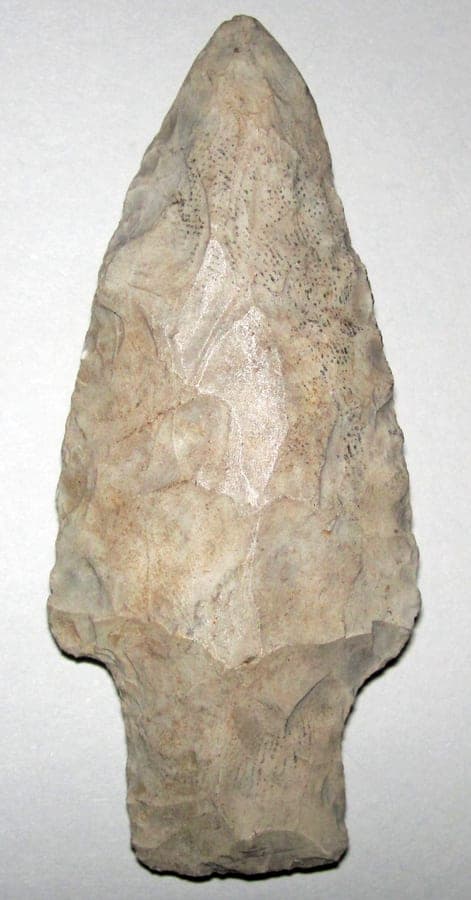
Thebes points are thick Early Archaic corner-notched blades (10,000–8,000 B.P.) from the Midwest, known for deep angled notches and beveled resharpened edges.
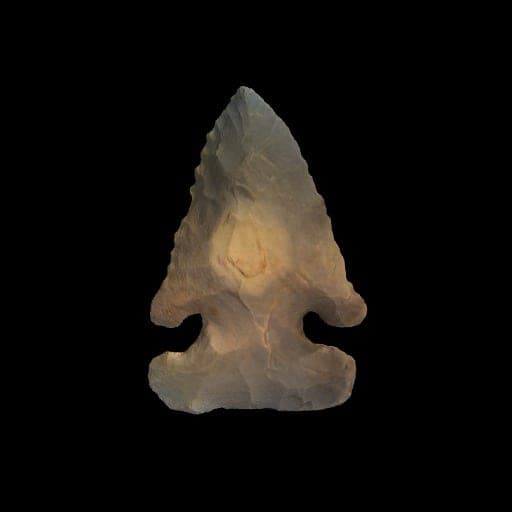
Photo: Mark W. Moore / Museum of Stone Tools, University of New England · Museum of Stone Tools (University of New England, Australia) · CC BY 2.0
At a glance
Period
10,000 - 8,000 B.P. · Early Archaic
Typical size
40–117 mm long, 24–56 mm wide
Region
These points are commonly found in Ohio, Indiana, Illinois and into eastern Iowa.
The Thebes point is one of the classic heavy-duty knives of the Early Archaic Midwest. Dating to roughly 10,000–8,000 B.P., these thick, corner-notched blades turn up in plowed fields and creek gravels across Ohio, Indiana, and Illinois, where their size and deep notching make them a favorite among finders. Howard D. Winters formally named the type in 1963 for the town of Thebes, Illinois, drawing on material from his survey work in the Wabash Valley.
How to identify a Thebes point
Start with the notches. Thebes points were notched in from the corners of the base, and the notches are deep and often unusual in form. Researchers recognize several variations: a diagonal notch that angles from the base toward the tip (most common in Indiana, Illinois, and Missouri), a curved "dogleg" notch seen most often in Ohio, a wide square notch, and the famous E notch, which is treated as a type of its own (Thebes E Notch). Below the notches the stem expands, the shoulders are barbed, and the base runs from slightly concave to convex with heavy grinding along its edge.
The blade tells the rest of the story. Most examples measure between 40 and 117 mm long (averaging near 57 mm) and 24 to 56 mm across the barbs, with a stout 7–12 mm thickness — noticeably chunkier than most corner-notched types. Fresh blades have straight to gently convex edges, but these tools were resharpened repeatedly while still in the haft, so many finds show a bevel (typically on the left side of each edge), serrations, or a recurved outline. Broad percussion flake scars usually remain visible on both faces, tidied up with fine pressure flaking around the margins.
Makers favored regional cherts such as Burlington, Avon, Bayport, Flint Ridge, and Upper Mercer, so color and texture follow whatever stone was available locally.
Age and where it's found
Thebes anchors the Thebes Cluster, an Early Archaic family that also includes Lost Lake, St. Charles, and Calf Creek points. The type dates to the early to middle Holocene, about 10,000–8,000 years before present.
The core range covers Ohio, Indiana, Illinois, and eastern Iowa. Finds thin out northward into Michigan, Wisconsin, and Minnesota and up the Ohio River valley, and the type is only rarely reported from Ontario, mostly on old terraces and beach ridges.
Think you found a Thebes?
Upload a photo and our shape-matching AI will compare it against 1,000+ documented point types — with an honest read on how well it fits.
More type guides