Etley Stemmed Projectile Point: Identification, Age & Range
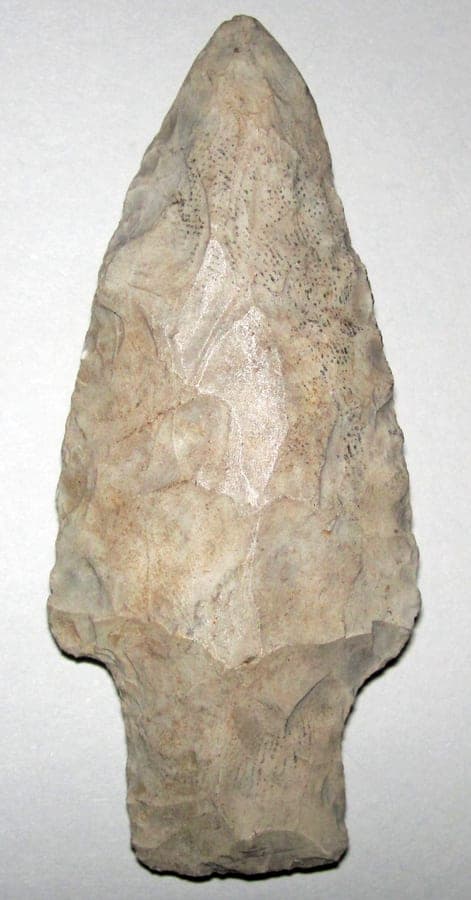
Etley Stemmed points are large Late Archaic blades (4,100-2,500 B.P.) concentrated around the St. Louis region of Missouri and Illinois.
At a glance
Period
4,100 - 2,500 B.P. · Middle to Late Archaic
Typical size
76–279 mm long, 32–60 mm wide
Region
This point has the heaviest concentrations in the St.
The Etley Stemmed is one of the big, impressive blades of the Midwest. Dating to roughly 4,100-2,500 B.P. in the Middle to Late Archaic, these points can exceed 10 inches in length, and even ordinary examples dwarf most other types a collector will pull from a plowed field. If you found a long, heavy stemmed blade near the Mississippi or lower Illinois River, Etley should be one of the first names you check.
The type was defined in 1951 by Edward G. Scully, a University of Michigan anthropologist whose fieldwork centered on the Mississippi drainage, and takes its name from the Etley site on the Oettle Farm in Calhoun County, Illinois. It anchors its own cluster, which also includes the Wadlow, Smith, Go-Kart, and Stone Square Stem types.
How to identify a Etley Stemmed point
Size is the first clue. Etley points run 76-279 mm long (roughly 3 to 11 inches) but only 32-60 mm wide, so the blade looks long and narrow for its length, with edges that often run nearly parallel through the midsection. The widest part of the blade typically sits above the shoulders rather than at them. Blade edges are usually excurvate or gently recurved; pieces that saw heavy resharpening can develop incurvate edges instead.
Check the stem next: it is strikingly short for such a long point, usually just 10-15 mm, or about one-tenth of the total length. It can expand slightly or contract slightly, ending in a straight to slightly convex base. Unlike many Archaic types, the base and hafting area show no grinding. Shoulders vary from sharply barbed to angled upward, largely depending on how much the blade was resharpened during its use life.
Workmanship leans on broad percussion flaking with only minimal pressure retouch, leaving a random flake pattern and a cross section, 10-15 mm thick, that ranges from flattened to lens-shaped. In the core range, most examples were made from Burlington chert that was not heat treated, so the stone tends to be a matte white to gray rather than glossy. Researchers believe the big, unnotched Wadlow blade served as a preform that knappers later finished into the Etley.
Age and where it's found
Etley points date to about 4,100-2,500 B.P. Archaeologists working along the lower Illinois River treat them as the marker artifact of the Titterington phase of the Late Archaic, dated there to roughly 2200-1800 B.C.E.
The heaviest concentrations center on the St. Louis area and the neighboring counties of eastern Missouri and western Illinois. Finds thin out toward southern Iowa, western Kentucky, and the western edge of Indiana, and the type has only rarely been reported as far north as southern Minnesota. A large stemmed blade found well outside this footprint is more likely to be a different type, such as a Savannah River point in the Southeast.
Think you found a Etley Stemmed?
Upload a photo and our shape-matching AI will compare it against 1,000+ documented point types — with an honest read on how well it fits.
More type guides