
Meadowood Projectile Point: Identification, Age & Range
Meadowood is a thin, side-notched Early Woodland point (3,300-2,700 B.P.) found from New York and New England into Pennsylvania and southern Ontario.
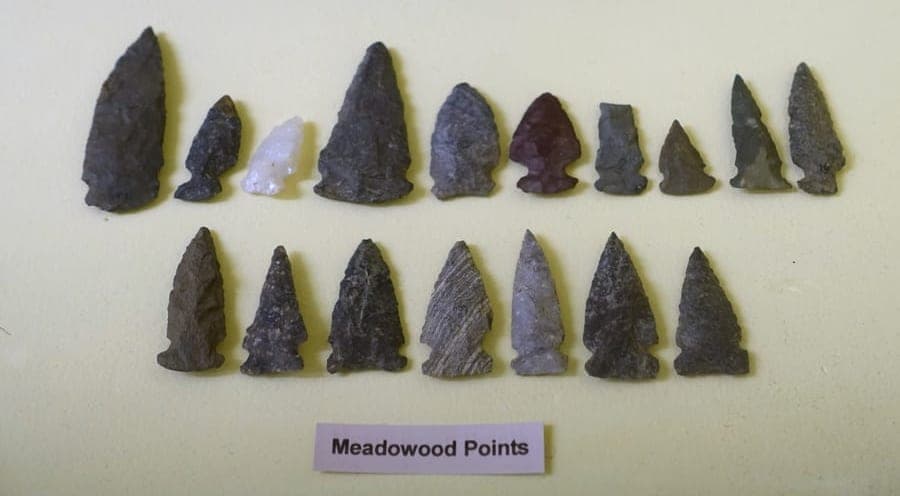
Photo: Daderot · Wikimedia Commons (photo taken at Robbins Museum of Archaeology, Middleborough, Massachusetts) · CC0 1.0
At a glance
Period
3,300 - 2,700 B.P. · Early Woodland
Typical size
4–89 mm long, 18–50 mm wide
Region
This point is primarily found in New York, into New England, Pennsylvania, and southwestern Ontario.
If you have found a flat, side-notched point in New York, Pennsylvania, or New England, Meadowood should be near the top of your list. It is the signature point of the Early Woodland Meadowood culture, and it turns up regularly in plowed fields and creek banks across the Northeast.
William A. Ritchie, New York's longtime state archaeologist, named the type in 1961. In Michigan the same form is still commonly called Hodges, a name Lewis Binford applied in 1963 after the Hodges site there.
How to identify a Meadowood point
The single most useful diagnostic is thinness. Meadowood points were made on wide, flat blanks, and finished pieces usually measure only 4 to 7 mm thick — noticeably slimmer than most other side-notched points from the region. The outline is triangular, with blade edges ranging from gently convex to straight; heavily resharpened pieces can look slightly pinched in, and some show serrations or a bevel on opposite edges.
Look next at the notches. They sit low on the blade, are broad and roughly parallel, and leave shoulders that run horizontal or slope slightly upward. The short expanding base below them can be as wide as the blade or even wider, finishes straight to convex, and almost always shows basal thinning plus heavy grinding. That stubby base is proportionally distinctive: stem length runs just 13 to 20 mm, around one-sixth of total length on smaller pieces and as little as one-eighth on larger ones.
Most complete examples run about 43 to 77 mm long and 28 to 38 mm wide, though the type's full range reaches roughly 89 mm. Flaking is random rather than patterned. Chert and rhyolite are the usual materials, with jasper and quartzite less common; in Pennsylvania, Onondaga chert dominates. If your point is wide, flat as a poker chip, and heavily ground along the base, Meadowood is a strong bet.
Age and where it's found
Meadowood dates to the Early Woodland period, roughly 3,300 to 2,700 B.P. Its heartland centers on New York and spreads across Pennsylvania, New England, and southwestern Ontario, with numbers thinning across Ohio and only scattered finds farther west in Michigan, Wisconsin, Illinois, and Indiana.
Unnotched preforms known as Meadowood Blades were buried in caches, sometimes together with Pomranky points, and a few sites yield Adena points alongside Meadowood material — possibly prestige items rather than close relatives. Individual pieces range from small, roughly flaked everyday tools to large, delicate examples of impressive craftsmanship.
Think you found a Meadowood?
Upload a photo and our shape-matching AI will compare it against 1,000+ documented point types — with an honest read on how well it fits.
More type guides