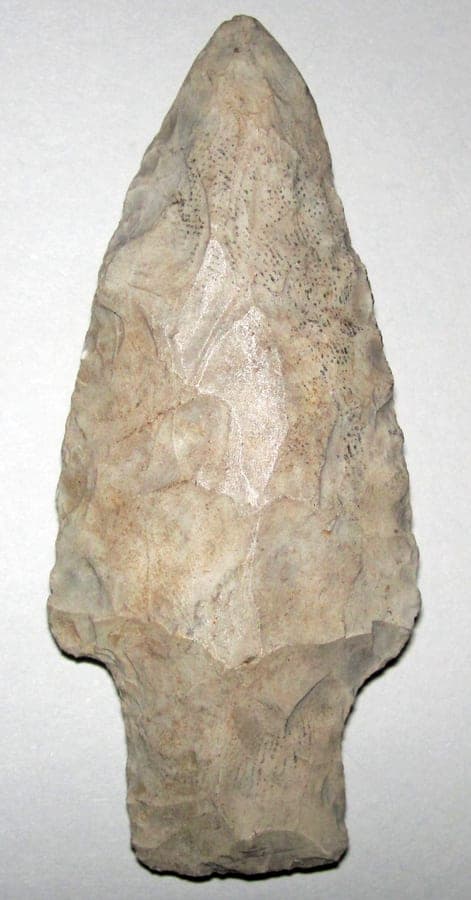
Pickwick Stemmed Projectile Point: Identification, Age & Range
Pickwick Stemmed points are large Middle to Late Archaic (6,000-3,500 B.P.) stemmed points of the Tennessee valley, often asymmetrical and serrated.
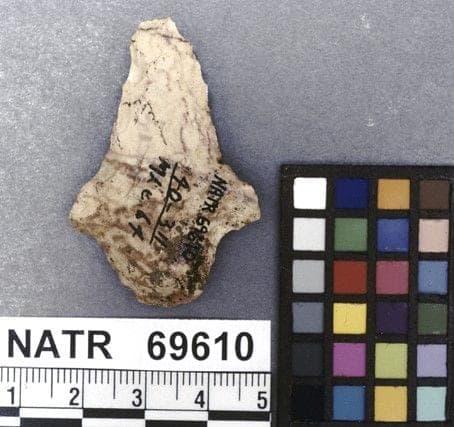
Photo: R Bruhn, National Park Service · National Park Service NPGallery (Natchez Trace Parkway / Southeast Archeological Center) · Public domain
At a glance
Period
6,000 - 3,500 B.P. · Middle to Late Archaic
Typical size
58–117 mm long, 35–60 mm wide
Region
This point is primarily found in the Tennessee River valley and into the Gulf Coast.
The Pickwick Stemmed is a big, broad-shouldered point of the Middle to Late Archaic, at home along the Tennessee River valley and south to the Gulf Coast. James Cambron, together with David DeJarnette and Edward Kurjack, named it in 1962 for the Pickwick Basin on the Tennessee River, with the Stanfield-Worley Bluff Shelter in Alabama as the type site. It belongs to the Ledbetter Stemmed cluster, and its lopsided blade — many examples look like they lean to one side — is often the first thing a finder notices.
How to identify a Pickwick Stemmed point
Expect a substantial point: 58 to 117 mm long, with most examples in the 74 to 85 mm range, and a wide blade of 35 to 60 mm. The blade shape runs from convex-edged to recurved, and asymmetry is normal rather than a flaw — one edge frequently bows out more than the other, a signature the type shares with its Ledbetter relatives. Many examples carry fine secondary pressure flaking that produces serrated or beveled edges.
The shoulders range from square to angled upward, are commonly uneven side to side, and can be barbed on some examples. The stem is straight to slightly contracting, and the base is most often straight, occasionally a bit convex; some points even keep a patch of the cobble's original weathered rind on the base. Cross sections run from elliptical to ridged down the midline of one or both faces, at 9 to 12 mm thick. Flaking is random overall.
Age and where it's found
Pickwick Stemmed points date to about 6,000 to 3,500 B.P., spanning the Middle to Late Archaic, with the type most abundant toward the later end of that range. Regional researchers place them just ahead of the appearance of Savannah River points, and excavated Georgia examples of the related Ledbetter/Pickwick group fall around 4,000 to 5,000 B.P. The closely related Ledbetter and Shoals Creek types are near-lookalikes within the same cluster.
The primary range is the Tennessee River valley down to the Gulf Coast. The type also appears, less frequently, in the southern parts of Illinois, Indiana, and Ohio, and in North Carolina's Tennessee River headwaters.
Think you found a Pickwick Stemmed?
Upload a photo and our shape-matching AI will compare it against 1,000+ documented point types — with an honest read on how well it fits.
More type guides