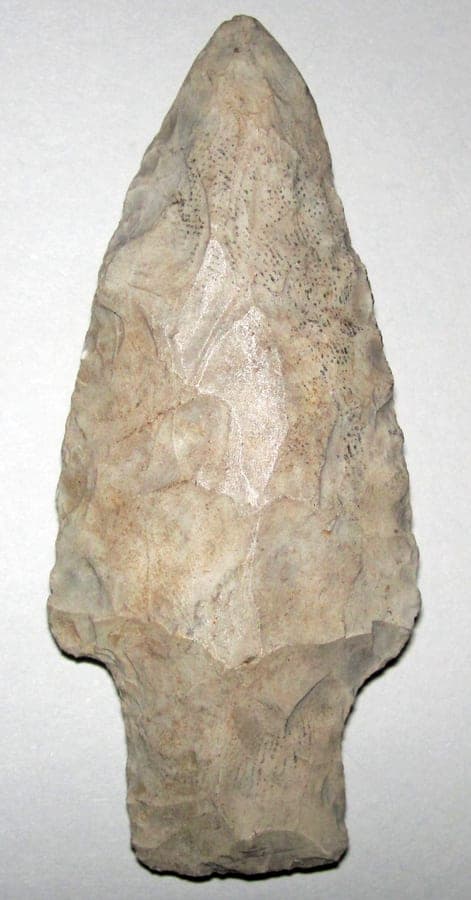
Brewerton Side Notch Projectile Point: Identification, Age & Range
Brewerton Side Notch points are Middle to Late Archaic (5,000-4,000 B.P.) side-notched points of the northeastern US and Ohio River valley.
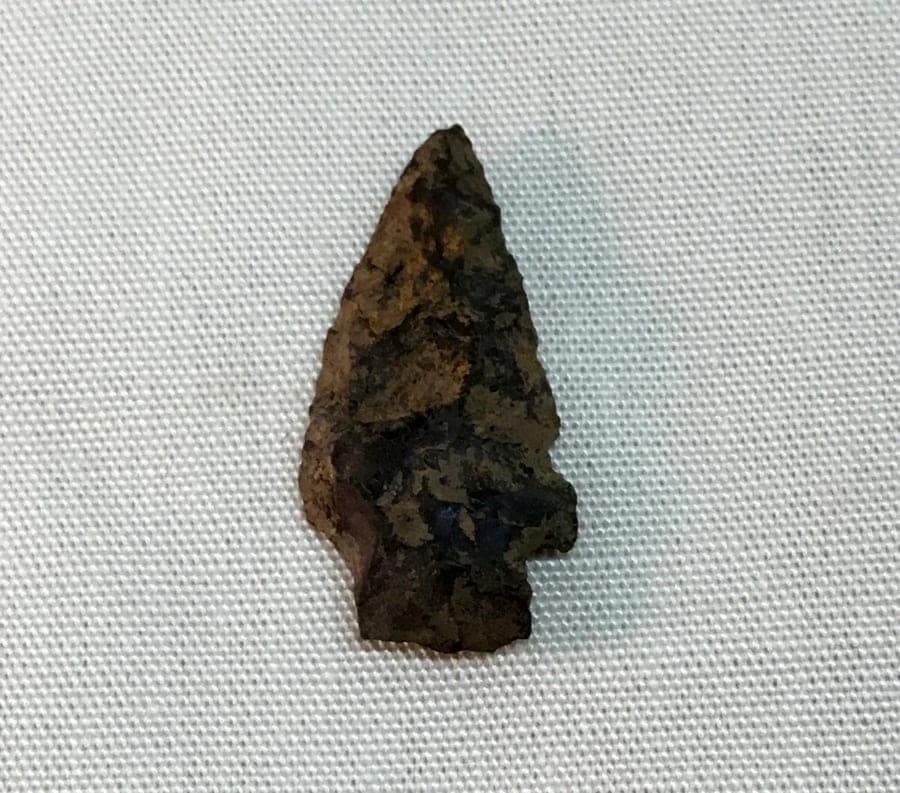
Photo: National Park Service · National Park Service (article 'Archaic Brewerton Projectile Point', Fort Stanwix National Monument) · Public domain
At a glance
Period
5,000 - 4,000 B.P. · Middle to Late Archaic
Typical size
21–98 mm long
Region
The Brewerton Complex points are primarily found in the northeastern states and into the Ohio River valley.
The Brewerton Side Notch is a workhorse point of the Northeast's Archaic period, dating to about 5,000-4,000 B.P. It is one of several forms in the Brewerton series, alongside the Brewerton Eared and Brewerton Eared Triangle, and it is grouped in the Matanzas Cluster. William Ritchie, New York's state archaeologist, named the type in 1961 from the Robinson site in Onondaga County, New York.
Because these points were made for well over a thousand years across a broad territory, they are a frequent find in plowed fields and stream banks from New England through the Ohio valley, and side-notched finds from that region are often compared against this type first.
How to identify a Brewerton Side Notch point
Look for a medium-sized point, 21-98 mm long but most commonly 32-57 mm, with a pair of notches cut into the sides just above the base. The notches are parallel to each other and set horizontally, producing an expanding stem below squared shoulders. In rare examples a second set of notches appears. Blade width runs 18-40 mm with a thickness of 6-12 mm, and the cross section is elliptical.
Blade edges are usually excurvate, sometimes straight, and only rarely incurvate, and some examples carry fine serrations. The base is typically straight, though on some pieces it dips into a shallow concave or bows gently convex, and grinding along the base occurs on part of the population. Flaking is random rather than patterned. Materials vary widely with local geology: quartz, quartzite, rhyolite, chert, and jasper are all recorded, so do not rule the type out just because the stone looks rough.
The most common confusions are with other side-notched Archaic types. Otter Creek points, a related form, tend to be larger with a concave base and squarish ears, while Big Sandy points belong to the Southeast and often show basal grinding with earlike corners. A thin, broad side-notched blade of high-grade chert in the Northeast is more likely a Woodland-era Meadowood.
Age and where it's found
Brewerton Side Notch points date to the Middle to Late Archaic, roughly 5,000-4,000 B.P., and are associated with the Brewerton Culture; a radiocarbon date of about 2,750 B.C. supports this range. Ritchie regarded the side-notched form as the earliest member of the Brewerton series, though others have argued the series' forms were all in use at the same time.
The heart of the distribution lies across the northeastern states and down through the Ohio valley. The type appears with less frequency in the Tennessee River basin and the mid to lower Mississippi valley, and it has been documented as far south as Alabama's Cave Spring site and Georgia's Etowah River site.
Think you found a Brewerton Side Notch?
Upload a photo and our shape-matching AI will compare it against 1,000+ documented point types — with an honest read on how well it fits.
More type guides