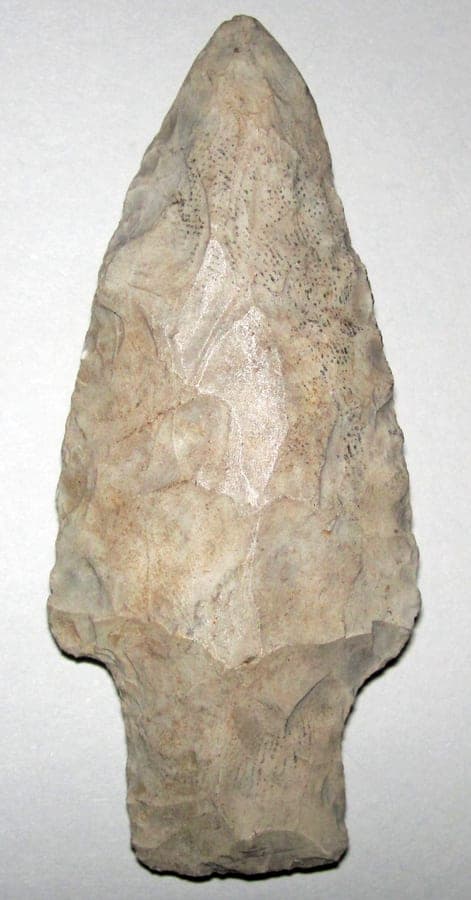
Big Sandy Side Notch Projectile Point: Identification, Age & Range
Big Sandy Side Notch points are Early Archaic (10,000-8,000 B.P.) side-notched points, most abundant in the Tennessee and Ohio River valleys.
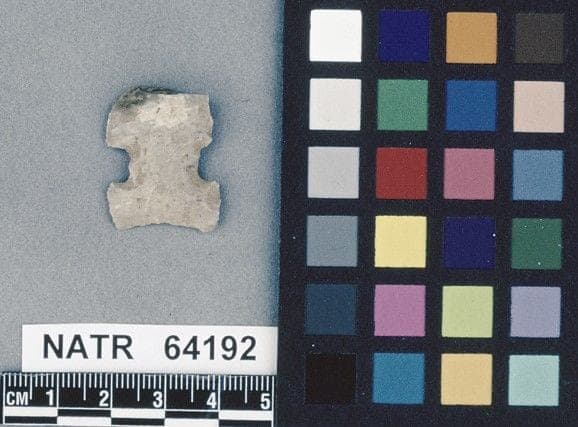
Photo: R Bruhn, National Park Service · NPGallery (National Park Service Digital Asset Management System) · Public domain
At a glance
Period
10,000 - 8,000,B.P. · Early Archaic
Typical size
35–80 mm long, 18–20 mm wide
Region
These points are most abundant in the Tennessee River valley and has the second highest frequency in the Ohio River Valley.
The Big Sandy Side Notch is regarded as the earliest point of the eastern Side Notched tradition, appearing around 10,000-8,000 B.P. in the Early Archaic and overlapping in time with the late Paleo Dalton points. If you found a side-notched point in the Tennessee Valley - the region where they are most abundant - Big Sandy is a strong first candidate.
Madeline Kneberg, the University of Tennessee anthropologist celebrated for her Tennessee River Valley excavations, named the type in 1956 after the Big Sandy Early Archaic phase that Thomas N. M. Lewis had defined, with the Big Sandy site in Henry County, Tennessee as the type site.
How to identify a Big Sandy Side Notch point
The defining trait is a pair of notches cut into the sides of the point above the base - not into the corners. The notches leave an expanded stem roughly as wide as the shoulders, straight shoulders, and a base that is most often straight but can be slightly convex or concave. The triangular blade runs from bowed-out to straight, and its edges are sometimes beveled or serrated.
Size runs medium to large, about 35-80 mm long with most examples around 40-50 mm - between a matchbook and a playing card in length. Cross sections are usually elliptical but can be flattened, rhomboid, or ridged, typically 6-8 mm thick. Points were shaped by percussion flaking and finished with pressure flaking along the edges; flaking is usually random, though rare pieces show oblique transverse patterning. Early 'true' Big Sandy points tend to be thin, with a less squared base, more developed ears, an incurved base edge, coarse-to-fine serration, and fine retouch.
The biggest identification pitfall is lumping. Many later side-notched types - notably Godar and Raddatz, which are Middle to Late Archaic - have been swept into the 'Big Sandy' label over the years. An authentic Big Sandy belongs to the Early Archaic. The type itself also changed through time: early forms are smaller (thought to be resharpened Graham Cave points), middle forms develop rounder bases, and later forms have longer stems and more pronounced ears. Named variants include Big Sandy Broad Base, Constricted Base, Leighton Base, and E-Notch.
Age and where it's found
Big Sandy dates to roughly 10,000-8,000 B.P. and defines the Big Sandy phase of the Early Archaic. Its early appearance, alongside Dalton points still in use, marks the transition out of the Paleo era in the Midsouth.
The Tennessee River valley holds the greatest concentration of finds, with the Ohio River Valley second; the type occurs at lower frequency in surrounding regions.
Think you found a Big Sandy Side Notch?
Upload a photo and our shape-matching AI will compare it against 1,000+ documented point types — with an honest read on how well it fits.
More type guides