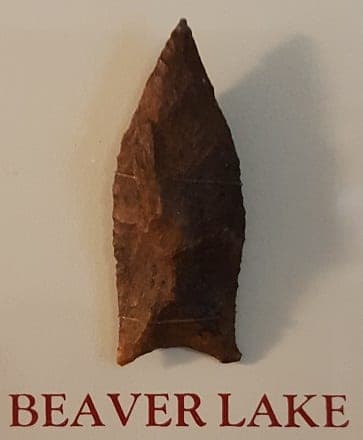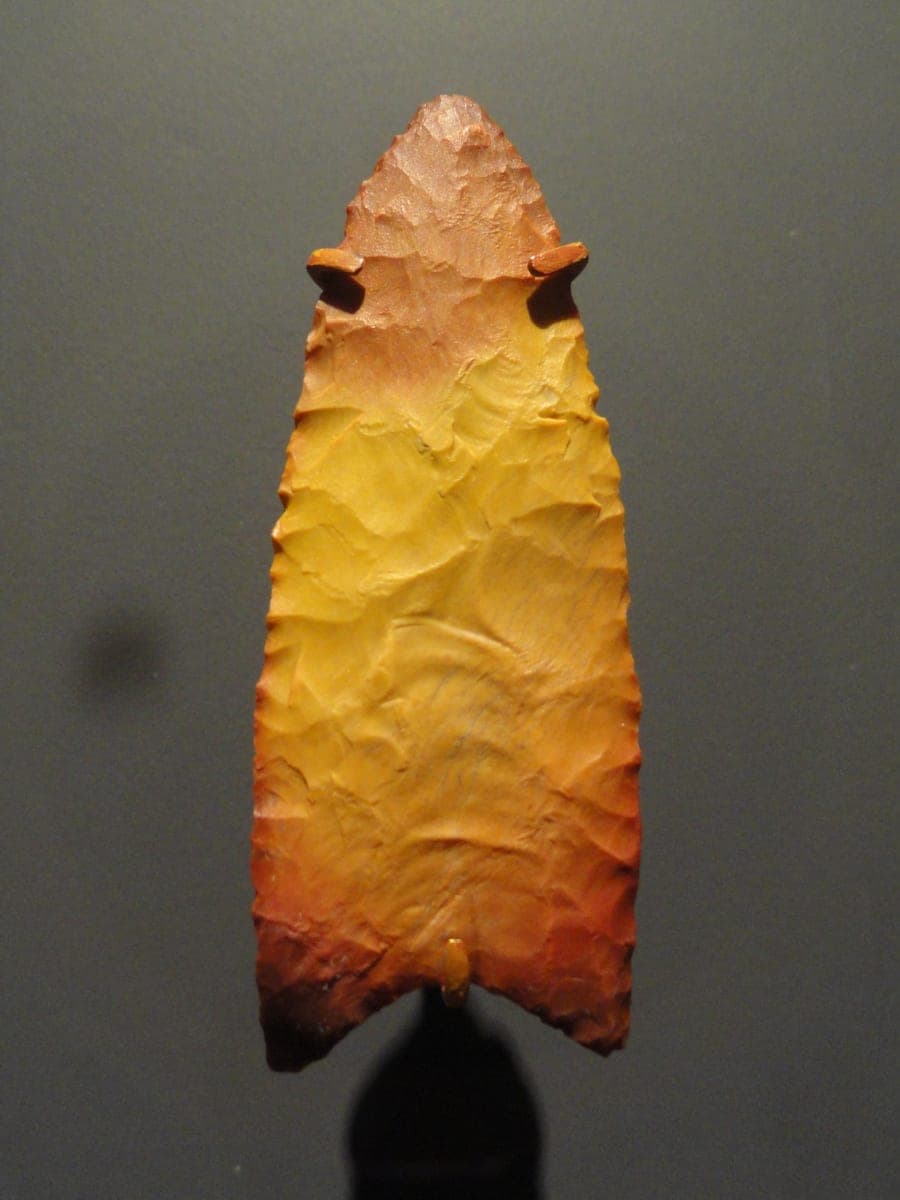
Hardaway Side Notch Projectile Point: Identification, Age & Range
Hardaway Side Notch points (10,500-9,000 B.P.) are thin, deeply notched Transitional Paleo points found from southern Virginia to Mississippi.
At a glance
Period
10,500 - 9,000 B.P. · Transitional Paleo
Typical size
25–85 mm long, 22–45 mm wide
Region
This point is primarily found southern Virginia and into Mississippi.
The Hardaway Side Notch is one of the earliest side-notched points in the Southeast, dating to the Transitional Paleo period. It was defined by Joffre L. Coe in 1964 from the deeply stratified Hardaway site in Stanly County, North Carolina — a landmark excavation in eastern archaeology. Creek-walkers and field hunters from southern Virginia down into Mississippi encounter these small, wide, strikingly thin points, often without realizing how old they are.
How to identify a Hardaway Side Notch point
Start with the notches and the base. Hardaway Side Notch points have a pair of deep, narrow notches cut straight into each side, forming a U-shaped opening rather than a wide shallow dip. Below the notches, the base is usually deeply concave — hollowed out enough that some examples look almost bifurcated, with two ear-like corners hanging down. The basal edge is typically ground smooth, and broad, shallow thinning flakes run from the base up the faces, sometimes reaching a third of the way to the tip.
The overall proportions are distinctive: these are wide points for their length. Total length runs 25 to 85 mm but averages only about 35 mm — around the size of a postage stamp to a matchbook — while width runs 22 to 45 mm. Combined with a thickness of just 3 to 10 mm and a cross section that grades from flattened to elliptical, the result is a short, broad, thin point with a straight to gently excurvate blade and random flaking. Material varies by locality and includes quartz, quartzite, chert, flint, felsite, and jasper.
Age and where it's found
Hardaway Side Notch dates to roughly 10,500 to 9,000 B.P., at the close of the Pleistocene and the opening of the Holocene. At the type site it occurs in the same levels as the Hardaway Dalton, and Justice (1987) positions it as a bridge between the Dalton tradition and the later Palmer corner-notched forms. Its named relatives include the Hardaway Blade, Hardaway Dalton, and Hardaway Palmer.
The core range runs from southern Virginia southwest into Mississippi, centered on the Carolina Piedmont. Examples occur with less frequency north of Virginia and west of the Mississippi drainage.
Think you found a Hardaway Side Notch?
Upload a photo and our shape-matching AI will compare it against 1,000+ documented point types — with an honest read on how well it fits.
More type guides