Otter Creek Projectile Point: Identification, Age & Range
Otter Creek points are Middle to Late Archaic side-notched points (6,000-4,300 B.P.) from Vermont, New England, New York, and eastern Canada.
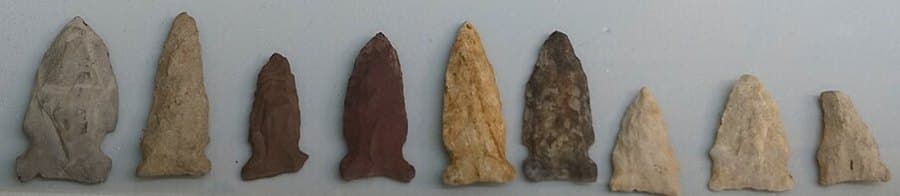
Late Archaic points from the Otter Creek section of the Robbins Museum's exhibit case in Middleborough, Massachusetts.
Photo: Daderot · Wikimedia Commons (Robbins Museum of Archaeology, Middleborough, Massachusetts; cropped) · Public domain
At a glance
Period
6,000 - 4,300 B.P. · Middle to Late Archaic
Typical size
25–115 mm long
Region
This point is primarily found in the Otter Creek region of Vermont and into the surrounding region of Maine, Quebec and Ontario.
The Otter Creek is the signature side-notched point of northern New England's Archaic period. William Ritchie named the type in 1971 for points recovered by Thomas Daniels in the Otter Creek Valley of Vermont. It is the hallmark point of western Vermont's Vergennes Phase, an expression of the broader Laurentian Archaic, and dates to roughly 6,000-4,300 B.P., the Middle to Late Archaic.
For someone who has found a side-notched point in Vermont, upstate New York, or southern Quebec or Ontario, Otter Creek is usually the first type worth checking, since it is both common in the region and reasonably distinctive once you know its base.
How to identify a Otter Creek point
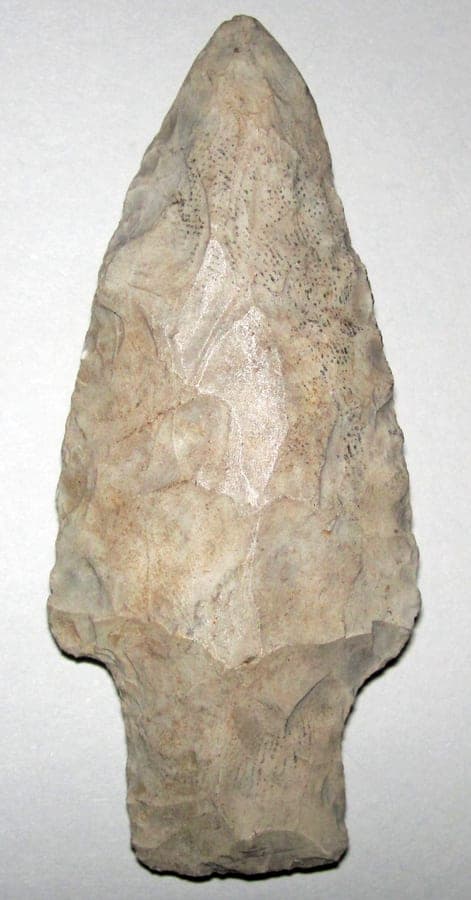
Otter Creek points are medium to large: 25-115 mm long, with most examples in the 70-89 mm range (about the length of a credit card or longer), 18-33 mm wide, and 6-13 mm thick, lens-like in cross section. Blade outlines take several shapes — leaf-like, egg-shaped, or convex-edged — though straight edges are common too, giving the point a long, narrow triangular look above the notches.
The base is the giveaway. Parallel side notches leave shoulders that sit horizontal or slope slightly upward, and the haft widens toward blocky, ear-like corners. The base itself is usually concave, occasionally straight, and carries basal grinding; some examples also show basal thinning. Flaking is random, and the materials are typical northern Archaic stone: quartz, quartzite, rhyolite, and chert.
Two use-life quirks are worth knowing. Many examples show wear concentrated on one edge, and even heavily resharpened blades tend to stay symmetric with the base, though the cross section may become lopsided. Heavily reworked pieces can end up resembling the Brewerton Eared Notch, a related form, which is a frequent identification pitfall in the Northeast.
Age and where it's found
Otter Creek points date to about 6,000-4,300 B.P. in the Middle to Late Archaic; in western Vermont they serve as the index artifact for the Laurentian tradition's Vergennes Phase.
The core distribution centers on Vermont's Otter Creek drainage and spills over into neighboring Maine, Quebec, and Ontario. The type also occurs throughout New York's Hudson drainage and Pennsylvania's Susquehanna drainage, and it has been reported as far east as New Brunswick, Canada.
Think you found a Otter Creek?
Upload a photo and our shape-matching AI will compare it against 1,000+ documented point types — with an honest read on how well it fits.
More type guides