Susquehanna Broadspear Projectile Point: Identification, Age & Range
Susquehanna Broadspear is a wide, expanding-stem point of 3,700-2,700 B.P., centered on the Susquehanna and Juniata river valleys of Pennsylvania.
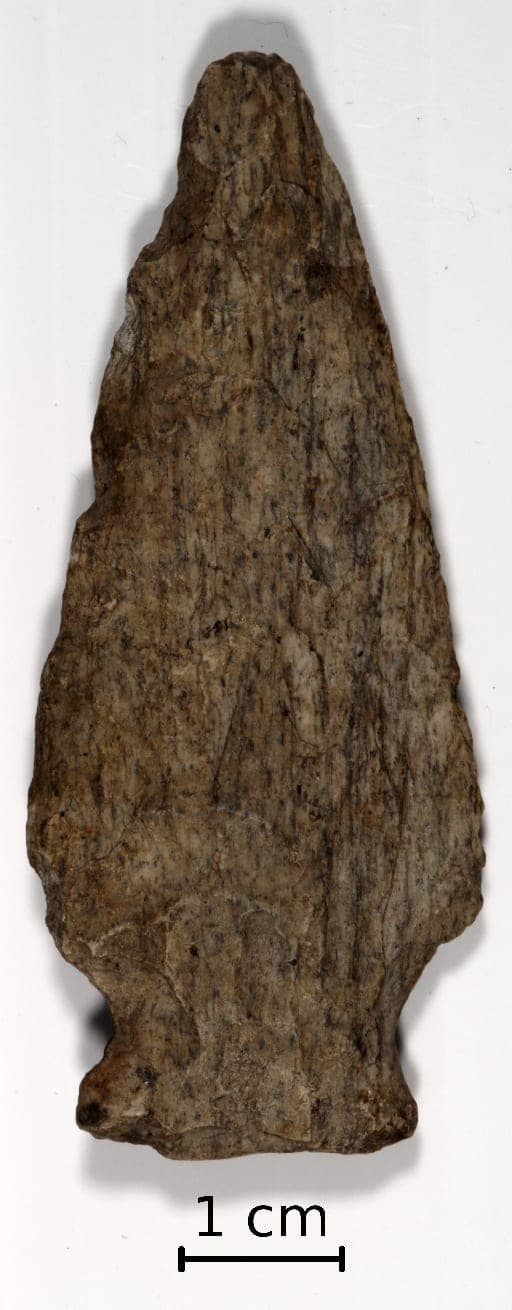
Photo: PAR · Wikimedia Commons · Public domain
At a glance
Period
3,700 - 2,700 B.P. · Late Archaic to Early Woodland
Typical size
40–200 mm long, 25–50 mm wide
Region
This point is primarily found in the Juniata River Valley and into the Susquehanna River Valley.
Susquehanna Broadspear is one of the classic broadpoints of the Northeast — the wide-bladed knife and spear forms that mark the closing centuries of the Archaic. John Witthoft, who served as Pennsylvania's state archaeologist, defined the type in 1953 and named it for the Susquehanna River Valley of eastern Pennsylvania. If you picked up a wide, thin point with a flaring stem along a Mid-Atlantic river, this type deserves a close look.
How to identify a Susquehanna Broadspear point
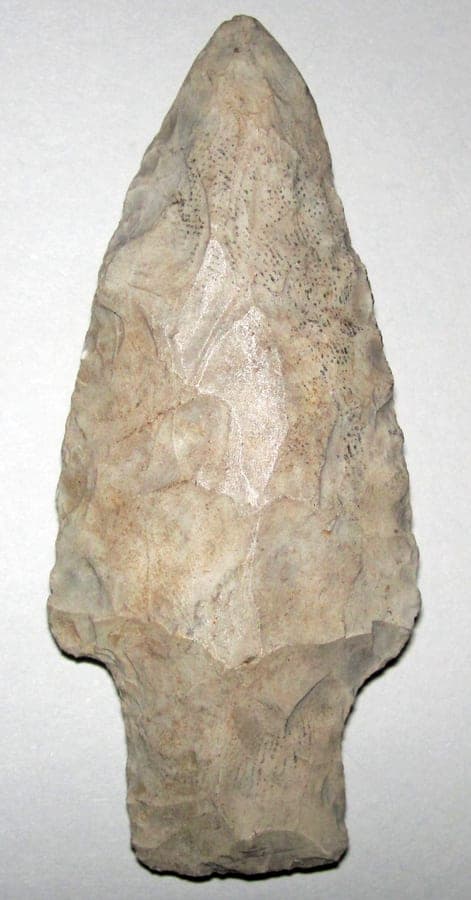
The blade is the first clue: broad, convex-edged, and frequently lopsided, because these tools doubled as knives and were resharpened unevenly. For such a wide piece the cross section is thin — 4 to 10 mm — and elliptical. Shoulders run horizontal or angle upward, and on some pieces one or both shoulders were deliberately removed, a form collectors call the clipped-wing variant.
Below the shoulders the stem flares outward but always stays narrower than the blade, ending in a straight to slightly concave base; older examples may show grinding in the hafting area. The stem is also short — just 7 to 13 mm long and 12 to 26 mm wide, with a neck of 12 to 22 mm — so the blade dominates the outline. Size varies enormously, from about 40 mm to an exceptional 200 mm long, though a typical example runs near 65 mm with a blade 25 to 50 mm across. Rhyolite and quartzite are the most common materials, followed by quartz, chert, and argillite — a coarse rhyolite broadpoint from Pennsylvania fits this type well. The combination to look for is a blade far wider than the little flaring stem beneath it, all on a piece thinner than you would expect for its size.
Age and where it's found
The type dates to about 3,700-2,700 B.P., spanning the Late Archaic into the Early Woodland, and is associated with an intrusive cultural tradition thought to have pushed outward from the Susquehanna Valley toward the Ohio drainage and New England. Finds concentrate in the Juniata and Susquehanna river valleys; the point is also common in the middle stretches of the Potomac drainage and the northern Shenandoah Valley, and it ranges north into southern Ontario, with fewer examples in New England and only occasional finds in West Virginia, Ohio, and Michigan.
Researchers believe the form evolved toward the later Ashtabula point, with the Orient point possibly representing an intermediate step. Wayland and Mansion Inn are regarded as variant forms, and the related family also includes Perkiomen, Drybrook, and Dismal Swamp.
Think you found a Susquehanna Broadspear?
Upload a photo and our shape-matching AI will compare it against 1,000+ documented point types — with an honest read on how well it fits.
More type guides