Snyders Projectile Point: Identification, Age & Range
Snyders is a broad, deeply corner-notched Middle Woodland point of the Hopewell culture, about 2,500-1,500 B.P., centered on the Ohio River Valley.
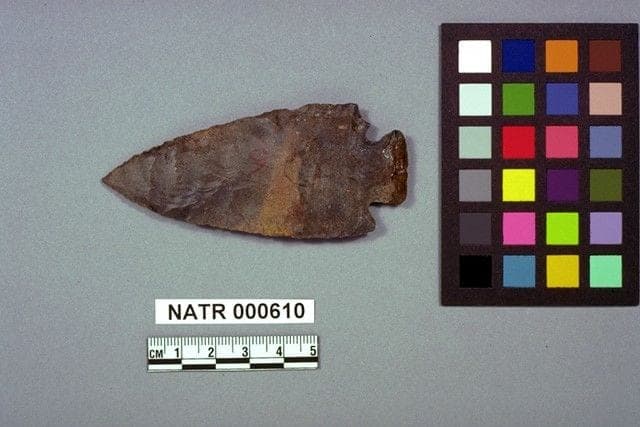
Photo: R. Bruhn, National Park Service Southeast Archeological Center · NPGallery (National Park Service, Southeast Archeological Center — Natchez Trace Parkway collection) · Public domain
At a glance
Period
2,500 - 1,500 B.P. · Late Archaic to Woodland
Typical size
42–150 mm long, 31–60 mm wide
Region
This point is most common in the Ohio River Valley and into the Great Lakes areas and in area associated with the Hopewell culture.
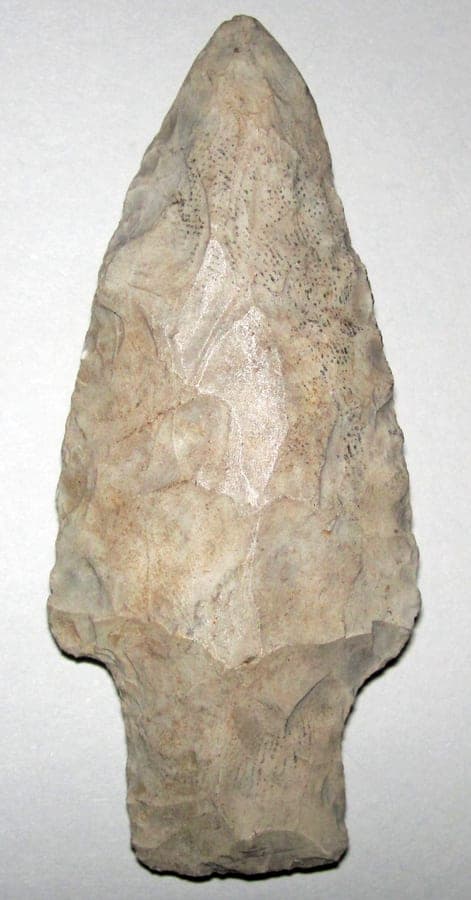
The Snyders point is one of the signature artifacts of the Hopewell world: a big, wide, deeply corner-notched blade that looks almost too well made to be an everyday tool. It dates to roughly 2,500-1,500 B.P., and researchers most often place classic examples with the Havana Hopewell tradition of the Middle Woodland period, around 200 B.C.E. to 200 C.E. Edward G. Scully defined the type in 1951 from the Snyders Hopewell site in Calhoun County, Illinois.
Because Hopewell people lived along the major midwestern river systems, Snyders points turn up in plowed bottomland fields and creek gravels across Illinois, Ohio, Indiana, and neighboring states, and their size and craftsmanship make them hard to overlook.
How to identify a Snyders point
Start with the overall proportions. Snyders points are broad for their length, their outline falling somewhere between a triangle and an egg shape, with a full, rounded look. Documented examples run 42 to 150 mm long (most around 57 mm, roughly the length of an adult thumb and beyond) and 31 to 60 mm wide. Despite that width, the point is usually thin, about 8-9 mm, and flat in cross section, though some pieces are more lens-shaped.
The notching is the key diagnostic. Large, deep notches enter at the corners of the base, carving out pronounced barbs at the shoulders and leaving a short, expanding stem below. The base itself is convex. Stem width typically measures a third to half of the point's full width, which gives the piece its distinctive wide-bladed, narrow-necked silhouette.
Workmanship is another clue. Snyders points were shaped by confident percussion flaking finished with light pressure retouch along the edges, in no set pattern, and they are usually made from high-grade stone. Knappers often chose showy or traded materials, among them Knife River flint, Burlington and Cobden cherts, and Hixton silicified sandstone, along with regional stones like Flint Ridge chalcedony and Upper Mercer chert. Heat treating of the stone is common. A crude, thick corner-notched point in poor local rock is probably something else.
Age and where it's found
Snyders points belong to the Middle Woodland period and are strongly tied to the Hopewell culture. They are most abundant across the Ohio River Valley and up through the Great Lakes country, with finds extending into the upper Mississippi, Arkansas, and Tennessee river valleys. Some of the largest, finest pieces may have been ceremonial rather than utilitarian, and many examples were reworked into knives or scrapers during their use lives.
The type anchors the Snyders cluster, which includes related forms such as the Hopewell point, Affis Snyders, Manker, Grand, and Ross, along with the North blade, believed to be an unfinished Snyders preform.
Think you found a Snyders?
Upload a photo and our shape-matching AI will compare it against 1,000+ documented point types — with an honest read on how well it fits.
More type guides