Palmer Corner Notch Projectile Point: Identification, Age & Range
Palmer Corner Notch points are small Early Archaic (9,500-8,500 B.P.) serrated points with heavily ground bases, found across the eastern United States.
At a glance
Period
9,500 - 8,500 B.P. · Early Archaic
Typical size
23–60 mm long, 14–29 mm wide
Region
This point is primarily associated with the Eastern Seaboard region of the United States, into the the Gulf Coastal region and the Tennessee River and Ohio…
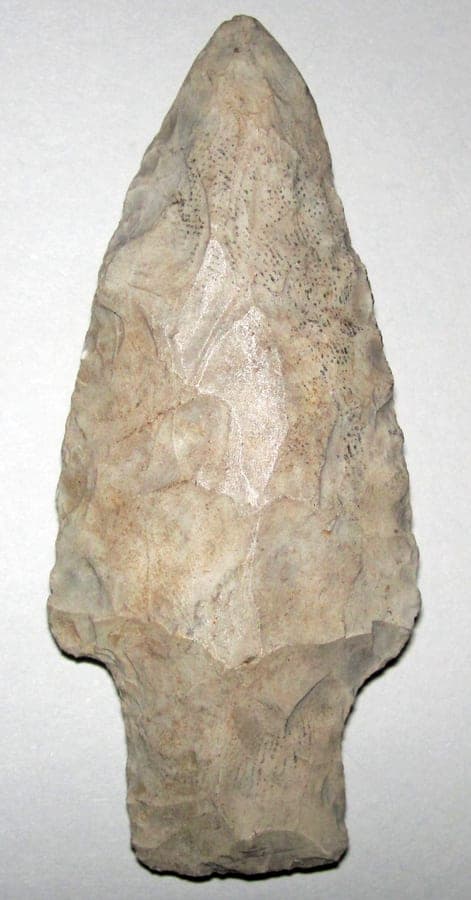
The Palmer Corner Notch is a small, finely made Early Archaic point that shows up across much of the eastern United States, dating to roughly 9,500-8,500 B.P. Finders often mistake it for a small Kirk - and for good reason, since the two are closely related and some researchers have argued they could be lumped together.
Joffre L. Coe defined the type in 1964 from the Hardaway site in Stanly County, North Carolina, naming it for nearby Palmer Mountain. Coe saw Palmer as the ancestor of the Kirk Corner Notched, with the later Decatur point continuing the lineage; all belong to the Kirk Corner Notch cluster.
How to identify a Palmer Corner Notch point
The single best diagnostic is the base: Palmer points typically show heavy basal grinding and thinning, leaving the hafting area noticeably smooth to the touch. Run a fingertip along the base and lower notch edges - on a genuine Palmer they usually feel dulled and polished rather than sharp. That ground base is exactly what separates Palmer from Kirk, which rarely shows grinding.
Beyond the base, look for corner notches that produce an expanding stem, shoulders that are usually barbed but sometimes horizontal or slightly upward-sloping, and a base edge that is most often straight. The triangular blade is generally straight-edged, occasionally bowed slightly in or out, and serrations are common. Flaking is random and the cross section is elliptical.
Size is the other tell. Palmer is small - about 23-60 mm long and 14-29 mm wide, with most examples only 26-35 mm long, shorter than a book of matches. Known materials include rhyolite, quartz, various cherts, and quartzite - with the oolitic variety of quartzite appearing in parts of the range.
Age and where it's found
Palmer dates to the Early Archaic, about 9,500-8,500 B.P. Coe placed it stratigraphically after the Hardaway occupation and considered it earlier than Kirk Corner Notched, though later researchers such as Whatley have noted that the time gap between the two types is not well established.
The distribution mirrors Kirk's: strongest along the Eastern Seaboard, through the Gulf Coast, and across the Tennessee and Ohio drainages, thinning toward the Mississippi basin and the Northeast. Related forms include Amos, Charleston Corner Notch, and Pine Tree Corner Notch.
Think you found a Palmer Corner Notch?
Upload a photo and our shape-matching AI will compare it against 1,000+ documented point types — with an honest read on how well it fits.
More type guides