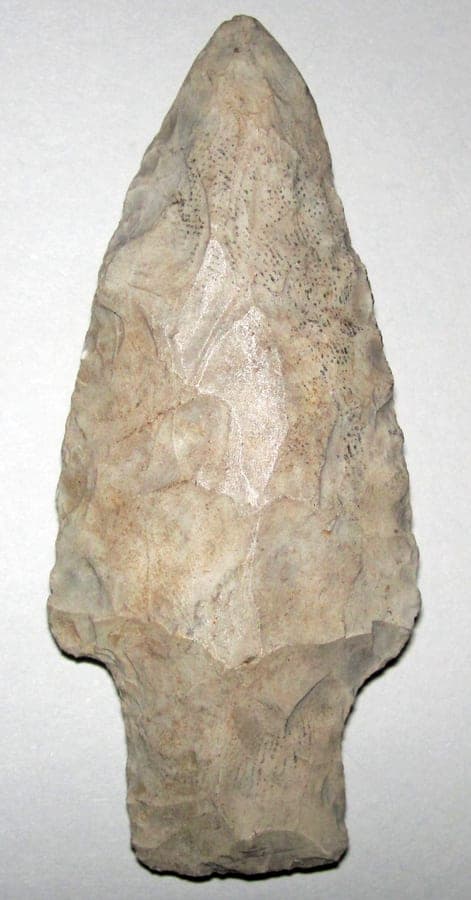
Lamoka Stemmed Projectile Point: Identification, Age & Range
Lamoka Stemmed points are small, thick Middle to Late Archaic points (5,500-3,500 B.P.) common in New York, Ontario, and the Ohio River basin.
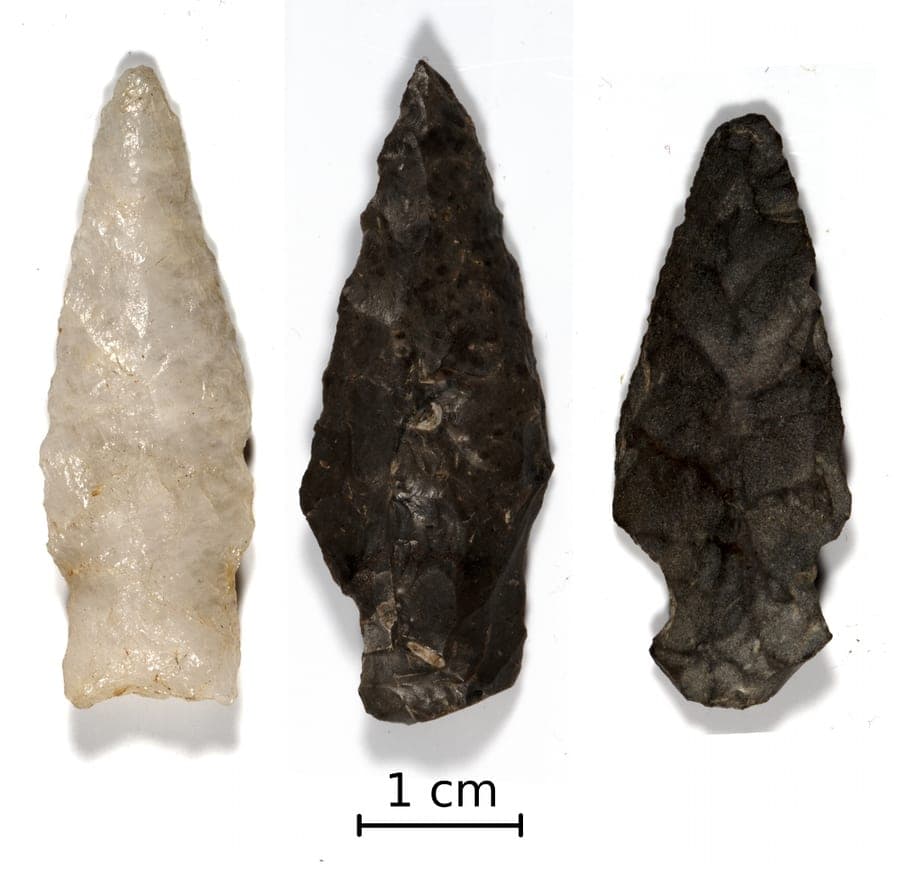
Photo: PAR · Wikimedia Commons · Public domain
At a glance
Period
5,500 - 3,500 B.P. · Middle to Late Archaic
Typical size
25–65 mm long, 12–19 mm wide
Region
This point is primarily found from New York into the Ohio River basin and the Niagara Peninsula in Ontario.
If you have found a small, chunky stemmed point in New York or the surrounding Northeast, there is a good chance you are holding a Lamoka. These little points are among the most common Archaic finds in the region, dating to about 5,500-3,500 B.P. They belong to the Laurentian Tradition and were named in 1961 by William A. Ritchie, New York's longtime state archaeologist, who excavated more than a hundred sites across the state.
Lamoka points anchor the Lamoka Cluster, a family of small, thick stemmed points that also includes Bare Island, Normanskill, and Wading River. The Durst Stemmed and Dustin types are widely considered the same point carrying different regional names.
How to identify a Lamoka Stemmed point
Think small and thick. Lamoka points run 25-65 mm long, averaging about 40 mm (roughly the length of a house key), with a narrow blade only 12-19 mm wide and a thickness of 5-9 mm that feels stout for the size. The cross section is elliptical, and the blade is usually excurvate, though smaller examples can have straighter edges.
The single most useful diagnostic is the base: it is typically left unfinished, often retaining rough, unflaked stone or cortex where other types show careful thinning. The stem is short (7-12 mm) and usually straight-sided, though some examples expand slightly, and the base ranges from straight to convex. Shoulders are frequently weak and slope upward, so the transition from stem to blade can be subtle; other examples show more distinct horizontal shoulders.
Workmanship is plain rather than refined. These points were shaped with soft percussion flaking and little or no pressure retouch, leaving a random flake pattern and a somewhat crude look. Makers used whatever was local: regional cherts, milky quartz, and quartzite are all common.
Age and where it's found
Lamoka points date to the Middle to Late Archaic, about 5,500-3,500 B.P., and are associated with the Laurentian Tradition of the Northeast.
The distribution centers on New York, reaching westward into the Ohio drainage as well as across the Niagara Peninsula of southern Ontario. Within that range they turn up on habitation sites in large numbers, which is why so many creek-bed and plowed-field finds in upstate New York turn out to be Lamokas or their close relatives.
Think you found a Lamoka Stemmed?
Upload a photo and our shape-matching AI will compare it against 1,000+ documented point types — with an honest read on how well it fits.
More type guides