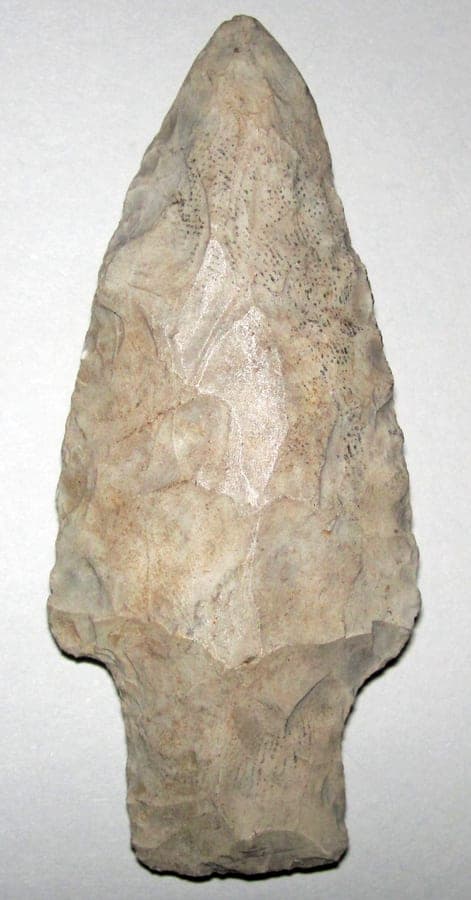
Orient Fishtail Projectile Point: Identification, Age & Range
Orient Fishtail is a slender point of 3,200-2,600 B.P. with a flaring fishtail base, common in the Hudson Valley, Long Island, and New Jersey.
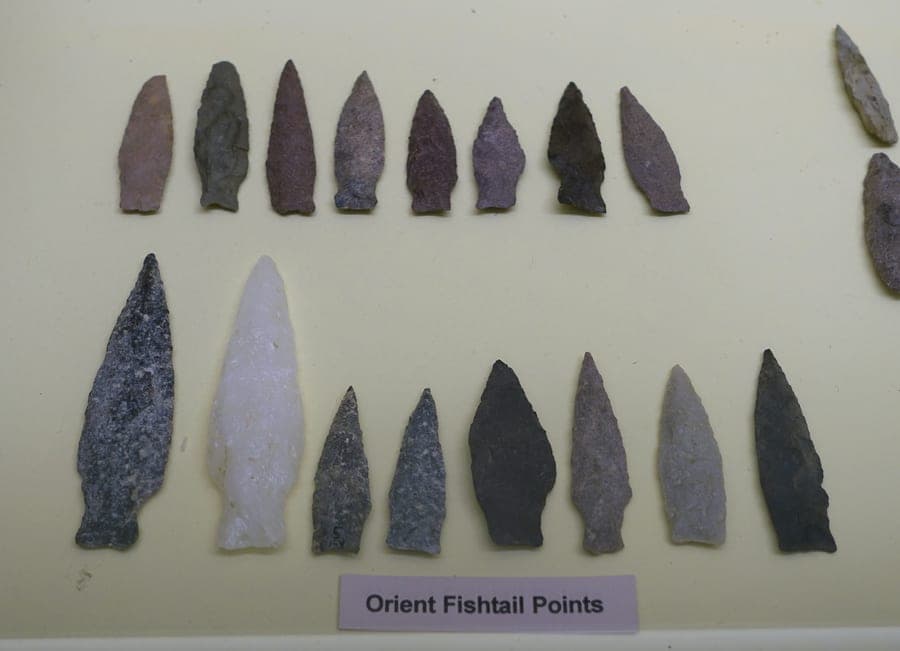
Photo: Daderot · Wikimedia Commons (photo taken at Robbins Museum of Archaeology, Middleborough, Massachusetts) · CC0 1.0
At a glance
Period
3,200 - 2,600 B.P. · Late Archaic to Early Woodland
Typical size
38–102 mm long, 14–25 mm wide
Region
This point is primarily found in the middle to lower Hudson River Valley of New York and New Jersey and Long Island.
Few Northeastern points are as instantly recognizable as the Orient Fishtail. The flaring base really does resemble a fish's tail, and that one trait identifies most examples at a glance. William Ritchie named the type in 1961 for the Orient 1 and 2 sites at Orient Point on Long Island, New York, and finders across the Hudson Valley and coastal Northeast still encounter it regularly.
How to identify a Orient Fishtail point
Start with the base. The stem widens toward a concave — occasionally straight — bottom edge, producing the characteristic fishtail silhouette; a few examples straighten out enough to look weakly stemmed instead. Measured across the bottom, the base runs 13 to 20 mm wide against a neck of only 11 to 18 mm, and that slight outward flare over a stem 13 to 19 mm long is what creates the tail. The hafting edges are usually ground smooth. Shoulders are rounded and slope upward into the blade rather than jutting out, giving the whole point a graceful, tapering outline — you will not find strong barbs or square shoulders on a typical Orient.
The blade itself is slender with convex edges, though resharpened pieces can be asymmetrical. Most examples fall between 38 and 102 mm long — averaging around 60 mm, about the length of an adult finger — yet only 14 to 25 mm wide, with a flattened to elliptical cross section 5 to 11 mm thick. Flaking is random rather than patterned. White quartz is the most common material, followed by quartzite, flints from local sources, and even slate; a milky quartz point with a flaring tail is a strong Orient candidate.
Age and where it's found
Orient Fishtail dates to about 3,200-2,600 B.P., bridging the Late Archaic and Early Woodland periods, and is the hallmark of the Orient culture of Long Island. Its core territory takes in Long Island and the Hudson River Valley's middle and lower reaches in New York and New Jersey, with the distribution extending to Connecticut's Quinnipiac River basin, the Niagara Peninsula in Ontario, West Virginia's Tug River valley, and parts of Virginia.
The type belongs to the broader Susquehanna family of broadpoints; researchers see it as a possible intermediate form between the Susquehanna Broadspear and the later Ashtabula point, and it is related to Drybrook, Perkiomen, Wayland, and Dismal Swamp.
Think you found a Orient Fishtail?
Upload a photo and our shape-matching AI will compare it against 1,000+ documented point types — with an honest read on how well it fits.
More type guides