Scottsbluff Projectile Point: Identification, Age & Range
Scottsbluff points are finely flaked, square-stemmed Cody Complex points from Plains bison-kill sites, dating to about 9,250-8,850 B.P.
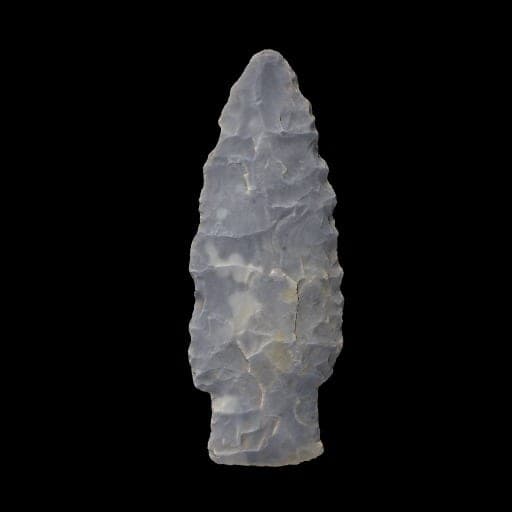
Photo: Mark W. Moore / Museum of Stone Tools, University of New England · Museum of Stone Tools (University of New England, Australia) · CC BY 2.0
At a glance
Period
9,250 - 8,850 B.P. · Transitional Paleo to Early Archaic
Typical size
50–150 mm long, 22–36 mm wide
Region
This point is commonly found in Wyoming to Colorado and western Nebraska.
The Scottsbluff is one of the signature points of the Cody Complex, the late Paleoindian bison-hunting culture of the Plains. Geologist Erwin H. Barbour and paleontologist C. B. Schultz named it in 1932 after finding examples at the Scottsbluff Bison Quarry in Nebraska, a Paleo-Indian bison kill site. For finders on the High Plains, a long, beautifully flaked point with a broad square stem is a strong candidate for this type.
How to identify a Scottsbluff point
Look at the stem and shoulders first. A Scottsbluff has a wide, mostly straight-sided stem — roughly as wide as it is long, 20 to 30 mm across — set off from the blade by weak, sometimes nearly absent shoulders that sit horizontal or angle slightly upward. The stem may expand a little, and the base runs from straight to slightly convex with heavy grinding on both the base and the stem edges. The blade above is excurvate: some examples are parallel-sided and curve in near the tip, others form a more triangular outline.
Flaking quality is a hallmark. These points were finished with well-controlled transverse pressure flaking, producing ribbon-like scars in horizontal to oblique parallel patterns, and the stone was not heat treated. The cross section is elliptical to slightly ridged, 6 to 13 mm thick. Total length runs 50 to 150 mm, with most examples 75 to 102 mm — pen length — and width runs 22 to 36 mm. Two forms are recognized: Type I is longer and thicker with weaker shoulders and a stem defined largely by grinding, while Type II is shorter, wider, and thinner with more distinct shoulders.
The classic confusion is with the Eden point, a fellow Cody Complex type. Eden is narrower, with very weak shoulders and a pronounced median ridge giving it a diamond-shaped cross section that Scottsbluff lacks. Bradley and Stanford found many pieces falling between the two and argued they may represent a single continuum, with resharpening of Scottsbluff points producing the ridge and reduced shoulders seen on Edens.
Age and where it's found
Scottsbluff dates to about 9,250 to 8,850 B.P., in the transition from Paleoindian to Early Archaic times during the early Holocene, as part of the Cody Complex and the Plano Stemmed cluster. Its relatives include Alberta, Eden, Holland, and the Cody Knife.
The type is most common from Wyoming through Colorado and western Nebraska, and along the High Plains from New Mexico north into Canada. It occurs into Texas and as far east as Ontario. The Cody Complex proper has not been documented in the Ohio River basin; superficially similar points found there are generally classified as McConnell Lanceolate, Stringtown, or Ohio Stemmed.
Think you found a Scottsbluff?
Upload a photo and our shape-matching AI will compare it against 1,000+ documented point types — with an honest read on how well it fits.
More type guides