Cahokia Side Notch Projectile Point: Identification, Age & Range
Cahokia Side Notch is a thin, finely made Mississippian arrow point, 1,100-500 B.P., tied to the Cahokia culture of Illinois and Missouri.
At a glance
Period
1,100 - 500 B.P. · Mississippian
Typical size
19–43 mm long, 11–22 mm wide
Region
This point is primarily associated with the Cahokia Culture in Illinois and Missouri.
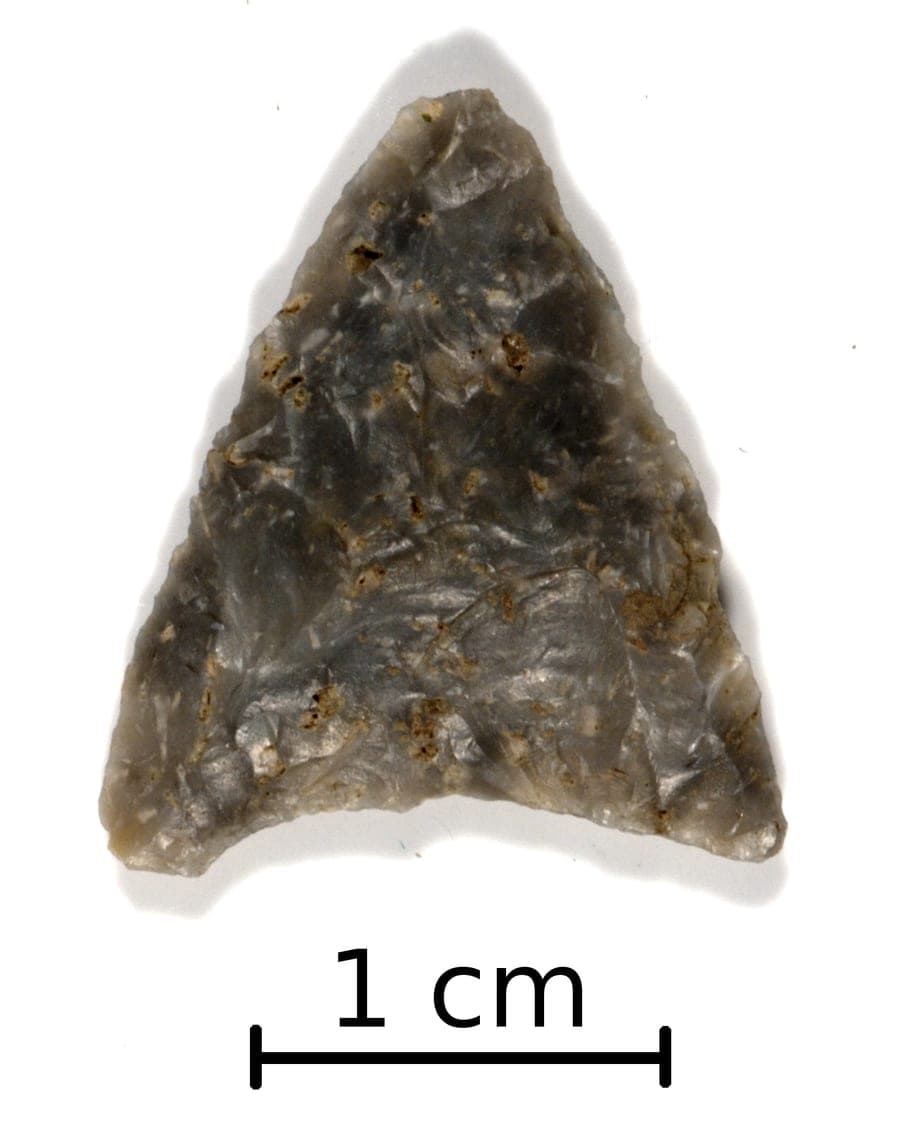
The Cahokia Side Notch is the classic arrowhead of the greatest prehistoric city north of Mexico. Made between about 1,100 and 500 B.P. during the Mississippian period, it is a small, thin triangular arrow point distinguished by neat, parallel notches cut into the sides of the blade. Warren Moorehead named the type in 1922 from the Cahokia Mounds site in St. Clair County, Illinois, and Edward G. Scully later formalized it.
Because these points combine small size with striking precision, finders sometimes mistake them for modern reproductions. Genuine examples are among the most skillfully pressure-flaked arrow points in eastern North America.
How to identify a Cahokia Side Notch point
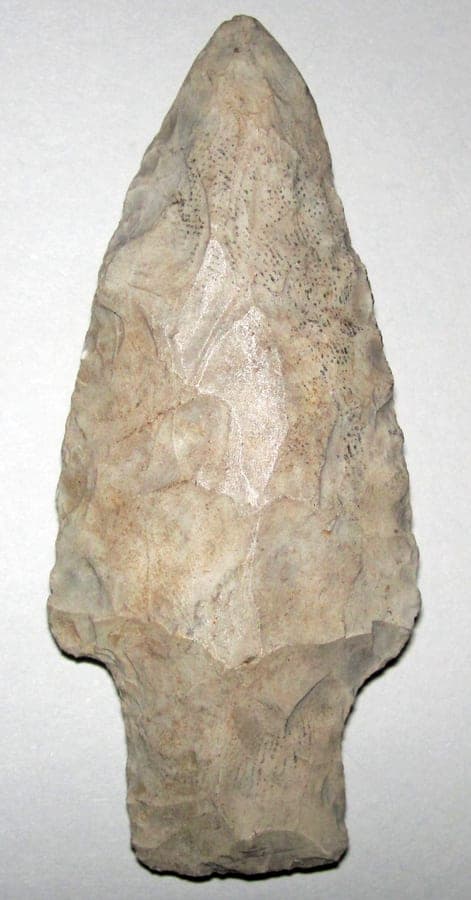
Picture a thin isosceles triangle, then add a matched pair of narrow notches entering the blade edges well above the base. That high, parallel side notching is the signature trait. Documented examples run 19 to 43 mm long, smaller than most pocket knives, with basal widths of 11 to 22 mm and blade widths at the shoulders of 7 to 17 mm. The cross section is flat, and the whole point is strikingly thin for its size.
The base area rewards a close look. Below the notches the basal edges flare outward so their line continues the angle of the blade, and the bottom edge itself is usually straight, though it can be concave or carry its own central notch. Blade edges are mostly straight, and on some pieces one or both edges carry serrations or extra notching. Named sub-types capture this variety: Serrated, Double Notch, Triple Notch, and Multiple Notch, plus rare examples with no notches at all. Perino observed that the triple- and multiple-notched forms tend to be older (Old Village period) while double-notched, serrated, and un-notched pieces are later (Trappist period).
Craftsmanship helps confirm the call. These points were pressure flaked to a consistently high standard, most often in white flint from nearby sources that was heat treated first, along with the tinted bands of Kaolin flint, darker gray-to-black flints, and on rare occasions even bone.
Age and where it's found
Cahokia Side Notch points date to 1,100-500 B.P. and belong to the Mississippian period, tied closely to the Cahokia culture centered in Illinois and Missouri. Finds thin out into Indiana, and the type has been reported as far north as eastern Iowa, southern Wisconsin (including the Aztalan site), and southeastern Minnesota. Points also traveled along Cahokia trade routes to major Caddoan centers such as Spiro Mounds in Oklahoma.
The type is thought to have been replaced over time by the plain Madison triangle, which shares the same basic shape minus the notches. On the Great Plains, the tri-notched Harrell and multiple-notched Huffaker points are close counterparts, and away from documented Mississippian village sites there may be no reliable way to tell them apart from Cahokia points.
Think you found a Cahokia Side Notch?
Upload a photo and our shape-matching AI will compare it against 1,000+ documented point types — with an honest read on how well it fits.
More type guides