Dalton Projectile Point: Identification, Age & Range
Dalton points date to 10,500-8,500 B.P. and are common in the Mississippi and Tennessee River valleys, known for serrated, heavily resharpened blades.
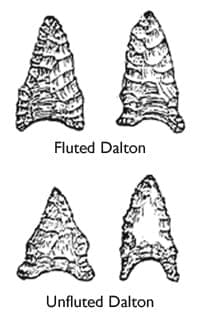
Photo: National Park Service · National Park Service, Southeast Archeological Center (illustration) · Public domain
At a glance
Period
10,500 - 8,500 B.P. · Transitional Paleo
Typical size
20–120 mm long, 19–35 mm wide
Region
This point is most commonly found in the mid to lower Mississippi River valley and into the Tennessee River Valley.
The Dalton point is one of the most frequently found early types in the American midcontinent, dating to about 10,500-8,500 B.P. in the Transitional Paleo period. It marks a turning point in prehistory: the Dalton culture bridged the shift from Ice Age big-game hunting to the broader foraging lifeways of the Archaic, adding new tools like the adz and hafted scrapers to the kit. Carl H. Chapman defined the type in 1948 from sites in Cole County, Missouri.
Daltons turn up constantly in plowed fields and creek gravels of the Mississippi valley, and because they were resharpened again and again during use, no two look quite alike — which makes them both common finds and common identification puzzles.
How to identify a Dalton point
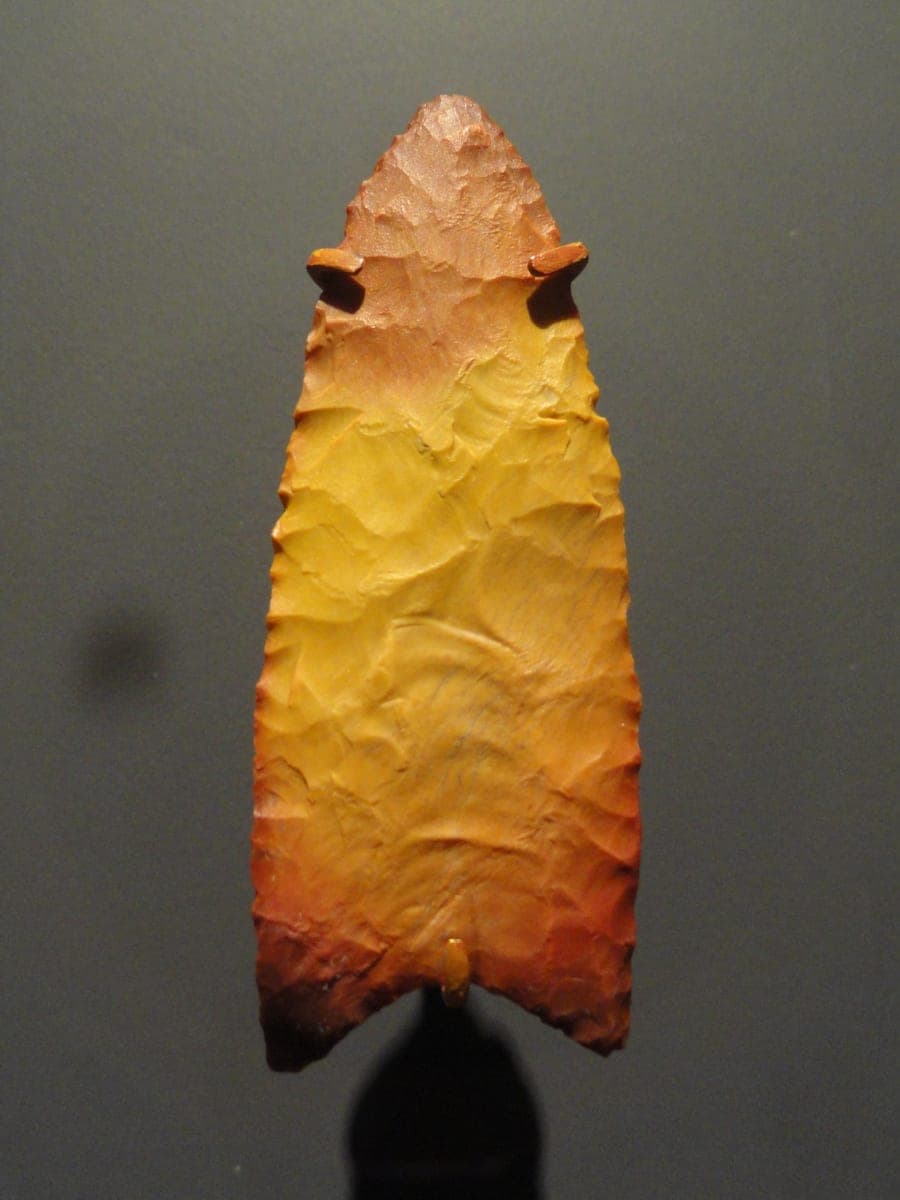
Look first at the base. A Dalton has a concave base with ears formed by a pinched-in waist at the hafting area, and the lower edges and basal concavity are ground smooth. Thinning flakes struck upward from the base can mimic a short flute, so a "fluted-looking" eared point with serrations is more likely Dalton than Clovis. Above the haft, the blade edges are commonly serrated — small, regular teeth along the edge — but not beveled, which helps separate Dalton from several Early Archaic knives.
Size runs from about 20 to 120 mm long, with most examples in the 35 to 55 mm range, and 19 to 35 mm wide; the basal notch is typically 3 to 12 mm deep. The cross section ranges from elliptical to flattened, and flaking patterns vary from oblique or horizontal transverse to collateral to random.
Expect heavy resharpening. Daltons served as projectile tips, hafted knives, and saws, so many surviving examples are worked down to short, steep-edged blades on an untouched base — the base is the reliable part to identify. Makers chose high-quality and sometimes exotic stone and heat-treated materials that benefited from it.
Age and where it's found
Dalton dates to roughly 10,500-8,500 B.P., in the early Holocene. Researchers debate the exact span — some would extend the type until the stemmed and notched forms of the Early Archaic take over — but it firmly occupies the Paleo-to-Archaic transition, and the Dalton pattern of multi-purpose points continues into later Early Archaic types.
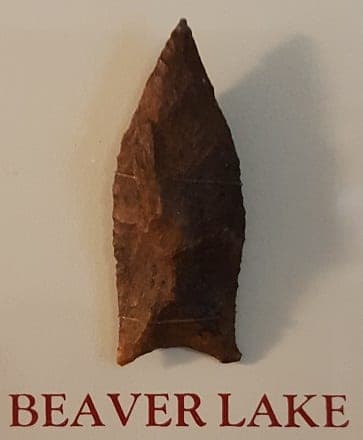
The type is most common along the middle and lower stretches of the Mississippi valley and in the Tennessee River valley, with thinner distribution through the Ohio valley, across the eastern U.S., and up into southeastern Canada. The family is large: named relatives include Beaver Lake, Quad, Hi-Lo, and a string of regional Dalton varieties such as Greenbrier, Colbert, and Sloan. Out on the Plains, the similar Meserve point may simply be lanceolate points resharpened Dalton-style.
Think you found a Dalton?
Upload a photo and our shape-matching AI will compare it against 1,000+ documented point types — with an honest read on how well it fits.
More type guides