How Old Is the Oldest American "Arrowhead"? Inside the Pre-Clovis Debate
For decades Clovis points marked the first Americans. Then Monte Verde, Cooper's Ferry, and 23,000-year-old footprints at White Sands rewrote the timeline — and the argument is still running.
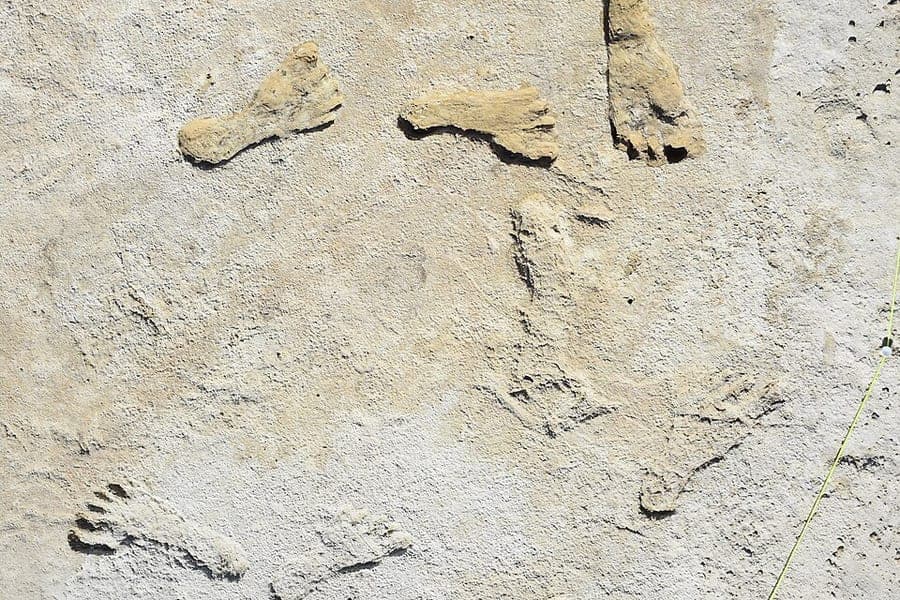
A trackway of seven human footprints in Ice Age gypsum at White Sands National Park, New Mexico — dated to roughly 21,000–23,000 years ago, thousands of years before Clovis.
Photo: National Park Service · NPGallery via Wikimedia Commons · Public domain
At a glance
- Most “arrowheads” aren’t. The bow reached most of North America only within the last ~1,500–2,000 years; the big early points tipped spears and atlatl darts.[1]
- Clovis is about 13,000 years old — 13,050–12,750 years by the tightest current dating — and was the accepted starting line for most of a century.[3]
- Monte Verde, Chile (~14,500 years) broke “Clovis First” when a delegation of skeptics visited in 1997 and conceded.[4]
- White Sands footprints (~21,000–23,000 years) are the oldest evidence yet, dated three independent ways — but they are footprints, not tools.[12][13][14]
Start with a technicality that surprises almost everyone: the oldest American “arrowheads” aren’t arrowheads. The bow arrived in most of North America only within roughly the last 1,500–2,000 years,[1] which makes small true arrow points like the Madison Triangle among the youngest stone tools you can find. The big, early points that anchor this story tipped spears and atlatl darts — thrown, not shot. Collectors call everything an arrowhead anyway, and archaeologists have learned to live with it.
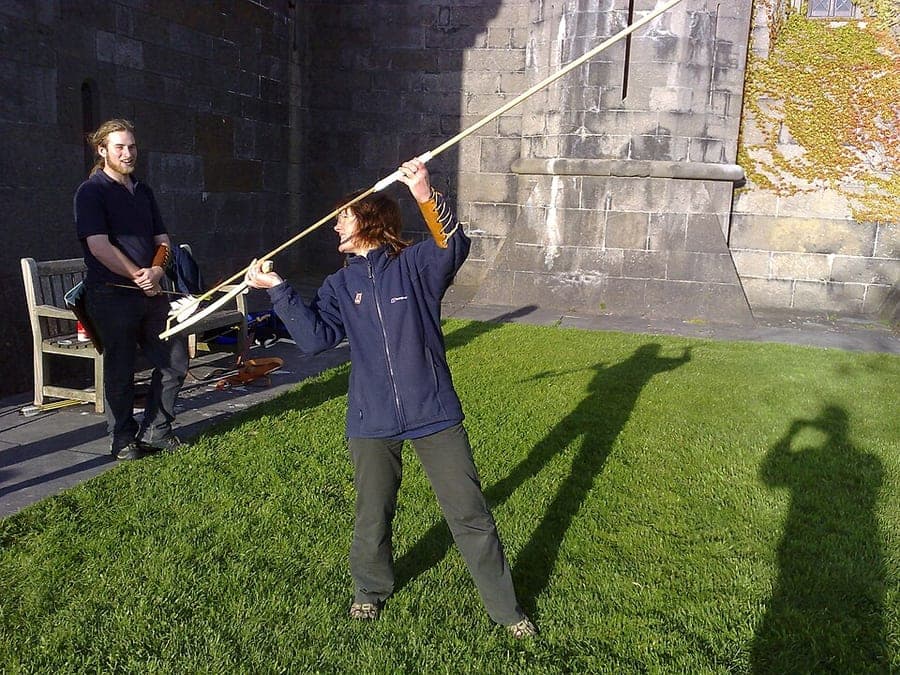
A dart seated on an atlatl, ready to launch. This is what most of the “arrowheads” in a collection were actually made for.
Photo: Richard Keatinge · Wikimedia Commons · CC BY-SA 3.0
For most of a century, the deepest layer of that story had one name on it: Clovis. How that certainty formed, how it came apart, and what has replaced it is one of the best scientific arguments of our time — and it is still running.
The Clovis benchmark
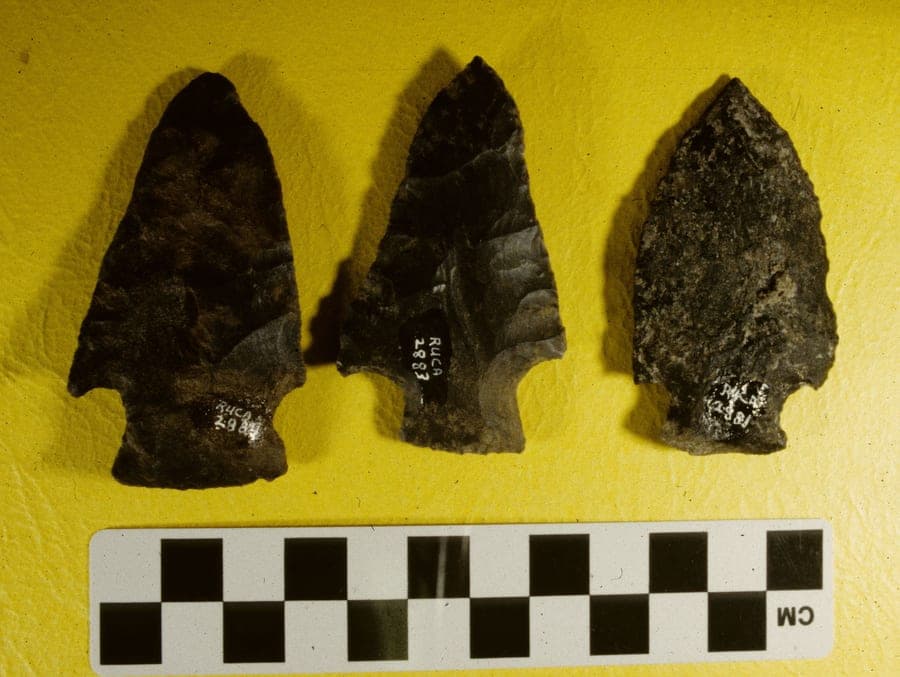
In 1932 a Philadelphia paleontologist named Edgar B. Howard visited a gravel pit at Blackwater Draw, near Clovis, New Mexico, and by the next summer had a crew digging.[2] What came out was extraordinary: large, distinctively fluted spear points lying among the bones of mammoths. The Clovis Fluted point became the signature of what looked like the founding culture of the Americas — a horizon of big-game hunters whose technology spread across the continent about 13,000 years ago. The tightest modern dating squeezes Clovis into a window of only a few centuries, 13,050 to 12,750 years ago.[3]
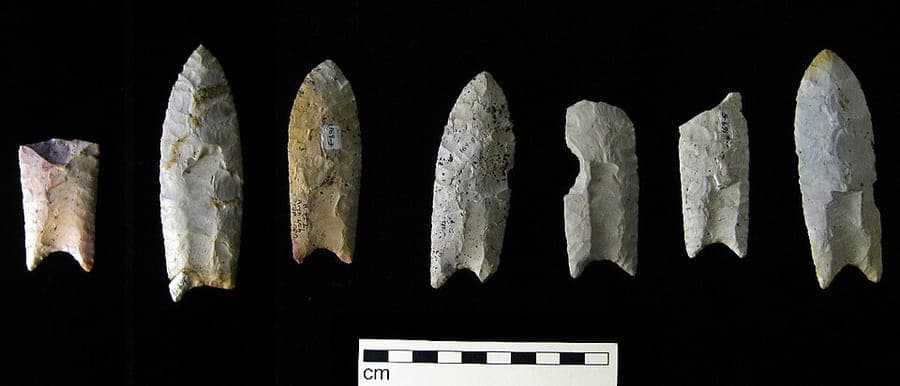
Clovis points from the Rummells-Maske cache, Cedar County, Iowa. For most of a century, this was where the story of the first Americans began.
Photo: Bill Whittaker · Wikimedia Commons (Iowa Office of the State Archaeologist collection) · CC BY-SA 3.0
Skepticism did its job. Until it met a site it couldn’t break.
“Clovis First” hardened into textbook orthodoxy: no credible site could be older, and for decades, claims that seemed older were dismissed, often harshly. The orthodoxy wasn’t unreasonable. Clovis sites were well dated and continent-wide, and most “older” claims really did fall apart under scrutiny — bad stratigraphy, contaminated dates, naturally broken rocks mistaken for tools.
The dam breaks at Monte Verde
Monte Verde is a waterlogged site in southern Chile — about as far from the Bering land bridge as you can get in the Americas. A peat bog sealed the camp and preserved what almost never survives: wooden structures, plant remains, hide, and unmistakable artifacts, dated to roughly 14,500 years ago, comfortably older than Clovis.[5] After years of argument, a delegation of prominent skeptics visited the site in January 1997, examined the collections and the ground, and conceded in print.[4] Clovis First had its first confirmed exception, and the door it opened has never closed.
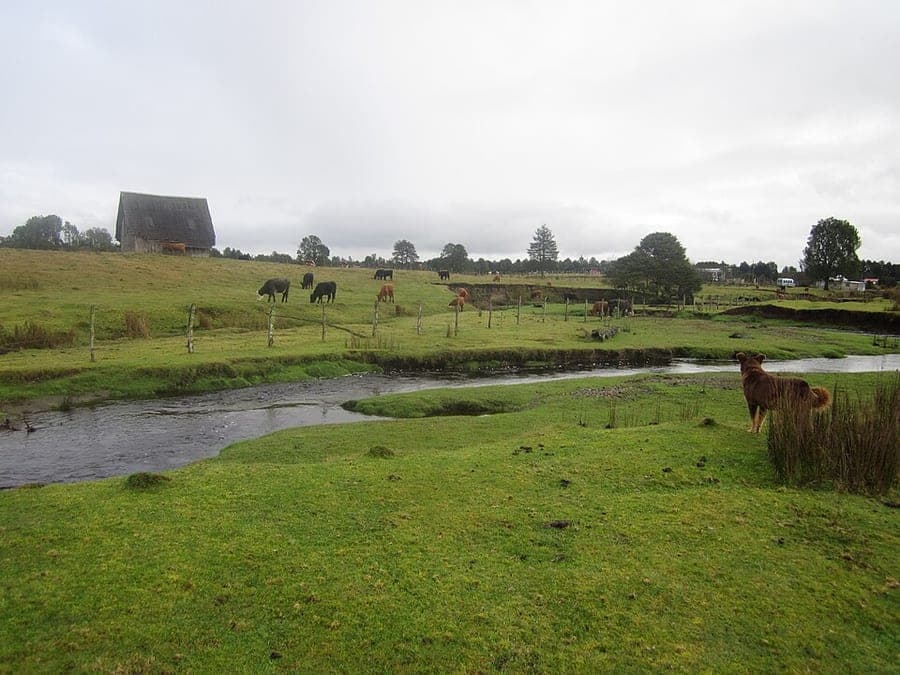
The Monte Verde site in southern Chile. A peat bog sealed the camp and preserved wood, plants and hide — the kind of evidence that finally forced a rewrite of the timeline.
Photo: Geología Valdivia · Flickr via Wikimedia Commons · CC BY 2.0
The evidence stacks up
Since Monte Verde, the pre-Clovis evidence has piled up across the continent, and it comes from every kind of site. In a submerged sinkhole of Florida’s Aucilla River, the Page-Ladson site yielded stone tools alongside butchered mastodon remains around 14,550 years old.[6] Coprolites from Paisley Caves in Oregon carried human DNA at about 14,000 years.[7] At Cooper’s Ferry, Idaho, stemmed points sit in layers roughly 16,000 years old,[8] with a large tool assemblage dated to about 15,800 years.[9] At the Gault site in Texas (and the neighboring Friedkin site), an artifact-bearing horizon lies beneath the Clovis layer, older than about 16,000 years.[10] Genetics points the same way: ancient and modern Indigenous genomes place founding populations in the Americas by roughly 15,000–17,000 years ago.[11]
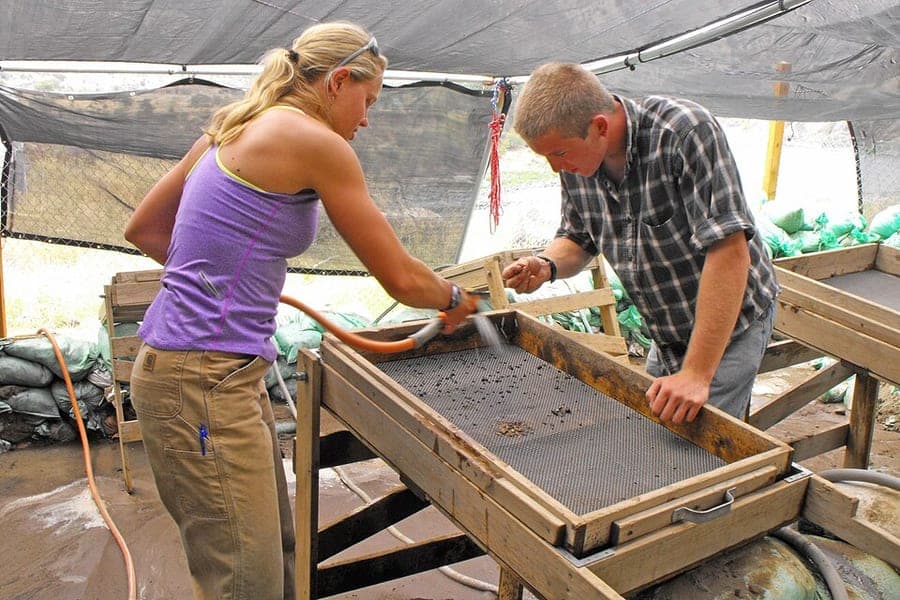
Field-school excavation at Cooper’s Ferry, Idaho, where stemmed points sit in layers about 16,000 years old.
Photo: Bureau of Land Management · Flickr via Wikimedia Commons · Public domain
The evidence, oldest to youngest
- ~23,000–21,000 years ago
White Sands, New Mexico — footprints
Human trackways in ancient lakebed sediment, dated three independent ways: seeds, then pollen and quartz grains, then the lake mud itself.[12][13][14] No tools have been tied to them.
- ~16,000 years ago
Cooper’s Ferry, Idaho — stemmed points
Stemmed projectile points and other tools in the deepest layers above the Salmon River.[8][9]
- Before ~16,000 years ago
Gault, Texas — early tools
An artifact-bearing horizon beneath the Clovis layer, dated by luminescence.[10]
- ~14,550 years ago
Page-Ladson, Florida — butchered mastodon
Stone tools with mastodon remains in a submerged sinkhole of the Aucilla River.[6]
- ~14,500 years ago
Monte Verde, Chile — the site that broke Clovis First
Wooden structures, plant food and hide sealed under peat; conceded by visiting skeptics in 1997.[4][5]
- ~14,000 years ago
Paisley Caves, Oregon — human DNA
Coprolites carrying human DNA, radiocarbon dated to about 14,000 years.[7]
- 13,050–12,750 years ago
Clovis — the old benchmark
Fluted points across the continent, now dated to a window of only about 300 years.[3]
- Within the last ~2,000 years
The bow and arrow
True arrow points — the small triangles collectors find most — spread across most of North America late in the story.[1]
White Sands: the outlier that keeps passing tests
Then came the finding that stretched the timeline much further. In 2021, researchers reported human footprints preserved in ancient lakebed sediments at White Sands National Park, New Mexico, dated by seeds in the footprint layers to roughly 21,000–23,000 years old — deep in the last Ice Age, ten thousand years before Clovis.[12]
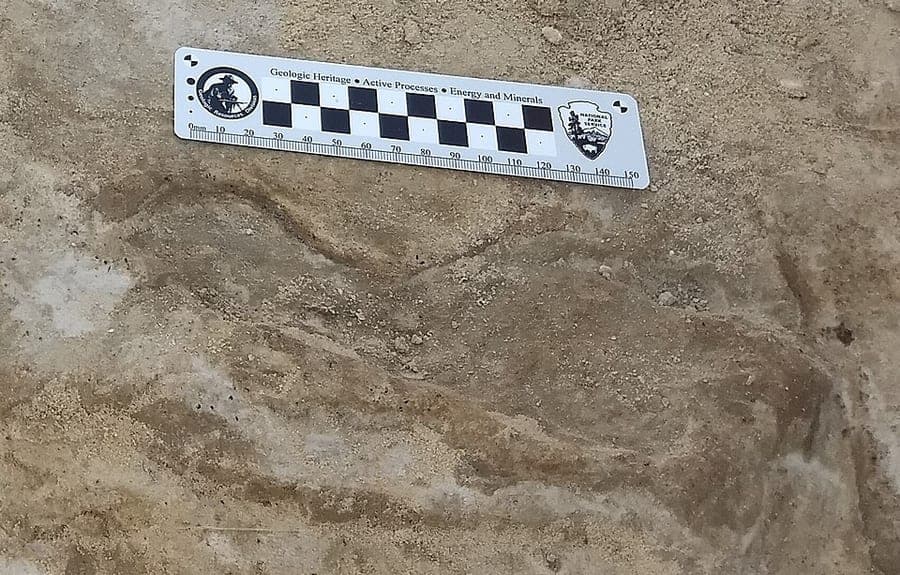
A single White Sands footprint with the black ditchgrass seeds that gave the first radiocarbon dates. The seeds are why the critics pushed back — and why the team went looking for two more clocks.
Photo: National Park Service · NPGallery via Wikimedia Commons · Public domain
Each round of testing has made the footprints harder to dismiss. They still aren’t tools.
The critiques were serious and specific: aquatic seeds can absorb old carbon from lake water and date too old. So the team came back in 2023 with two independent clocks — pollen dating and optically stimulated luminescence on the quartz grains themselves — and got the same answer.[13] A 2025 study dating the ancient lake mud landed in the same window again, and dozens of radiocarbon dates from the footprint layers now agree.[14] The result hasn’t convinced everyone, but each round of testing has made it harder to dismiss.
What this means for what’s in your hand
The debate doesn’t demote your finds — it deepens their context. A Clovis Fluted or Folsom Fluted point is still among the oldest datable artifacts an ordinary person can encounter in North America, and later Paleo forms like Dalton and Agate Basin still mark the continent’s first well-understood cultures. Realistically, most field finds are younger — Archaic and Woodland types dominate plowed-field surfaces — but “younger” here still means thousands of years old.
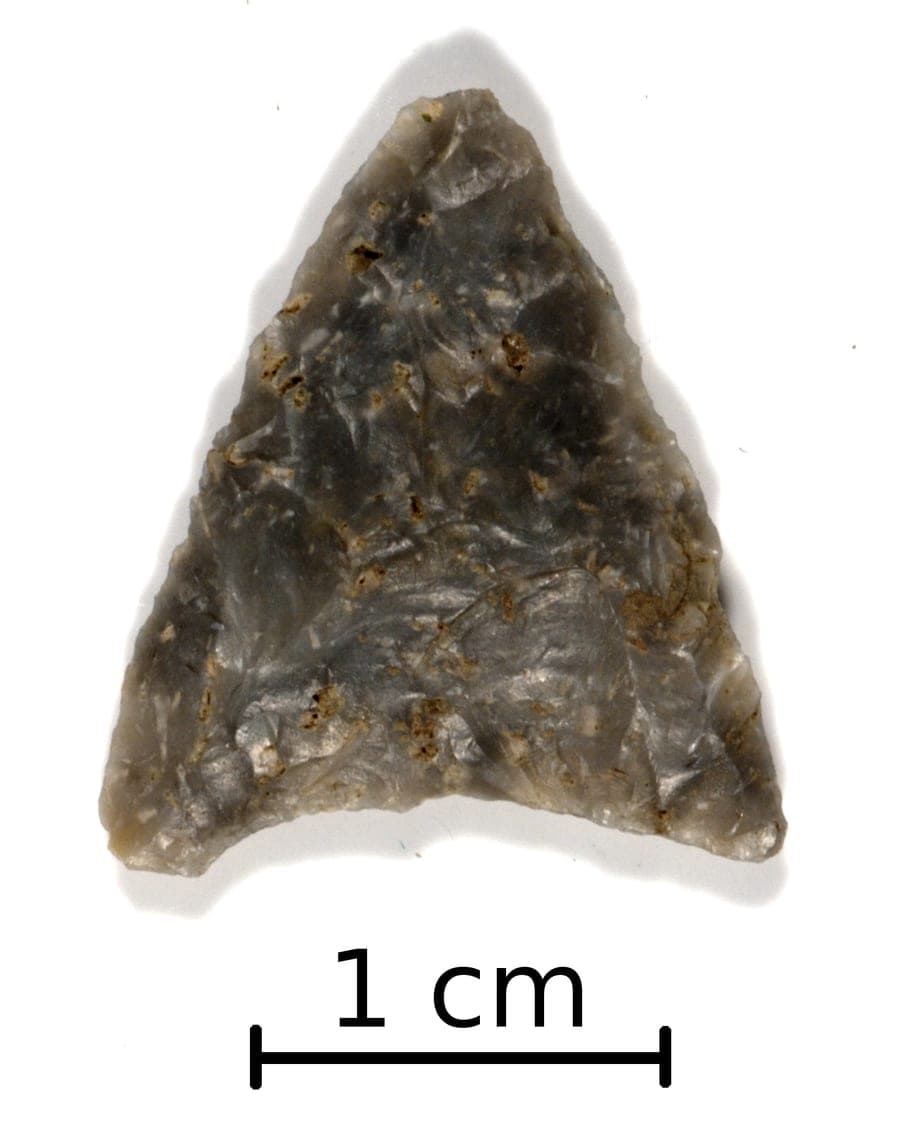
This one really is an arrowhead: a Levanna triangle, a true arrow point from the last thousand-odd years, shown at 1 cm scale. Almost everything older and larger in this story tipped a spear or an atlatl dart.
Photo: PAR · Wikimedia Commons · Public domain
And the honest bottom line, for science and for collecting alike: the story of the first Americans is not settled. The evidence says people were here earlier than the textbooks of thirty years ago allowed. How much earlier, and carrying what tools, is exactly what is still being dug up.
Related type guides
Found a point that might be Paleo?
Fluted and early lanceolate forms have distinctive shapes our matching engine knows well. Get an honest read on what you're holding.
Run a free Quick CheckReferences
- 1.Blitz, J. H. (1988). Adoption of the bow in prehistoric North America. North American Archaeologist. DOI
- 2.Boldurian, A. T. (2008). Clovis type-site, Blackwater Draw, New Mexico: A history, 1929–2009. North American Archaeologist. DOI
- 3.Waters, M. R., et al. (2020). The age of Clovis — 13,050 to 12,750 cal yr B.P. Science Advances. DOI
- 4.Meltzer, D. J., et al. (1997). On the Pleistocene antiquity of Monte Verde, southern Chile. American Antiquity. DOI
- 5.Dillehay, T. D., et al. (2008). Monte Verde: Seaweed, food, medicine, and the peopling of South America. Science. DOI
- 6.Halligan, J. J., et al. (2016). Pre-Clovis occupation 14,550 years ago at the Page-Ladson site, Florida, and the peopling of the Americas. Science Advances. DOI
- 7.Gilbert, M. T. P., et al. (2008). DNA from pre-Clovis human coprolites in Oregon, North America. Science. DOI
- 8.Davis, L. G., et al. (2019). Late Upper Paleolithic occupation at Cooper’s Ferry, Idaho, USA, ~16,000 years ago. Science. DOI
- 9.Davis, L. G., et al. (2022). Dating of a large tool assemblage at the Cooper’s Ferry site (Idaho, USA) to ~15,785 cal yr B.P. extends the age of stemmed points in the Americas. Science Advances. DOI
- 10.Williams, T. J., et al. (2018). Evidence of an early projectile point technology in North America at the Gault Site, Texas, USA. Science Advances. DOI
- 11.Moreno-Mayar, J. V., et al. (2018). Terminal Pleistocene Alaskan genome reveals first founding population of Native Americans. Nature. DOI
- 12.Bennett, M. R., et al. (2021). Evidence of humans in North America during the Last Glacial Maximum. Science. DOI
- 13.Pigati, J. S., et al. (2023). Independent age estimates resolve the controversy of ancient human footprints at White Sands. Science. DOI
- 14.Holliday, V. T., et al. (2025). Paleolake geochronology supports Last Glacial Maximum (LGM) age for human tracks at White Sands, New Mexico. Science Advances. DOI
Further reading
Keep reading