Cumberland Fluted Projectile Point: Identification, Age & Range
Cumberland Fluted points date to 11,000-9,000 B.P. in the Cumberland and Tennessee River basins, with long full-face flutes and flared basal ears.
At a glance
Period
11,000 - 9,000 B.P. · Late Paleo
Typical size
35–105 mm long, 15–25 mm wide
Region
This point is primarily found in the Cumberland River basin and through-out the Tennessee River basin.
The Cumberland Fluted point is a Late Paleo type of the mid-South, dating to about 11,000-9,000 B.P. It is the Southeast's answer to the long-fluted tradition: while it shares sites with Clovis and Dalton points, its fluting technique appears closer to Folsom's. Thomas N.M. Lewis named the type in 1954 after the Cumberland Valley spanning Tennessee and Kentucky, and early literature sometimes called it the Ohio Fluted point.
For a finder in Tennessee, Kentucky, or northern Alabama, a slender fluted point with a pinched waist is one of the most exciting identifications to confirm — Cumberland is far less common than Clovis, and the two are regularly confused.
How to identify a Cumberland Fluted point
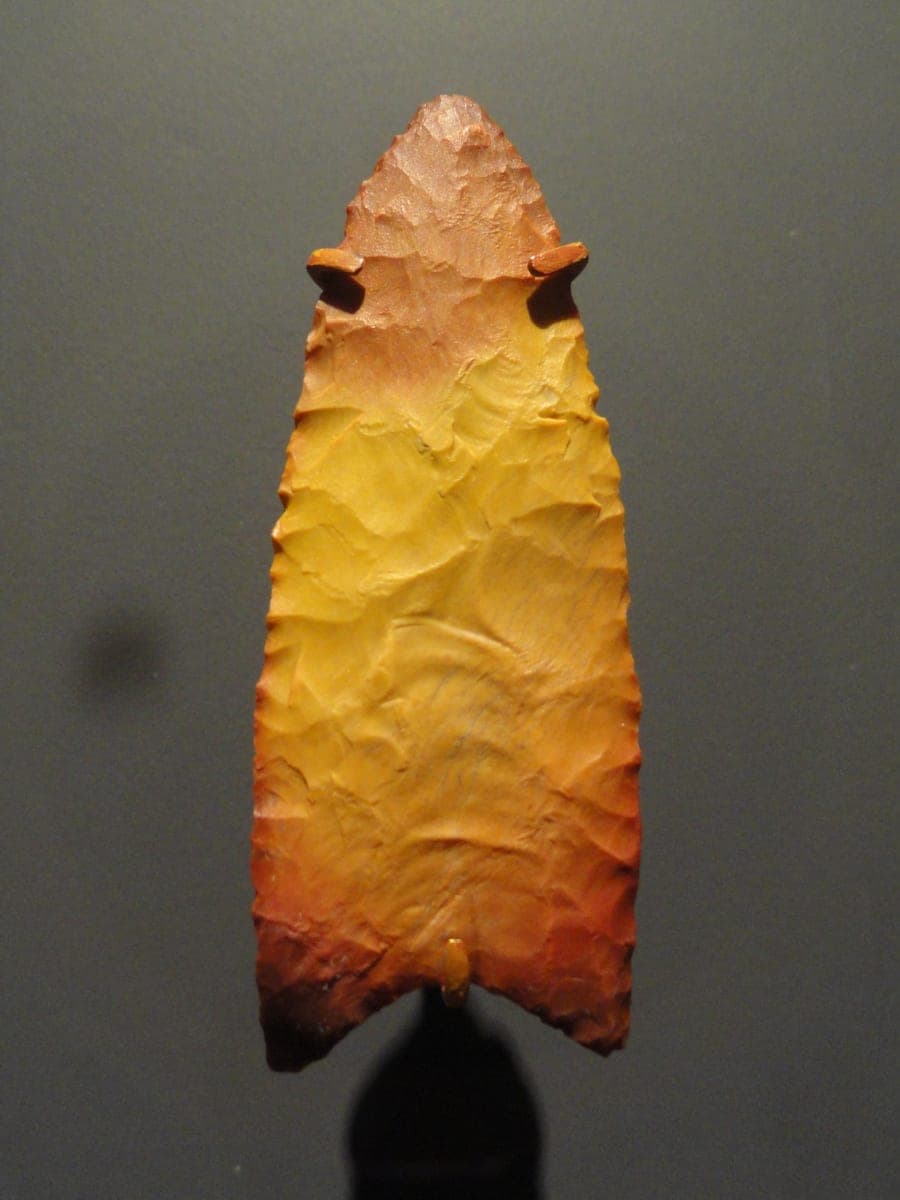
Shape is the first clue. A Cumberland is a narrow lanceolate whose hafting area pinches into a waist; the edges sweep back out below it to form flared ears, giving the point a graceful recurved outline. The base is concave, and grinding on the lower edges can extend a third of the way up the point or more.
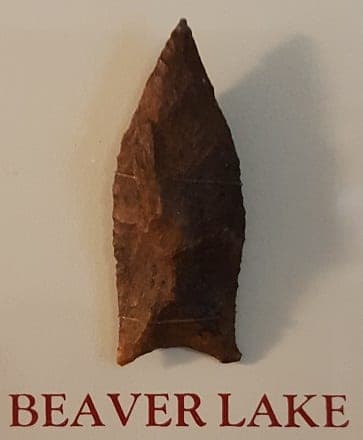
Now check the flute. Both faces carry a long channel flake running from a third of the face up to its entire length — much farther than the short flutes on a Clovis. Where the flute stops short of the tip, the unfluted upper blade shows a median ridge, so the cross section is flattened through the fluted zone and elliptical above it. Short flake scars at the base mark where the fluting platform was trimmed away by pressure flaking. An otherwise identical point with no flutes is not a classic Cumberland — that form matches Beaver Lake, sometimes nicknamed the Unfluted Cumberland.
Expect lengths of about 35 to 105 mm, widths of only 15 to 25 mm, and thickness between 3.5 and 8 mm, with a collateral flaking pattern. Cherts, flints, and jasper are the usual materials. The northern relative Cumberland Barnes carries the same technology into the Great Lakes region.
Age and where it's found
Cumberland dates to roughly 11,000-9,000 B.P., spanning the late Pleistocene into the early Holocene during the Late Paleo period.
The core territory is the Cumberland River basin and the Tennessee River basin, with lower frequency into the Mississippi and Ohio basins. Scattered examples reach the Great Lakes, and a handful of reported finds extend to Minnesota, Ontario, Quebec, Nova Scotia, and Maine — though those far-northeastern points overlap with the similar Debert type and may represent Debert variations rather than true Cumberlands.
Think you found a Cumberland Fluted?
Upload a photo and our shape-matching AI will compare it against 1,000+ documented point types — with an honest read on how well it fits.
More type guides