Clovis Fluted Projectile Point: Identification, Age & Range
Clovis Fluted points date to 15,000-10,000 B.P. (Paleo period) and occur across the eastern U.S., recognized by basal flutes and heavy edge grinding.
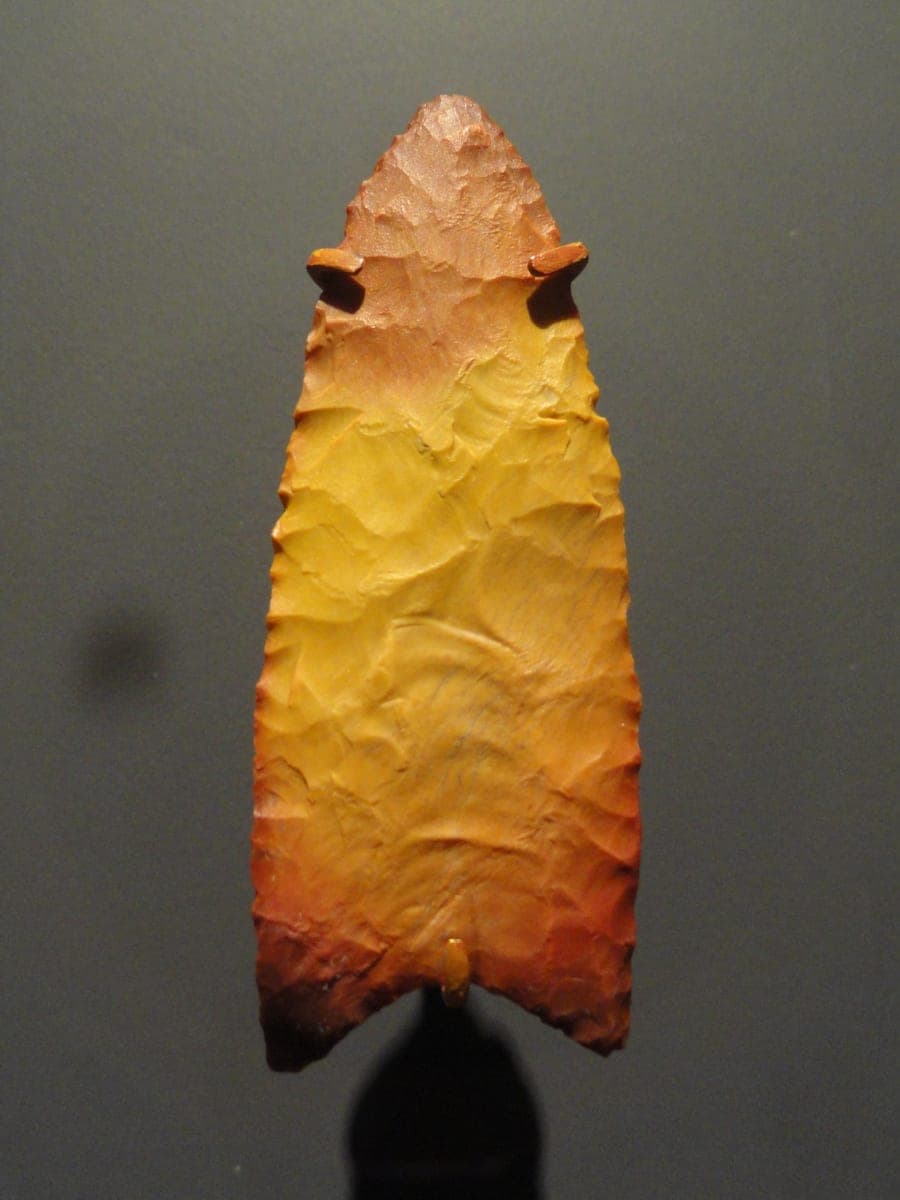
Photo: Daderot · Wikimedia Commons (photo taken at the Natural History Museum of Utah) · CC0 1.0
At a glance
Period
15,000 - 10,000 B.P. · Paleo
Typical size
45–150 mm long, 20–45 mm wide
Region
This point has the heaviest concentrations through-out the Ohio, Tennessee, and Mississippi River basins and the eastern United States (red).
The Clovis Fluted point is the most famous projectile point in North America, made by some of the continent's earliest known inhabitants between 15,000 and 10,000 B.P. These were spear and dart tips used by Paleo hunters during the late Pleistocene, and they are strongly associated in the archaeological record with hunting now-extinct Ice Age animals such as mammoths. The type takes its name from the Clovis Site at Blackwater Draw in Curry County, New Mexico, where Edgar B. Howard identified it in 1935.
Because "Clovis" has become shorthand for almost any fluted Paleo point, many finds get that label first and questioned later. Regional variants exist — some formally named as subtypes such as Redstone, Ross County, and Debert — so classification of fluted points remains actively debated.
How to identify a Clovis Fluted point
Start with the flute: a broad, shallow channel scar that begins at the base and travels up the point's face. On a Clovis, the flute usually appears on both faces but sometimes only one, and it typically travels about one fifth to one third of the way up the blade — noticeably shorter than the near-full-length flutes on Folsom points. The channel often ends abruptly in a small step or hinge where the flake broke away.
The overall form is a thin triangular outline that sits flat in cross section. Blade edges curve gently outward or show a slight recurve, and the base is concave. Bases vary: some examples have small ears, some have edges that expand or contract toward the base, so the outline can read as either eared or lanceolate. Run a fingernail along the lower edges — genuine examples show medium to heavy grinding around the base and hafting area, a dulling done intentionally so the binding would not be cut.
Size varies widely, from about 45 to 150 mm long (roughly 2 to 6 inches) and 20 to 45 mm wide. Makers roughed out and thinned the blade by percussion, then finished the edges with finer pressure work; flake patterns range from random to collateral or transverse.
Age and where it's found
Clovis dates to roughly 15,000-10,000 B.P., placing it in the Paleo cultural period at the end of the last Ice Age. It is one of the oldest widely recognized point types on the continent.
Finds cluster most densely in the basins of the Ohio, Tennessee, and Mississippi rivers, and more broadly across the eastern United States. Numbers thin out on the Plains of the U.S. and Canada, and the type is rarely encountered west of the Continental Divide or in the far north. If you found a fluted point in a creek or field east of the Mississippi, Clovis is the first candidate to check — but compare it against Cumberland, Redstone, and other fluted forms before settling on the name.
Think you found a Clovis Fluted?
Upload a photo and our shape-matching AI will compare it against 1,000+ documented point types — with an honest read on how well it fits.
More type guides