Plainview Projectile Point: Identification, Age & Range
Plainview points (10,000-9,000 B.P.) are unfluted concave-base lanceolates of the Plains bison-hunting tradition, found from Texas to Alberta.
At a glance
Period
10,000 - 9,000 B.P. · Transitional Paleo
Typical size
45–95 mm long, 18–28 mm wide
Region
This point is commonly found on the plains from Texas to Alberta.
The Plainview is an unfluted lanceolate of the Plains bison-hunting tradition, dating to the Transitional Paleo period. Elias H. Sellards — working with colleagues Grayson E. Meade and Glen L. Evans — named it in 1947 for the Plainview site on Running Water Draw in Hale County, Texas. At first glance a Plainview can pass for a Clovis without the flute, which is exactly why finders on the Southern Plains often need a second look to sort one out.
How to identify a Plainview point
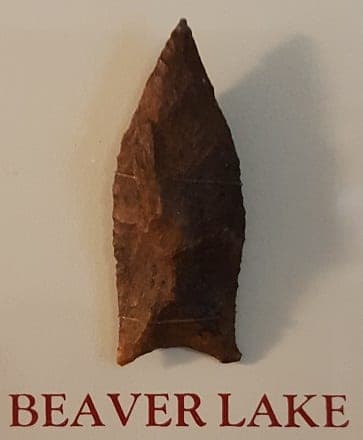
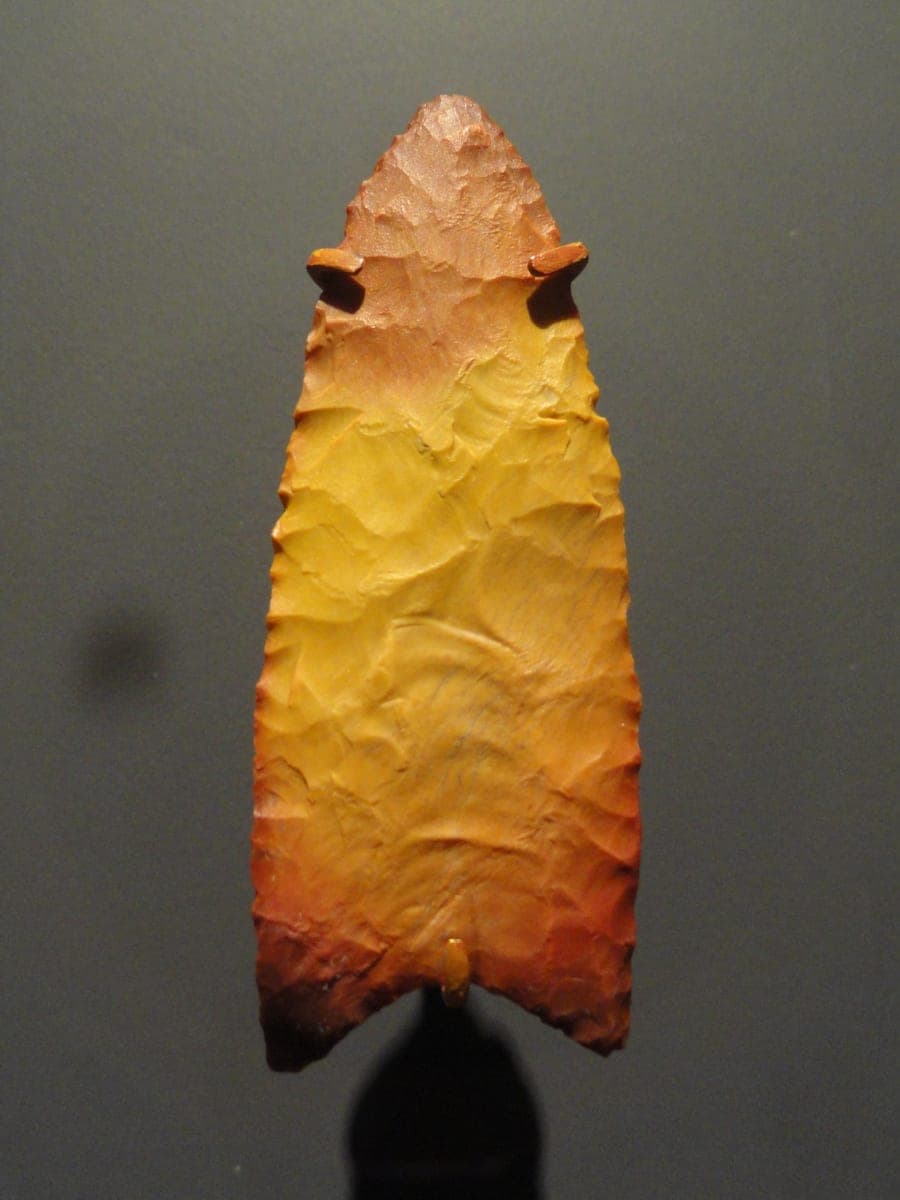
The outline is a slim lanceolate: edges essentially straight and parallel through the lower blade, curving gently inward toward the tip, which on some examples turns in abruptly. A few pieces show slight ear-like corners at the base. The base is concave — anywhere from a shallow 1 mm dip to a pronounced 8 mm hollow — and the basal edge and hafting margins are commonly ground smooth.
The key trait separating Plainview from fluted types is how the base was thinned. Instead of a true channel flute, Plainview bases carry long thinning flakes struck up the faces. These can superficially resemble short flutes, but they lack the single deep channel of Clovis or Folsom. The cross section is flattened to elliptical, though cruder examples can show a median ridge. Makers roughed out the preform by percussion and finished with controlled pressure flaking in transverse parallel to collateral patterns. Length runs 45 to 95 mm — most examples sit in the 65 to 90 mm range, about the length of a credit card or a bit more — with blade width of 18 to 28 mm and basal width of 20 to 26 mm.
Age and where it's found
Plainview dates to roughly 10,000 to 9,000 B.P., in the late Pleistocene to early Holocene. At the Lake Theo site in Texas, Plainview material lay between Folsom and Archaic deposits. Justice considers the type related to Dalton, and it belongs to the Plano Lanceolate cluster along with Midland, Milnesand, Hell Gap, Angostura, and Browns Valley. The similar Goshen point is thought to be older, and points once called Coastview in Texas have been folded back into Plainview.
The core range is the Plains corridor from Texas north to Alberta, with finds at lower frequency outside the Plains and reports from the Valley of Mexico and Tehuacan Valley. Texas and Oklahoma examples tend to be older, while Canadian and Mexican examples tend to be younger — MacNeish suggested the type arose in Texas and spread outward, persisting on the fringes after it faded in its homeland.
Think you found a Plainview?
Upload a photo and our shape-matching AI will compare it against 1,000+ documented point types — with an honest read on how well it fits.
More type guides