How Arrowheads Are Actually Authenticated
What professional authenticators really examine — material, patina, flaking forensics, use-wear, provenance — and where photo-based AI screening honestly fits.
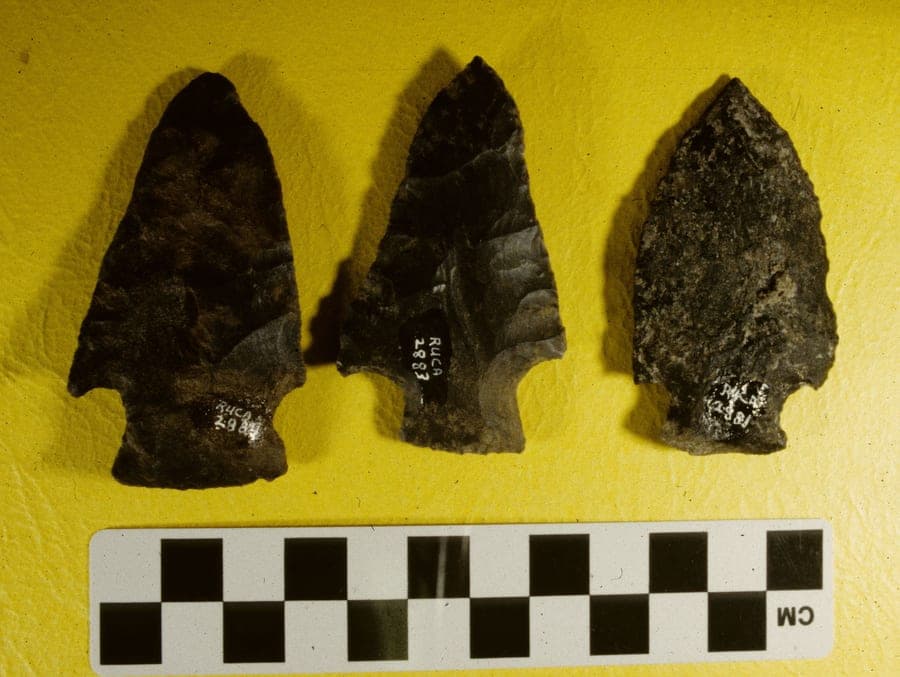
Three Kirk corner-notched points from a National Park Service collection, each carrying a painted catalogue number and photographed with a scale bar. That is what documentation looks like: the number ties each stone to a record of where it came from.
Photo: National Park Service · Wikimedia Commons (National Park Service / NPGallery) · Public domain
At a glance
- Five layers, each catching a different kind of fake: material and typology, surface history, flaking forensics, use-wear, and provenance.
- Patina forms after the flaking, so on a genuine piece it runs continuously across every scar; fresh work cuts through it.[1]
- Use-wear is readable under a microscope: polish and striations concentrate where a working tool actually wore.[2]
- Provenance is the strongest single signal — and the hardest thing to fake retroactively.
Authentication has a mystique problem. Collectors mail a point to a well-known name, a certificate of authenticity comes back, and the process in between stays a black box. But there is no magic in that box. Inside it is a stack of specific, learnable examinations, and each one catches a different kind of fake. Knowing what they are makes you a sharper buyer even if you never authenticate anything yourself.
There’s no magic in the box — there’s a stack of specific, learnable examinations, each of which catches a different kind of fake.
Material and typology: does the piece make sense?
The first checks are contextual. Is the stone right for the claimed type and region? Prehistoric knappers overwhelmingly used local and regionally traded materials, and documented types have known material profiles — a point claimed from a Tennessee creek made of a stone that outcrops a thousand miles away needs explaining. Then the shape itself: real types are consistent in their proportions, base treatment, and workmanship, which is why type identification is step one of authentication, not a separate hobby.
Fakes tend to fail this test in a particular way. They blend traits from several types, or they render a famous form at a size or symmetry its makers never produced — the “perfect” Clovis that is a little too long, a little too even, a little too much like the photograph its maker was working from.
Surface history: patina, mineralization, and soil sheen
Stone that has been buried for thousands of years records it chemically. Weathering rinds and patina develop as the surface slowly alters,[1] minerals precipitate into microscopic crevices, and soil movement leaves a soft polish. Crucially, all of it forms after the flaking. On a genuine piece, patina flows continuously across flake scars. On a re-worked or freshly made piece, new scars cut through the old surface and read brighter and rawer than their surroundings.
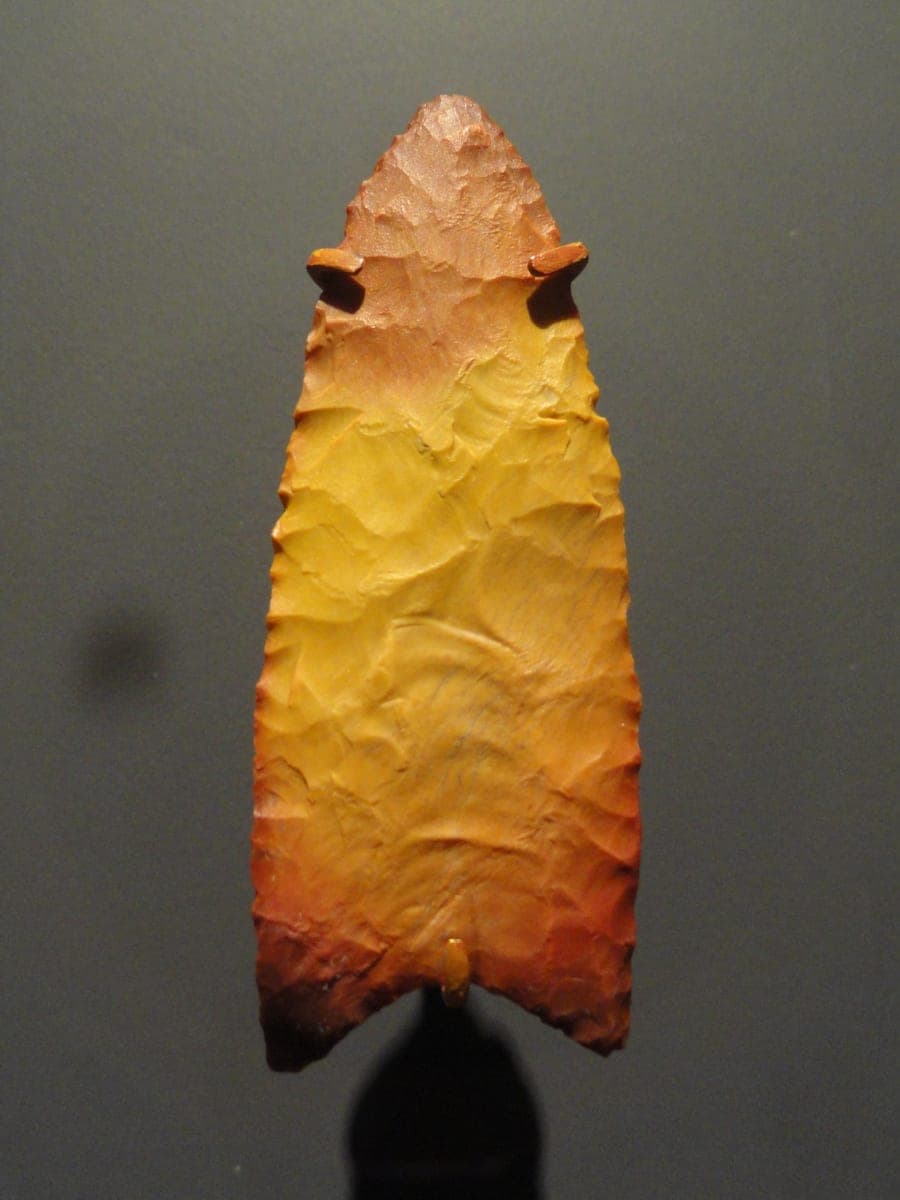
A Clovis fluted point in a museum collection. The weathered surface and colour banding are the kind of thing an authenticator reads under hard light: on a genuine piece the patina formed after the flaking, so it runs continuously across every scar.
Photo: Daderot · Wikimedia Commons (photo taken at the Natural History Museum of Utah) · CC0 1.0
Patina is a clock that only starts after the last flake comes off.
Fakers know this, which is why artificial aging exists: acid etching, staining, tumbling, burial in prepared soil.[4] Done crudely, it produces a uniform dullness that looks nothing like differential natural weathering. Done well, it can be convincing to the naked eye — which is why authenticators bring magnification and hard, raking light, and why chemical patina is corroborated against every other line of evidence rather than trusted alone.
Flaking forensics and use-wear
Flake scars are a manufacturing record. An experienced eye reads the sequence — which flakes came first, how platforms were prepared, whether the rhythm matches the claimed technology.[3] Modern shortcuts leave signatures: copper and steel pressure tools bite differently than antler, and some fakes are simply too regular, the work of someone optimizing for beauty rather than function.
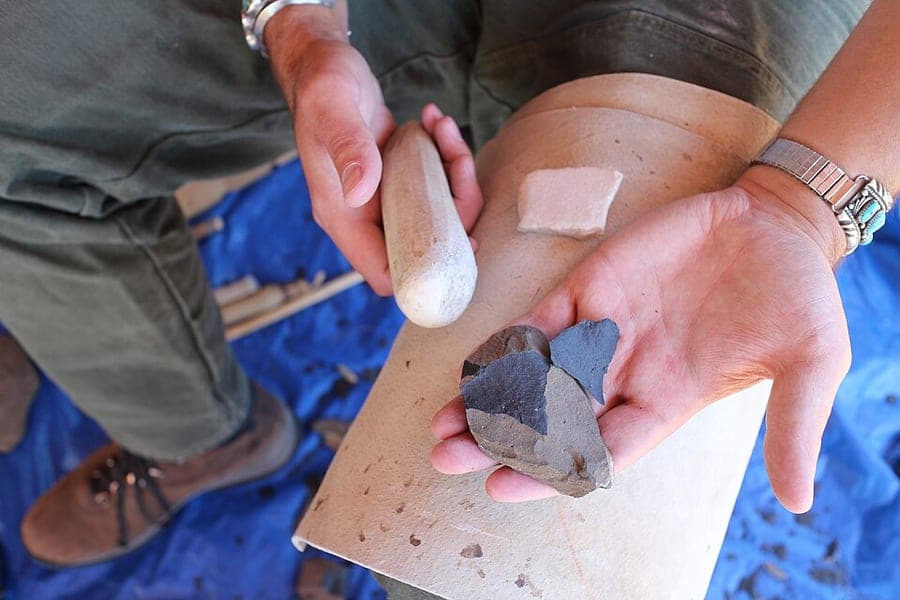
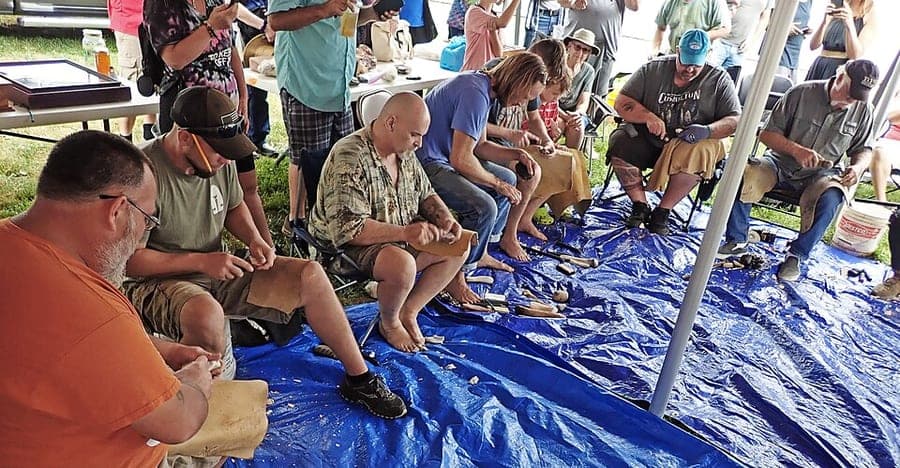
A flintknapping demonstration at Tonto National Monument. Every strike leaves a scar, and the sequence of scars is the manufacturing record an examiner reads.
Photo: Tonto National Monument (NPS) · Flickr via Wikimedia Commons · CC BY 2.0
Under magnification, genuine use adds another layer. Edge micro-damage, polish, and striations concentrate where a functioning tool would actually wear, often followed by ancient resharpening; the experimental work that established how to read those traces dates back to the 1970s.[2] Fake “use-wear” — deliberate edge grinding to simulate age — tends to be uniform and undirected in ways real use never is.
Provenance: the paper trail
A documented chain — old collection labels, field notes with dates and locations, auction records, a photograph of the piece taken decades ago — is extremely hard to fake retroactively, and it multiplies the credibility of everything else. This is why serious collectors preserve documentation obsessively, and why a spectacular point with zero history warrants proportional skepticism no matter how good it looks.
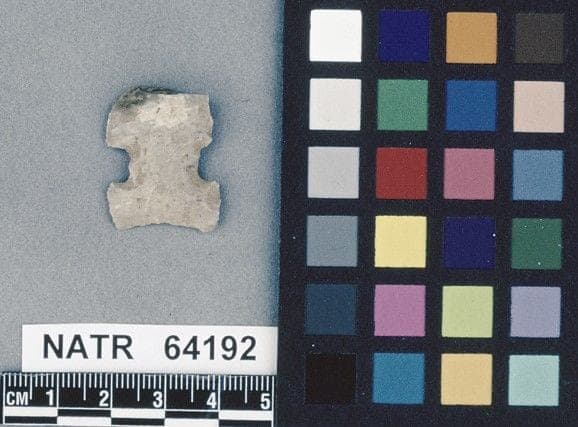
A catalogued Big Sandy base from the Natchez Trace Parkway. Even a broken piece keeps its evidentiary value when it keeps its paperwork.
Photo: R Bruhn, National Park Service · NPGallery (National Park Service Digital Asset Management System) · Public domain
The strongest single authenticity signal isn’t on the stone at all.
Where AI honestly fits
Photo-based AI screening — what we build — automates the first layers of this stack and makes them available before you buy, not weeks after. Our system matches a point’s shape against a reference corpus of 1,000+ documented types, checks proportions against published ranges, and reads visible surface and flaking evidence for consistency, returning a probability rather than a verdict. We publish measured accuracy numbers precisely because photo screening is a filter, not a certificate.
The practical workflow that follows from all this: screen photos early to catch obvious problems cheaply, insist on provenance for anything significant, and put physical examination by a professional authenticator at the top of the stack for high-stakes pieces. Each layer catches what the previous one can’t — which is exactly how it is supposed to work.
Related type guides
Want the first layers of this stack on your point?
A Quick Check gives you a fast risk read; an Authentication Report adds a documented report with type matching, evidence breakdown, and a shareable verification page.
Run a free Quick CheckReferences
- 1.Rottländer, R. (1975). The formation of patina on flint. Archaeometry. DOI
- 2.Keeley, L. H. (1980). Experimental Determination of Stone Tool Uses: A Microwear Analysis. University of Chicago Press. press.uchicago.edu
- 3.Whittaker, J. C. (1994). Flintknapping: Making and Understanding Stone Tools. University of Texas Press. utpress.utexas.edu
- 4.Whittaker, J. C., & Stafford, M. (1999). Replicas, fakes, and art: The twentieth century Stone Age and its effects on archaeology. American Antiquity. DOI
Further reading
Keep reading