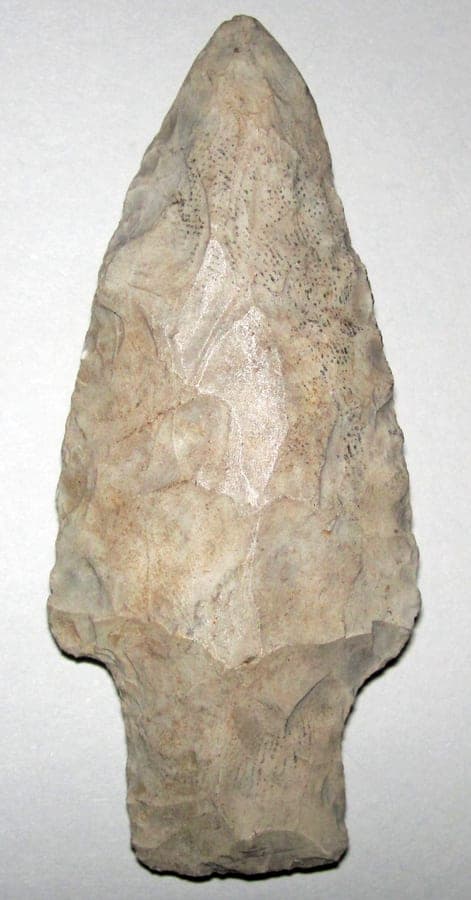
Pedernales Projectile Point: Identification, Age & Range
Pedernales points are Transitional Archaic dart points (3,000-2,000 B.P.) from central Texas, known for their deeply notched, bifurcated bases.
At a glance
Period
3,000 - 2,000 B.P. · Transitional Archaic
Typical size
30–130 mm long, 30–50 mm wide
Region
This point is primarily found in central Texas and into the lower Rio Grande region.
If you hunt creek gravel or plowed ground anywhere in the Texas Hill Country, the Pedernales point should be near the top of your study list. It is one of the most commonly encountered dart points in central Texas, and its split base makes it one of the easier large points to recognize. J. Charles Kelley defined the type in 1947 after studying examples from the Pedernales River area on the Edwards Plateau; older literature sometimes calls it the Pedernales Indented Base, and Cambron used the spelling Pedernalis.
How to identify a Pedernales point
Most Pedernales points run about 60 to 90 mm long (call it two and a half to three and a half inches), though the documented range stretches from 30 to 130 mm. Blades measure 30 to 50 mm across at the shoulders and are thin for their size, usually just 5 to 7 mm thick, and the cross section is flattened. The outline is triangular, with edges that are gently convex to straight on fresh examples; pieces that were resharpened many times can show concave or S-curved edges instead.
The base is the trait to check first. Classic examples are bifurcated: a notch about 5 to 8 mm deep splits the bottom of the stem into two lobes, and striking out that notch sometimes left a short flute-like scar running up one or both faces. Not every example is this obvious. On some points the base is only slightly concave, and those are far easier to confuse with other stemmed types. The stem itself is usually straight-sided, occasionally tapering a little, around 15 to 20 mm long, and unlike many Archaic dart points it rarely shows grinding along the hafting edges.
Shoulders are prominent and usually barbed, but the barbs shrank each time the blade was resharpened, and heavily reworked pieces can lose their shoulders almost entirely and take on a lanceolate look. Workmanship is generally high, with a random flaking pattern, and makers often used local central Texas cherts, including the distinctive amoeba-patterned chert of the Pedernales River country.
Age and where it's found
Pedernales points date to roughly 3,000 to 2,000 B.P., placing them in the Transitional Archaic. They are concentrated in central Texas, extending downstream toward the lower Rio Grande, with numbers thinning toward the Texas coast and the Trans-Pecos.
Occasional finds turn up well outside that core: Cambron recorded examples at shelter and shell mound sites in Alabama, and Suhm and Krieger considered such distant occurrences likely intrusive, meaning the points probably traveled rather than being made locally.
Think you found a Pedernales?
Upload a photo and our shape-matching AI will compare it against 1,000+ documented point types — with an honest read on how well it fits.
More type guides