Harrison Turkeytail Projectile Point: Identification, Age & Range
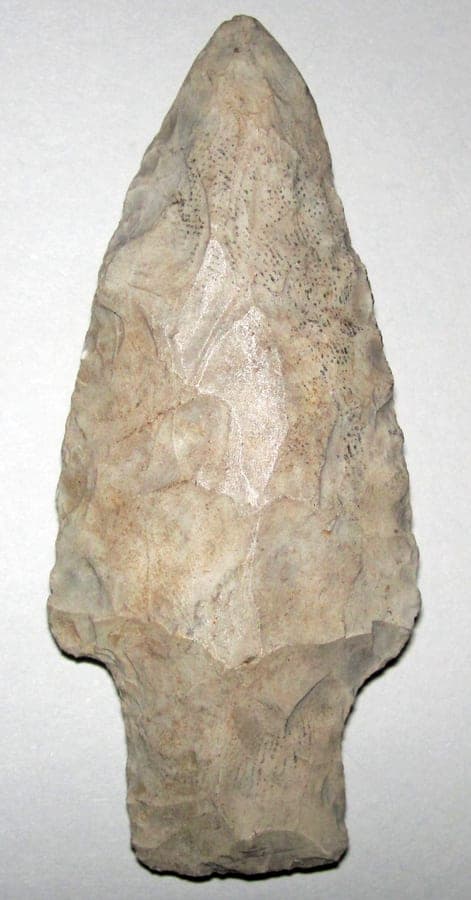
Harrison Turkeytail is a Late Archaic to Early Woodland point, 4,000-2,500 B.P., with a pointed tail-like base, concentrated in the Ohio River Valley.
At a glance
Period
4,000 - 2,500 B.P. · Late Archaic to Early Woodland
Typical size
50–203 mm long, 22–41 mm wide
Region
This point has the heaviest concentration in the Ohio River Valley.
Few point types are as instantly recognizable as the turkeytail. Notch a long, slender blade near the bottom and let the base taper to its own small point, and the result resembles the fanned tail of a wild turkey, which is how the family got its name. The Harrison variety, defined by the influential archaeologist Lewis R. Binford in 1963, takes its name from Harrison County, Indiana, and dates to 4,000-2,500 B.P., spanning the Late Archaic into the Early Woodland period and associated with the Adena culture.
Turkeytails are frequently found in caches and burial contexts rather than as lost hunting equipment, so a fresh plow-field find of one is a notable event for any collector in the Midwest.
How to identify a Harrison Turkeytail point
The base tells you almost everything. On a Harrison Turkeytail, the blade narrows through a pair of shallow notches into a small stem, and the stem then converges abruptly to a pointed base, so both ends of the artifact come to a tip. No other common midwestern family shares that double-pointed outline. Some examples carry a second set of notches.
The blade is triangular, ranging from gently convex to straight-edged on smaller pieces, elliptical in cross section, with shoulders that sit level or sweep slightly upward. These are medium to very large artifacts: documented lengths run 50 to 203 mm, over 20 cm at the top end, while widths stay a slim 22 to 41 mm. The stem section is short, about 15 to 30 mm long, and expands only slightly or stays parallel before tapering into the pointed tail. Flaking follows no regular pattern.
Condition matters when identifying this type. Because the tail is thin and fragile, many field finds have lost it, and a broken turkeytail can pass for an ordinary notched blade. Check the break at the base: a snapped surface where a tail should be is a strong hint.
Age and where it's found
Harrison Turkeytails date to 4,000-2,500 B.P. and are linked to the Adena culture, whose heartland lay in the Ohio River Valley. That valley holds the heaviest concentration of finds, with the distribution reaching the Great Lakes country and running across the Tennessee River drainage. Points in the turkeytail cluster stayed in use from the Late Archaic well into early and middle Woodland times.
Justice (1987) treats the Harrison form as combining the earlier Marshall and Mitchell turkeytail variations, and the type sits within a broader Adena-related family that includes Adena Stemmed, Adena Robbins, Cresap, and Little Bear Creek forms.
Think you found a Harrison Turkeytail?
Upload a photo and our shape-matching AI will compare it against 1,000+ documented point types — with an honest read on how well it fits.
More type guides