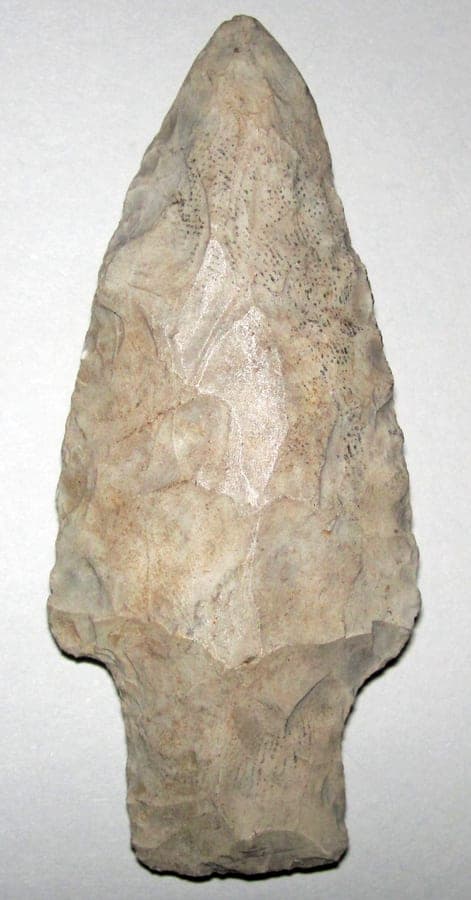
Montell Split Stem Projectile Point: Identification, Age & Range
Montell points are Late to Transitional Archaic dart points (3,000-1,000 B.P.) from the Edwards Plateau of Texas, marked by a deep central basal notch.
At a glance
Period
3,000 - 1,000 B.P. · Late to Transitional Archaic
Typical size
40–100 mm long
Region
This point is primarily found through out the Edwards Plateau and into Big Bend region and the mid Rio Grande River valley of Texas and northern Coahuila.
Few Texas dart points are as easy to name as a classic Montell: the base carries a long, narrow slot straight up its center, splitting the stem into two square-cornered ears. The type has a tangled naming history. F. Bryan first called these points Delia Notch Base in 1936 for finds near Delia in Limestone County, Texas; J. Charles Kelley renamed the type Montell Split Stem in 1947; and Suhm, Krieger, and Jelks shortened the name to simply Montell in 1954.
How to identify a Montell Split Stem point
Montell points are medium to large darts, 40 to 100 mm long with most examples falling between 60 and 70 mm, so a typical piece is a bit shorter than a credit card is long. Width at the shoulders runs 30 to 50 mm. The cross section is flattened, workmanship is usually good, and the flaking pattern is random. These were dart or spear tips thrown with an atlatl, not arrow points, so anything this size and heft rules out the small arrow types of later centuries.
Start with the base. The defining trait is a deep central notch that is long and narrow, more of a slot than a curve, leaving two squarish basal ears on either side. The stem around that notch runs from straight to slightly expanding, typically 10 to 20 mm long. Shoulders are usually barbed but can be straight across, and the blade is typically convex-edged, sometimes serrated, and occasionally beveled on one face only. Points that were resharpened repeatedly can show straight or S-curved blade edges instead of the original convex outline.
If the notch in the base is wide and shallow rather than a narrow slot, or the ears look rounded rather than squared, consider the other split-base Texas types listed below before settling on Montell.
Age and where it's found
Montell points date from about 3,000 to 1,000 B.P., spanning the Late to Transitional Archaic. Archaeologists place them within the Uvalde and Edwards Plateau foci of central Texas; the type has not been established in complexes outside that area.
Geographically the type centers on the Edwards Plateau and extends into the Big Bend country, the middle Rio Grande valley, and northern Coahuila in Mexico.
Think you found a Montell Split Stem?
Upload a photo and our shape-matching AI will compare it against 1,000+ documented point types — with an honest read on how well it fits.
More type guides