LeCroy Bifurcated Projectile Point: Identification, Age & Range
LeCroy Bifurcated points are small Early Archaic (8,500-7,800 B.P.) points with a deeply split base, common in the Ohio and Tennessee River valleys.
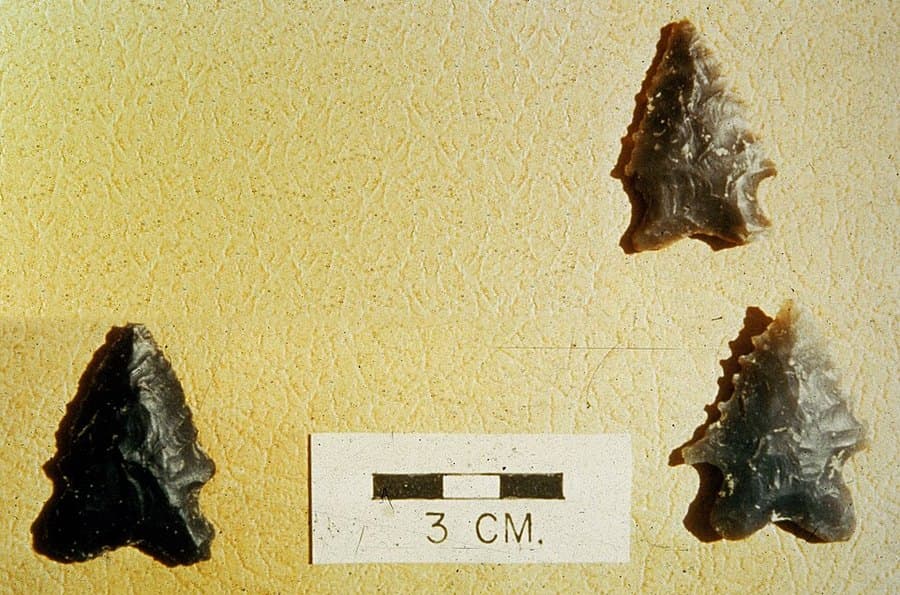
Points from Russell Cave, Alabama. The two on the right show the deep basal notch that splits a LeCroy stem into two lobes.
Photo: National Park Service · Wikimedia Commons (Russell Cave National Monument; cropped to remove two Kirk Serrated points, background filled) · Public domain
At a glance
Period
8,500 - 7.800 B.P. · Early Archaic
Typical size
19–53 mm long, 16–40 mm wide
Region
These points are primarily associated with the Ohio River Valley and into Mid Mississippi River Valley, the Tennessee River Valley, and Piedmont of South and…
The LeCroy Bifurcated is a small Early Archaic point instantly recognizable by its split base - the bottom of the stem is divided into two rounded lobes, like a tiny fishtail. Dating to about 8,500-7,800 B.P., it is considered the most frequently encountered bifurcated-base point in the eastern United States, so if you found a little forked-base point in Tennessee, Kentucky, Ohio, or the Carolinas, LeCroy should be near the top of your list.
Madeline Kneberg, a University of Tennessee anthropologist known for her Tennessee River Valley excavations, named the type in 1956 for the A. L. LeCroy site in Hamilton County, Tennessee. It defines its own LeCroy cluster, with related bifurcate forms such as Fox Valley and Kanawha.
How to identify a LeCroy Bifurcated point
The base tells the story. LeCroy has a deeply notched, bifurcated base with two rounded ear-like lobes that angle downward. The stem is broad and unusually long for the point's size - often a third to half the total length - and runs straight to slightly expanding. Grinding or smoothing in the hafting area is common. Among the eastern bifurcate types, LeCroy is the smallest.
These are genuinely small, thin points: about 19-53 mm long and 16-40 mm wide, with most examples in the 31-41 mm range - roughly the length of a standard paper clip. The stubby little blade is usually straight-edged but sometimes curved on resharpened pieces, and it is very often serrated and a bit asymmetrical. Shoulders typically slope upward, and many examples carry irregular or uneven barbs. Look for fine pressure flaking over the earlier percussion work; cross sections are thin and elliptical.
Makers used cherts, jasper, quartz, and quartzite, and many pieces show signs of heat treatment. The classic confusion is with the other bifurcates: St. Albans has weak to absent shoulders where LeCroy's are clearly defined, and both St. Albans and MacCorkle have more lobed bases compared with LeCroy's straighter-sided stem.
Age and where it's found
LeCroy belongs to the later Early Archaic. Broyles placed it around 8,300 B.P. based on the stratified St. Albans site in West Virginia, where it postdates the St. Albans Side Notched type and precedes Kanawha Stemmed; Chapman put the LeCroy phase in eastern Tennessee at roughly 8,500-7,800 B.P.
The core distribution covers the Ohio valley, the middle stretch of the Mississippi, the Tennessee drainage, and the Piedmont of Virginia and the Carolinas.
Think you found a LeCroy Bifurcated?
Upload a photo and our shape-matching AI will compare it against 1,000+ documented point types — with an honest read on how well it fits.
More type guides