Beaver Lake Auriculate Projectile Point: Identification, Age & Range
Beaver Lake Auriculate points date to 10,500-9,500 B.P., mainly in the Tennessee River Valley — waisted, unfluted lanceolates with flared ears.
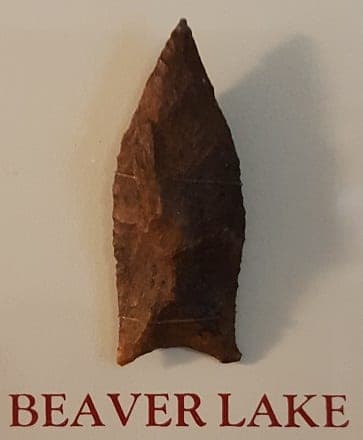
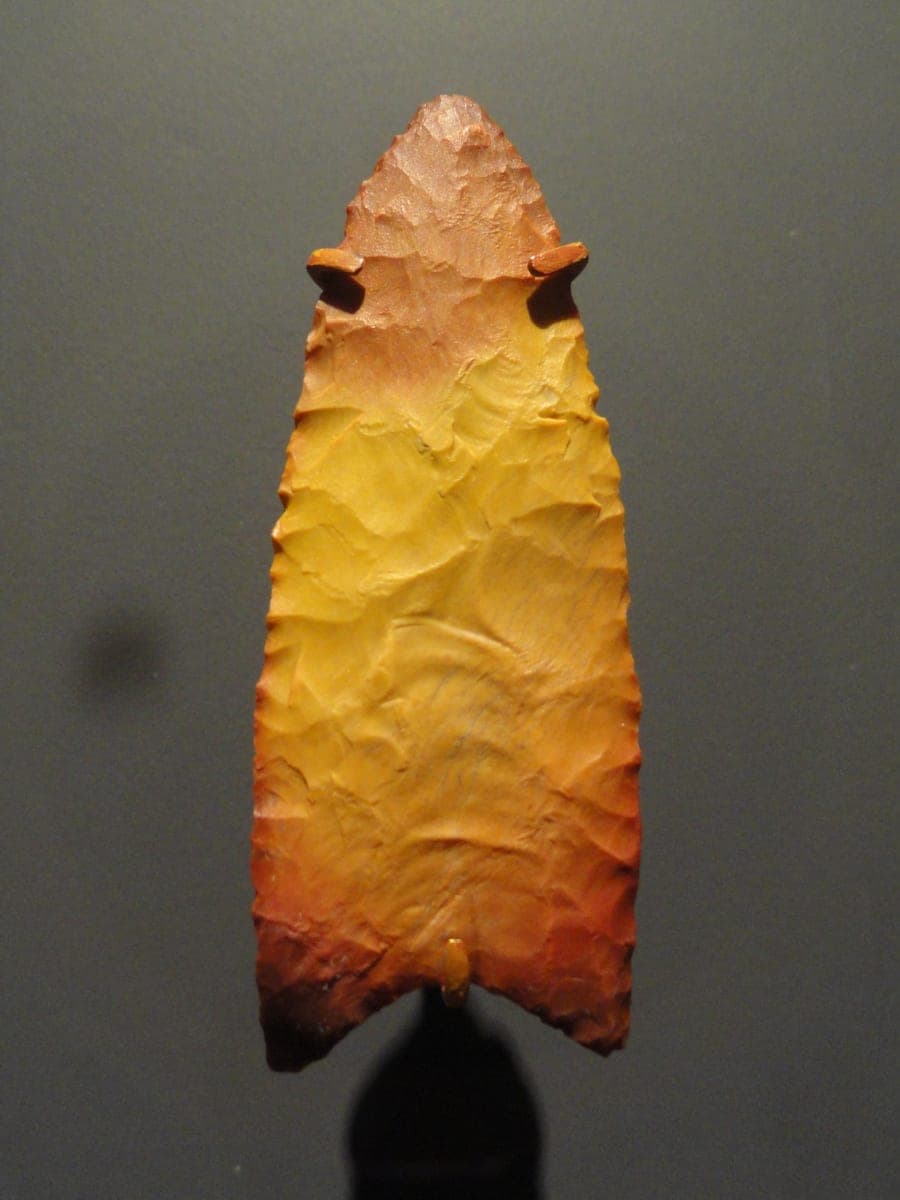
Photo: Donald Albury · Wikimedia Commons (specimen on display at the Matheson History Museum, Gainesville, Florida) · CC BY-SA 4.0
At a glance
Period
10,500 - 9,500 B.P. · Transitional Paleo
Typical size
47–86 mm long, 20–35 mm wide
Region
This point is primarily in the Tennessee River Valley and less frequently into the Ohio River Valley.
The Beaver Lake Auriculate is a Transitional Paleo point of the mid-South, dating to about 10,500-9,500 B.P. It is often nicknamed the Unfluted Cumberland because it wears the same elegant waisted silhouette as the Cumberland point without the channel flutes. David DeJarnette, Edward Kurjack, and James Cambron named the type in 1962 for the Beaver Lake area of Limestone County, Alabama, with the Stanfield-Worley Bluff Shelter serving as the type site.
For someone who has found a slender, eared point in a Tennessee Valley creek bed, Beaver Lake sits at the crossroads of several look-alike types, so working through its traits carefully pays off.
How to identify a Beaver Lake Auriculate point
The outline is the key: a medium to large lanceolate whose edges narrow to a waist at the hafting area and then flare back out toward the base, forming distinct ears. The base is usually concave — only rarely straight — with a shallow notch of about 2 to 5 mm, and it often shows grinding or thinning. Notably, the base tends to be a touch wider than the blade itself, a useful check with calipers.
Unlike Clovis or Cumberland, there are no flutes. The cross section is mostly elliptical, though a median ridge can appear on one or both faces from the shallow flaking used to shape the blade. Look closely at the edges: secondary retouch removed longer, evenly spaced flakes from alternating faces; random flaking is the usual pattern, though collateral work also occurs. Cherts and hornstone are the typical materials.
Size falls between about 47 and 86 mm long, averaging around 64 mm, with blade widths of 20 to 35 mm and thickness near 7 to 9 mm. A fluted point of this shape is a Cumberland; a serrated, heavily resharpened one is likely a Dalton; a squat, wide-eared one points toward Quad.
Age and where it's found
Beaver Lake dates to roughly 10,500-9,500 B.P., in the Transitional Paleo period as the Pleistocene gave way to the Holocene. It is generally grouped in the Dalton Cluster alongside Dalton, Quad, and the many regional Dalton varieties, though some researchers instead see it as an outgrowth of Simpson technology from the Southeast.
The heartland is the Tennessee River Valley, with finds occurring less frequently up into the Ohio River Valley. A few examples are reported as far afield as the Tampa area of Florida, but anything outside the mid-South is unusual.
Think you found a Beaver Lake Auriculate?
Upload a photo and our shape-matching AI will compare it against 1,000+ documented point types — with an honest read on how well it fits.
More type guides