Gatecliff Stemmed Projectile Point: Identification, Age & Range
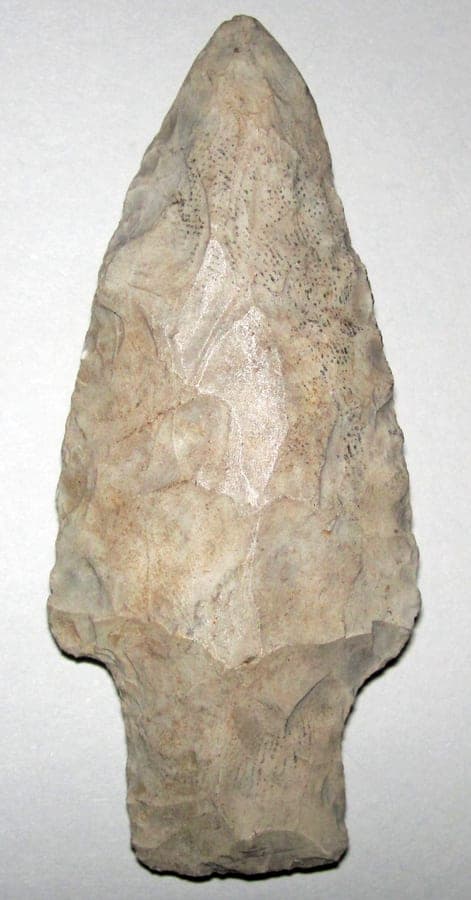
Gatecliff Stemmed is a Great Basin dart point with sloping shoulders and a contracting stem, dating 5,000-3,000 B.P. in the Middle to Late Archaic.
At a glance
Period
5,000 - 3,000 B.P. · Middle to Late Archaic
Typical size
34–53 mm long, 21–27 mm wide
Region
This point is primarily found through out the Great Basin and extend east to the Colorado River and extend down the Colorado River to California.
Gatecliff Stemmed is a Middle to Late Archaic dart point of the Great Basin, easiest to recognize by a stem that tapers inward toward the base rather than flaring out. Like other points of its size and age, it tipped atlatl darts rather than arrows. Finders in Nevada, Utah, and the desert country along the Colorado River drainage encounter it on Archaic-age surfaces alongside other dart-era tools.
David H. Thomas named the type in 1981 for Gatecliff Shelter in central Nevada, the deeply stratified rockshelter where his excavations helped anchor the modern Great Basin point sequence. Before that work, these points were folded into the Gypsum type, and the two remain grouped in the same cluster.
How to identify a Gatecliff Stemmed point
Look first at the stem. On a Gatecliff point the stem contracts: it is widest at the shoulders and narrows steadily down to a straight or convex base. There are no notches. The shoulders most often angle upward, though on some pieces they sit horizontal or even turn into light barbs. That taper is the single most useful trait, because the region's other common dart forms of the era widen again at the base.
Size falls in a fairly tight band. Lengths run 34 to 53 mm, averaging around 42 mm, so a typical example is about the length of an adult thumb. Widths measure 21 to 27 mm on a thin profile of just 3 to 5 mm. The blade edge runs straight to convex and may be serrated. Cross sections are flattened to elliptical, flaking is typically random but can shift toward an oblique pattern, and the base usually shows no grinding, a helpful contrast with many earlier lanceolate forms that were heavily ground.
A version of this point with the base notched into two lobes is classified separately as Gatecliff Split Stem.
Age and where it's found
The type dates to roughly 5,000 to 3,000 B.P., the Middle to Late Archaic, spanning the Middle Holocene into the Neoglacial interval. It sits in the Gypsum Cave cluster of contracting-stem dart points, and its position in the stratified deposits at Gatecliff Shelter is what tied the form to this time window.
Its range covers the Great Basin, reaches east as far as the Colorado River, and follows that river downstream into California. Within that territory a Gatecliff find is a good sign the surface has produced Archaic-age material.
Think you found a Gatecliff Stemmed?
Upload a photo and our shape-matching AI will compare it against 1,000+ documented point types — with an honest read on how well it fits.
More type guides