Washita Projectile Point: Identification, Age & Range
Washita points are small, thin side-notched arrow points of the Southern Plains, made about 800-400 B.P. by Mississippian-era communities in Texas and Oklahoma.
At a glance
Period
800 - 400 B.P. · Mississippian
Typical size
19–27 mm long, 12–20 mm wide
Region
This point is primarily found in the Southern Plains region of Texas and Oklahoma and into the Central Plains.
If you picked up a tiny, thin triangular point with a matching pair of side notches in a plowed field in Oklahoma or Texas, there is a good chance you are holding a Washita. These are true arrow points, small and light enough to tip an arrow shaft, made by late prehistoric farming and hunting communities on the Southern Plains. Because their villages sat along rivers in country that is now heavily cultivated, Washita points turn up regularly for modern finders.
Oklahoma archaeologist Robert E. Bell defined the type in 1958, naming it for the Washita River area of Oklahoma. He split it off from the closely related Harrell point, which had previously been treated as covering both forms.
How to identify a Washita point
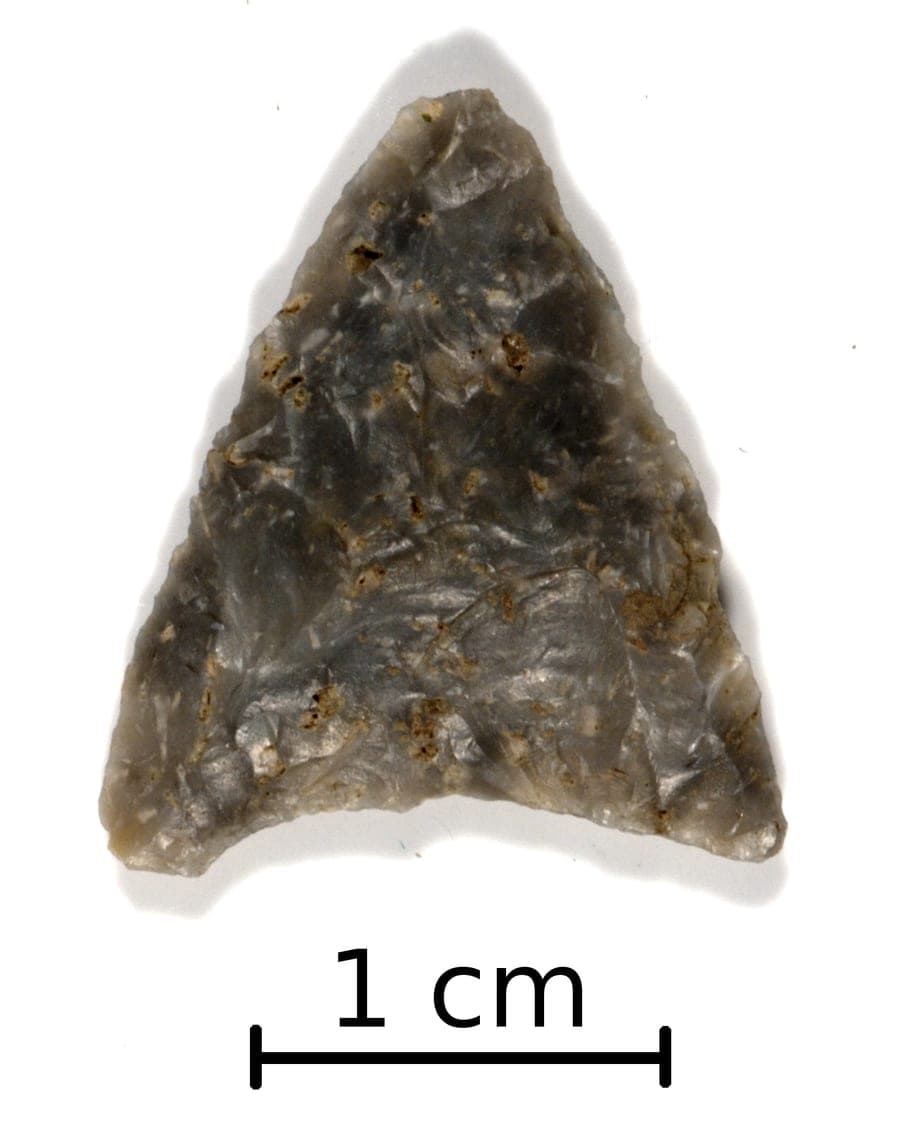
Size is the first clue. Washita points run only 19 to 27 mm long, with most under 24 mm, so a typical example is smaller than a US quarter. Widths fall between 12 and 20 mm. The point is thin and flat in cross section, and the flaking shows no organized pattern.
The outline is a neat triangle with mostly straight blade edges that are sometimes serrated. A pair of narrow, parallel side notches sits comparatively high on the blade, cutting in only 2 to 3 mm but pinching the point to a neck of roughly 5 to 7 mm. Below the notches the stem flares back out to horizontal shoulders and a base 10 to 16 mm across, usually the widest spot on the entire point. The base itself ranges from straight to slightly concave.
The quickest way to separate a Washita from its near twin, the Harrell point, is to check the middle of the base: Harrell carries a third notch there, and Washita does not. A Washita-shaped point with a distinctly concave base is often assigned to the Washita Peno variant. If there are no notches at all, you are probably looking at a plain triangular type instead.
Age and where it's found
Washita points date to about 800 to 400 B.P., placing them in the Mississippian period as the Medieval Warm interval gave way to the Little Ice Age. On the Southern Plains they are tied to the Washita River culture of Oklahoma and Texas and to Caddoan-related farming communities.
The core range is the Southern Plains of Texas and Oklahoma, reaching into the Central Plains. Very similar small side-notched arrow points elsewhere usually carry other names, such as Cahokia Side Notch in the Mississippi valley and Plains Side Notch across most of the High Plains, though archaeologists working in Alberta, Canada also apply the Washita label to comparable points there.
Think you found a Washita?
Upload a photo and our shape-matching AI will compare it against 1,000+ documented point types — with an honest read on how well it fits.
More type guides