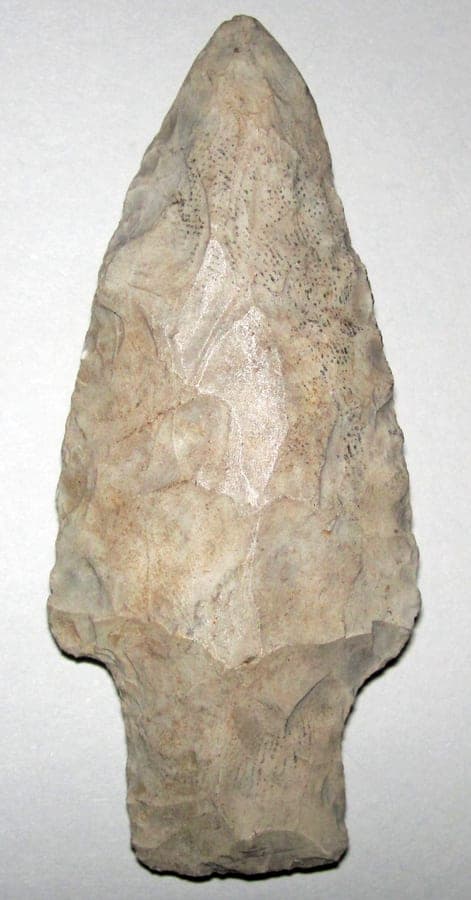
Levanna Triangle Projectile Point: Identification, Age & Range
Levanna is a broad triangular arrow point of 1,300-600 B.P., usually concave-based, found across New England, New York, and eastern Ontario.
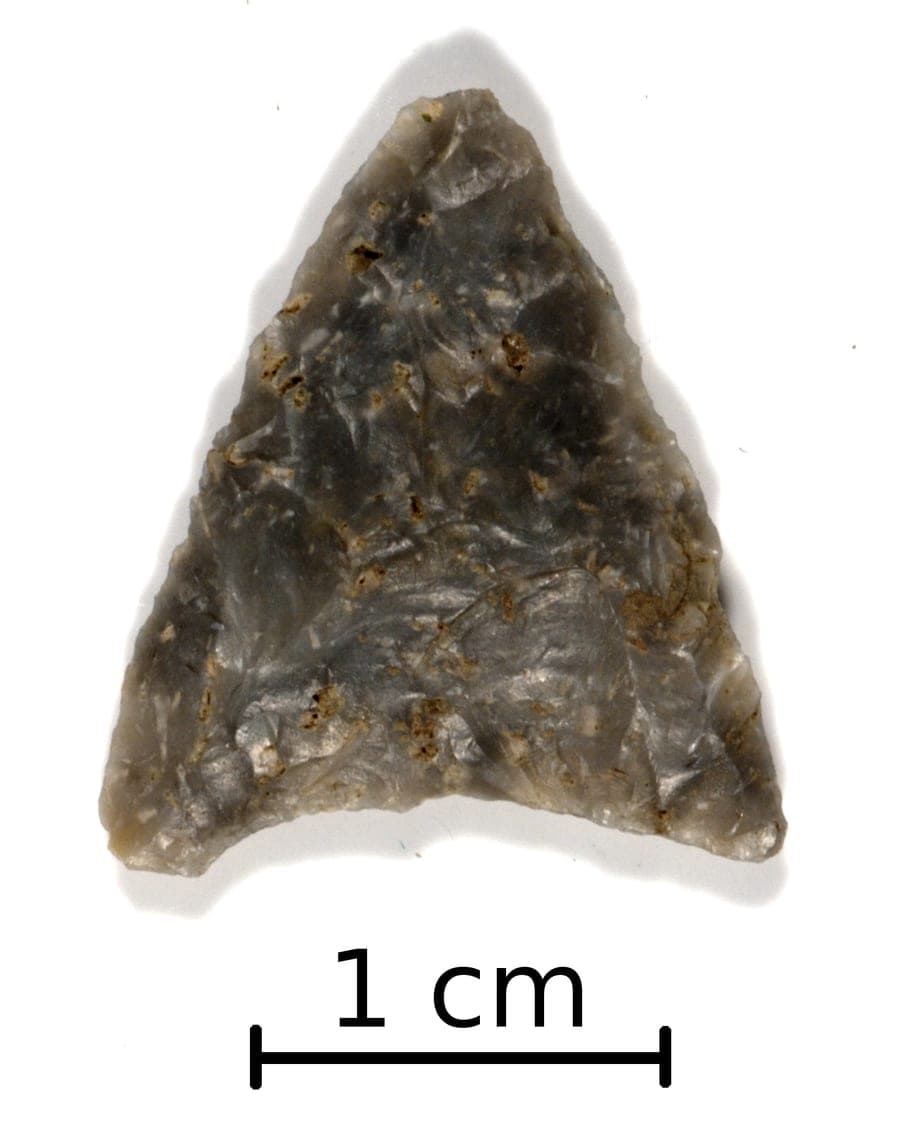
Photo: PAR · Wikimedia Commons · Public domain
At a glance
Period
1,300 - 600 B.P. · Mississippian
Typical size
32–44 mm wide
Region
This point is primarily found in the New England region and into eastern Ontario and may be found into northern Virginia.
Plain triangles are among the most common finds in the Northeast, and Levanna is the large, broad version most finders turn up. It is a true arrow point — light enough to tip an arrow rather than a spear — and it was named by William Ritchie in 1961 for the Levanna site in Cayuga County, New York. Because the shape is so simple, the challenge is not spotting that you have a triangle point but working out which triangle type it is; width, base shape, and geography do most of that work.
How to identify a Levanna Triangle point
A Levanna is simply a triangle: no stem, no notches, no ears — just three edges. About seven in ten examples are roughly as wide as they are long, giving an almost equilateral outline; the rest are taller isosceles shapes roughly twice as long as they are wide. The base is the key trait. It is usually concave, sometimes deeply so, though a few examples finish nearly straight. The blade edges themselves are mostly straight.
Size is what separates Levanna from later triangles. Width runs a broad 32 to 44 mm — wider than a US quarter, often considerably so — while lengths span about 22 to 75 mm and thickness is typically 8 to 10 mm, with a flattened cross section that turns elliptical on the thicker pieces. When the base is deeply concave, the two lower corners stand out as sharp points, which can make a worn example look eared even though the type has no true ears. Flaking follows no regular pattern. Quartz and rhyolite are the most common materials, with chert, jasper, and argillite used less often.
Age and where it's found
Levanna dates to about 1,300-600 B.P. and belongs to the triangle cluster that spans the Late Woodland into the early Mississippian era; within that group it stands out as bigger and earlier than most, and it was eventually replaced by the smaller, narrower Madison point. Finds concentrate across New England and New York, reach eastern Ontario, and occasionally turn up as far south as northern Virginia.
Many researchers consider Levanna and the southeastern Yadkin point to be the same basic form carrying two regional names — worth remembering if your triangle came from the mid-Atlantic states.
Think you found a Levanna Triangle?
Upload a photo and our shape-matching AI will compare it against 1,000+ documented point types — with an honest read on how well it fits.
More type guides