Scallorn Corner Notch Projectile Point: Identification, Age & Range
Scallorn points are small corner-notched arrow points (1,300-500 B.P.) from Texas and surrounding states, with barbed shoulders and expanding stems.
At a glance
Period
1,300 - 500 B.P. · Late Woodland to Mississippian
Typical size
25–45 mm long, 13–21 mm wide
Region
This point is most commonly found in in central Texas throughout the Red River Valley of Texas, Oklahoma, Louisiana, Arkansas, The frequency decreased…
Scallorn points mark the early centuries of bow-and-arrow hunting in Texas. These small, barbed, corner-notched arrow points turn up regularly in central Texas fields and creek beds, and they anchor the Scallorn Cluster of early arrow points. J. Charles Kelley applied the name in 1947 for the town of Scallorn in Mills County, Texas, with the Kyle Site in Hill County as the type site; Miller and Jelks first described the point in 1952, and Suhm and Krieger published the full description in 1954.
How to identify a Scallorn Corner Notch point
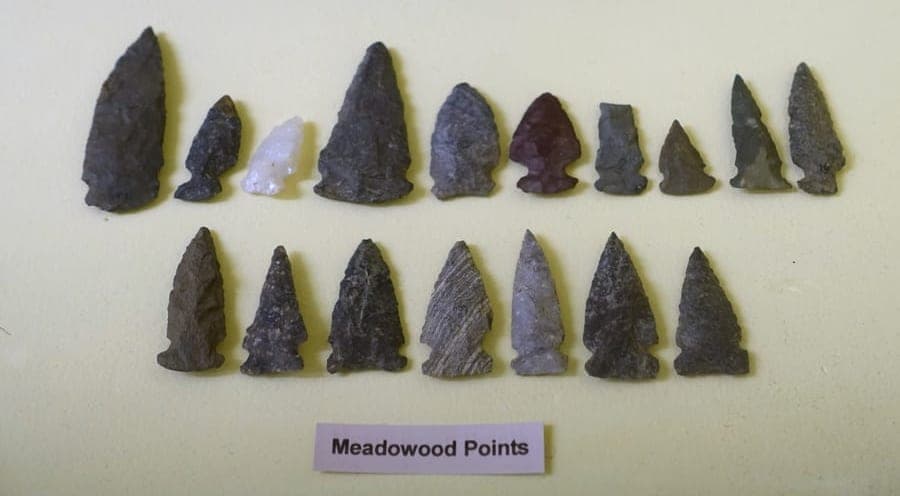
Think small and thin. Scallorn points measure 25 to 45 mm long and 13 to 21 mm across, so many are barely longer than a quarter, and they are only 2 to 5 mm thick with a flat cross section. Any well-made corner-notched point in that size class from Texas or the surrounding states deserves a look as a possible Scallorn.
The corner notches are what to check next. Notching in from the corners of a small triangular blank left an expanding stem and a pair of barbed shoulders; those barbs are one of the type's defining traits, though a few examples show squared shoulders instead. Bases run anywhere from flat to gently rounded. Blade edges are usually straight, sometimes gently convex, and serration is common; on points with flaring shoulder tips the edge can even read as slightly concave. Some blades are broad, others slender, and the flaking shows no organized pattern.
The unnotched Crisp Ovate point is thought to be the preform from which Scallorn points, among others, were finished, so an ovate blank of the right size found nearby is not out of place.
Age and where it's found
Scallorn points date to about 1,300 to 500 B.P., contemporary with the Late Woodland through Mississippian periods farther east. They are most common in central Texas and throughout the Red River drainage of Texas, Oklahoma, Louisiana, and Arkansas, and they become progressively scarcer south of the border in Coahuila, Nuevo Leon, and Tamaulipas.
The Sequoyah and Washington points are close relatives. Sequoyah examples were originally lumped in with Scallorn; work at Missouri's Williams Shelter showed the two forms were distinct, and James Brown formally named Sequoyah as its own type in 1968.
Think you found a Scallorn Corner Notch?
Upload a photo and our shape-matching AI will compare it against 1,000+ documented point types — with an honest read on how well it fits.
More type guides